White-handed gibbonHylobates lar — habitat, diet and reproduction
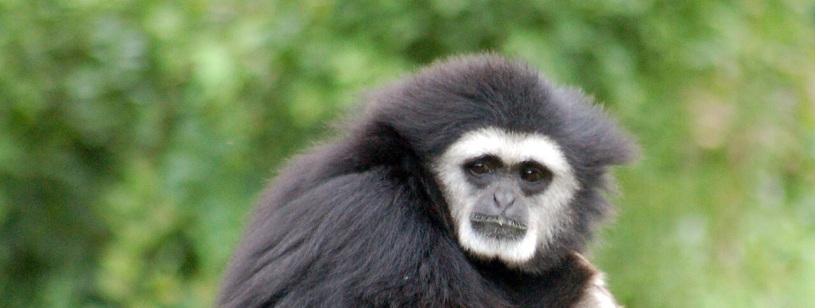
Dark-furred white-handed gibbon with a pale ring around its face at Philadelphia Zoo. · Derek Ramsey (Ram-Man) / Wikimedia Commons / CC BY-SA 2.5 (https://creativecommons.org/licenses/by-sa/2.5/). Cropped and resized. Source: https://commons.wikimedia.org/wiki/File:White-handed_Gibbon_Hylobates_lar_Black_1800px.jpg
The white-handed gibbon (Hylobates lar) is a primate of Southeast Asian forests. It swings between branches using its arms and communicates through loud songs. Pale hands, feet and facial markings help identify the species, also called the lar gibbon.
Quick facts
| Common name | White-handed gibbon; lar gibbon |
| Scientific name | Hylobates lar |
| Lifespan | Several decades; can exceed 40 years in human care |
| Length | Approximately 42–59 cm, head and body |
| Weight | Approximately 4–8 kg |
| Diet | Omnivorous, with a large fruit component |
| Predators | Large raptors, cats and pythons are potential predators |
| Conservation status | Endangered |
| Distribution | Southeast Asia, including the Malay Peninsula and Sumatra |
| Habitat | Tropical forests, mainly the tree canopy |
| Family | Hylobatidae |
| Reproduction | Usually one infant after about seven months of gestation |
- Primary category:Primates
- Explore this animal's categories:
Interesting facts
- Arms are longer than legs, supporting travel beneath branches.
- Both sexes may have pale or dark coats.
- Pairs perform duets that communicate their presence.
- The body has no tail; balance depends on posture and limbs.
Records and extremes
Gibbons are specialised for suspended movement. Brachiation means travelling by swinging the body from one arm to the other. Long hands act as hooks.
This movement carries them across gaps between crowns. On broad branches or the ground, they can walk upright with raised arms helping balance.
Some white-handed gibbons exceed 40 years in human care. Such longevity requires suitable conditions and sustained care; exceptional ages differ from typical lifespans.
Characteristics
The slender body has mobile shoulders and long fingers. Feet can grip supports, assisted by an opposable big toe.
Coats range from cream to brown or nearly black. Pale hands, feet and a facial ring contrast most clearly against dark fur.
Males and females are similar in size. Head-and-body length is around 42–59 cm, with weight roughly 4–8 kg.
Behaviour
Active during daylight, gibbons spend much of their time in trees. Feeding periods alternate with rest, and trees provide night-time sleeping sites.
Family groups commonly contain adults and offspring of different ages. Relationships vary, and some wild groups have more complex arrangements than a single stable pair.
Songs are especially noticeable in the morning. Duets support communication between partners and advertise the group’s territory.
Habitat and distribution
The range extends through parts of mainland Southeast Asia towards the Malay Peninsula and Sumatra. Remaining populations depend on increasingly fragmented forests.
Food trees and connected crowns provide routes through the canopy. Nearby branches allow movement above the ground.
Large cleared gaps interrupt these routes. Connections between wooded areas help animals reach feeding sites and potential partners.
Diet and feeding
Ripe fruit is important, alongside young leaves, flowers and insects. Seasonal changes and tree fruiting alter what is available.
Gibbons collect fruit in the canopy and move between feeding trees. Efficient movement helps them search widely.
Swallowed seeds can be carried and deposited elsewhere. The primates therefore contribute to dispersal of some forest plants.
Reproduction and life cycle
A single infant is usually born after approximately seven months of gestation. It clings to its mother and initially depends on her milk and protection.
The mother provides most early care. Weaning is gradual and can extend to around 20 months.
Births are normally separated by several years. Young remain in the family while learning movement and feeding skills. Slow reproduction limits population recovery.
Name and history
Linnaeus described the species in 1771. The accepted name is Hylobates lar, within the family Hylobatidae.
Its common name refers to pale extremities. Hylobates refers to life in trees, reflected in both anatomy and behaviour.
Conservation and threats
Classified as Endangered, the species faces forest loss and fragmentation. Capture for trade and entertainment adds pressure.
Sanctuaries care for former pets and animals used in attractions. Recovery requires space, appropriate social conditions and long-term care. Some rehabilitation programmes work towards release.
Forest protection and reduced capture are essential. Habitat restoration must provide food trees, shelter and connections between populations.
Frequently asked questions
Does it have a tail?
It has no tail; limbs and posture help maintain balance.
Are females always pale?
Both sexes can have light or dark coats in this species.
Why does it sing?
Songs communicate between partners and advertise territory.
Does it eat only fruit?
Leaves, flowers and insects also enter its diet.
Can it walk upright?
Yes. Raised arms assist balance when walking on two legs.
Is it suitable as a pet?
It is a wild primate with complex social and movement needs. Capture for trade threatens the species.