BadgerInteresting facts and information
Badgers are several groups of mammals in the weasel family (Mustelidae). This overview covers the European badger (Meles meles), the American badger (Taxidea taxus) and the honey badger (Mellivora capensis). Their diets, social lives and habitats differ.
The examples below belong to different badger lineages, not to one species with a single way of life.
European badgers build and reuse large burrow systems called setts. Other badgers dig too, but their burrows and social lives are different.
- European badger (Meles meles) – A burrowing badger that often lives in family groups called clans; its behaviour depends on habitat and food.
- American badger (Taxidea taxus) – A mostly solitary badger of open grasslands in North America and an extremely fast digger.
- Honey badger (Mellivora capensis) – A bold, tough badger of Africa and Asia, famous for raiding bees' nests.
Quick facts
| Common name | Badger |
| Scientific name | Meles meles (European badger); Taxidea taxus (American badger); Mellivora capensis (honey badger) |
| Typical lifespan | Often 4-14 years in the wild, up to about 20 years in captivity |
| Length | 55-90 cm |
| Weight | 7-17 kg (males), 6-13 kg (females) |
| Diet type | Omnivore (earthworms, insects, small mammals, fruit, roots) |
| Main predators | Few as adults: wolves, lynxes and bears (European badger); lions and leopards (honey badger); humans and traffic everywhere |
| Conservation status | Mostly Least Concern (IUCN); the hog badger is Vulnerable, and local populations face different pressures |
| Distribution | Europe, North America, Africa, Asia |
| Living environment | Forests, grasslands, deserts, mountains, farmland |
- Primary category:Mammals
- Explore this animal's categories:
Interesting facts
- Badgers are master builders - A European badger sett can have dozens of entrances and hundreds of metres of tunnels, and some setts have been used for centuries.
- They recognise each other by smell - Members of a badger group share a group scent, which they spread by scent-marking each other and their territory.
- The honey badger is famously fearless - Protected by thick, loose skin, it will stand up to much larger animals, including lions and hyenas.
- European badgers live in groups - Most badgers live alone, but European badgers often live in family groups called clans, which share a sett.
- They eat almost anything - Badgers are omnivores and eat small mammals, insects, earthworms, fruit, roots and, in the case of the honey badger, bee larvae and honey.
- Honey badgers can survive some snake bites - They have a degree of resistance to the venom of some snakes, such as cobras.
- American badgers and coyotes sometimes hunt together - The coyote chases prey above ground, while the badger digs it out of its burrow.
- European badgers can live over 14 years in the wild and around 20 years in captivity, but many die younger, often on roads.
Records and remarkable features
- European badgers (Meles meles) are stocky animals whose weight changes a lot with the seasons; they are heaviest in autumn, before winter.
- Honey badgers (Mellivora capensis) belong to a separate badger lineage and are known for their toughness and boldness.
- American badgers (Taxidea taxus) are among the fastest diggers of all mammals and can bury themselves in loose soil within minutes.
- Long-lived - European badgers can live over 14 years in the wild and about 20 years in captivity.
- European badgers may keep up large burrow systems, called setts, over many generations.
Physical characteristics and adaptations
Badgers are compact, muscular mammals built for digging. Their bodies are short and sturdy, with strong claws and powerful jaws.
Key physical adaptations
- A compact, muscular body - Lets badgers move through narrow tunnels and defend themselves well.
- Thick, coarse fur - Protects them from cold, damp and scratches underground.
- A wedge-shaped head and long snout - Help them dig and root in the soil for food.
- Long, curved claws - Adapted for fast, powerful digging.
- A strong, locking jaw - In the European badger, the lower jaw fits so tightly into the skull that it cannot be dislocated, giving a very firm grip.
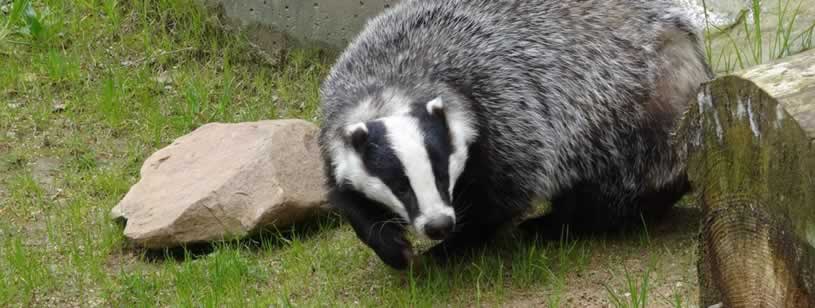
- Bold face markings - The black-and-white stripes of the European badger may warn other animals that it can defend itself.
What do badgers look like?
| Feature | Details |
|---|---|
| Colour | Grey, black, brown and white, with distinct patterns (striped face in the European badger) |
| Length | 55-90 cm |
| Weight | 7-17 kg |
| Fur | Thick and often coarse |
| Claws | Long, curved and specialised for digging |
| Eyesight | Poor, but made up for by an excellent sense of smell and good hearing |
| Smell | Very well developed; used to find food and mark territory |
Habits and behaviour
Depending on the species, badgers live alone or in groups. Most are active at night and avoid people and predators.
Daily life
- Excellent diggers - They build complex burrows with several chambers and exits.
- Territorial - They mark their territory with scent glands, which helps avoid fights.
- Secretive - They are rarely seen and avoid unnecessary conflict.
- Less active in winter - European badgers in cold regions spend more time underground in winter, but they do not truly hibernate.
Specific behaviours
- Large, complex setts - Big setts can have hundreds of metres of tunnels and have been used for generations.
- Clean bedding - Badgers regularly drag out old bedding and bring in fresh grass, leaves and bracken.
- Latrines - They use special pits near the edges of their territory as toilets, which also act as territory markers.
- Tough against snakes - The honey badger is partly resistant to some snake venoms and can recover from cobra bites.
- Teamwork with coyotes - American badgers sometimes hunt alongside coyotes: the badger digs out rodents, and the coyote catches those that run away.
Survival strategies
- Strong claws for digging and self-defence.
- Powerful jaws for holding prey and fighting back.
- Many tunnels and exits for a quick escape from danger.
- Night-time activity to avoid predators and people.
Habitat and geographic distribution
Badgers live on several continents and in many habitats, from forests and grasslands to deserts and farmland.
Distribution context
| Region | Notable species | Habitat examples |
|---|---|---|
| Europe | Meles meles (European badger) | Woodland, grassland, farmland |
| North America | Taxidea taxus (American badger) | Prairies, plains, semi-arid areas |
| Africa | Mellivora capensis (honey badger) | Savannas, deserts, open woodland |
| Asia | Arctonyx collaris (hog badger) | Tropical and subtropical forests |
| Middle East and South Asia | Mellivora capensis (honey badger) | Mountains and deserts |
Habitat types
- Deciduous and mixed woodland - Preferred by European badgers, especially next to fields and pasture.
- Prairies and plains - Typical habitat of the American badger.
- Deserts and savannas - The honey badger is well adapted to dry habitats.
- Farmland and towns - Some badgers live close to people, even in suburbs.
Environmental change
- Deforestation and development destroy setts and feeding areas.
- Spreading towns bring badgers closer to people and roads.
- Climate change can affect their food, such as earthworms in dry summers.
- Pollution and pesticides can harm badgers and their prey.
Diet and feeding
Badgers are omnivores and eat a wide range of foods, depending on their habitat and the season. Their food includes small mammals, insects, earthworms, birds, fruit, roots and carrion.
What do badgers eat?
| Food group | Examples |
|---|---|
| Small mammals | Mice, rats, young rabbits, hedgehogs |
| Birds and eggs | Found in nests on the ground |
| Reptiles and amphibians | Lizards, frogs, small snakes |
| Insects and other invertebrates | Earthworms, beetles, wasp and bee larvae |
| Fruit and plants | Berries, apples, cereals, roots, mushrooms |
| Honey and bees | The honey badger breaks into bees' nests for honey and larvae |
| Carrion | Badgers sometimes eat dead animals they find |
Feeding methods
- Digging - They use their strong claws to dig up earthworms, larvae and roots.
- An excellent sense of smell - Helps them find prey hidden underground.
- Raiding bees' nests - The honey badger tolerates bee stings and tears open nests to reach honey and larvae.
- Digging out prey - American badgers dig ground squirrels and other rodents out of their burrows.
Ecological role
- Controlling rodents and insects - Badgers help keep these populations in check.
- Spreading seeds - By eating fruit, badgers help spread plants.
- Recycling - Eating carrion helps return nutrients to the ecosystem.
Reproduction and life cycle
Many badgers, including the European and American badgers, have delayed implantation: the fertilised egg waits before it starts to develop, so the young are born at the best time of year.
Breeding season
- European badgers can mate at almost any time of year, most often in spring, but the cubs are usually born in late winter.
- Males compete for females, and in clans the dominant animals usually breed most.
- Honey badgers and American badgers are mostly solitary and meet only to mate.
Birth and rearing of young
| Stage | Duration | Characteristics |
|---|---|---|
| Mating to birth | Often many months (because of delayed implantation); active pregnancy about 7 weeks | The young are born in the safety of the sett |
| Number of young | Usually 1-5 | The young are born blind and depend on their mother |
| Nursing | About 3-4 months | The mother looks after her young in the burrow |
| Independence | About 6-12 months | Some young leave to find their own territory; young European badgers often stay in their clan |
Adaptations for survival
- Safe underground chambers for raising young.
- Delayed implantation, so that the young are born in the right season.
- The young grow quickly and learn to find food by following their mother.
Name and history
Origin of the name
- The origin of the word "badger" is uncertain; it may come from "badge", after the white mark on the animal's forehead.
- An older English name for the badger is "brock", a word of Celtic origin that survives in place names such as Brockhurst.
- In other languages, the badger is called Dachs in German, tejón in Spanish and tasso in Italian.
Taxonomic classification
| Classification | Name |
|---|---|
| Kingdom | Animalia |
| Phylum | Chordata |
| Class | Mammalia |
| Order | Carnivora |
| Family | Mustelidae |
| Genera | Meles, Taxidea, Mellivora, Arctonyx and others |
| Species | Several species in these genera; badgers do not form a single genus. |
Evolution and fossils
- Badgers belong to the weasel family, together with weasels, otters, martens and wolverines.
- "Badger" is not one natural group: the different badger lineages evolved separately within this family and look alike because they all dig.
- Fossils of the genus Meles have been found in Europe and Asia, showing that badgers have lived there for a very long time.
Cultural significance and mythology
In many cultures, the badger stands for persistence, courage and protection. Its digging skills and its fierce defence of its home have linked it with determination and survival.
Badgers in myths and symbolism
- In some Native American traditions, such as those of the Hopi, the badger is linked with healing and with knowledge of medicinal roots, because it digs in the earth.
- In Britain, badger-baiting was a cruel blood sport for centuries until it was banned in 1835; today, badgers and their setts are protected by law.
Superstitions and popular beliefs
- In Japanese folklore, the mujina, often identified as a badger, is a shape-shifting trickster.
- The popular Japanese tanuki statues placed outside shops and restaurants for good luck show a raccoon dog, which is often mistranslated as "badger".
- In European folk medicine, badger fat and hair were once believed to have healing powers.
Conservation status and threats
Most badger species are not globally threatened, but some local populations are declining because of human activities.
Main pressures
- Habitat loss - Deforestation and the spread of farmland and towns reduce the space available to badgers.
- Hunting and trapping - In some countries, badgers are seen as pests and are hunted.
- Bovine tuberculosis - In England, badgers have been culled in some areas to try to reduce the spread of the disease to cattle.
- Road traffic - Many badgers are killed by cars, especially in rural areas.
- Persecution - Illegal badger-baiting and sett digging still happen in some places.
Protection efforts
| Measure | Organisation / action |
|---|---|
| Protecting habitats | Conserving woodland, hedgerows and setts |
| Monitoring populations | Studies of badger numbers and of bovine tuberculosis |
| Campaigns against persecution | Charities such as the Badger Trust and the Wildlife Trusts |
| Legal protection | In the UK, the Protection of Badgers Act 1992 protects badgers and their setts |
Threatened species
- European badger (Meles meles) - Least Concern overall, but affected by road deaths, culling and persecution in some areas.
- Honey badger (Mellivora capensis) - Least Concern, but often killed in conflicts with beekeepers and livestock farmers.
- Hog badger (Arctonyx collaris) - Listed as Vulnerable, mainly because of hunting and forest loss in Southeast Asia.
The badgers in popular culture
Badgers are important characters in books, films and cartoons, where they are often shown as wise, brave and loyal.
Badgers in literature and art
- The Wind in the Willows (Kenneth Grahame, 1908) - Mr Badger is one of the most famous badger characters, gruff but wise and protective.
- Fantastic Mr Fox (Roald Dahl, 1970) - Badger is one of the hero's loyal friends and helps him dig.
- The Redwall series (Brian Jacques) - Badger lords and mothers are noble, powerful leaders of the animal world.
Badgers in films and cartoons
- The Animals of Farthing Wood (1993-1995) - A British animated series in which Badger is a respected, wise character.
- Harry Potter - The emblem of Hufflepuff house is a badger, standing for loyalty and hard work.
- Robin Hood (Disney, 1973) - Friar Tuck is a kind, brave badger.
Badgers as symbols
- A symbol of courage and persistence - Thanks to their toughness and determination.
- In heraldry - Badgers appear on some coats of arms, often for families with names like Brock.
- The "Badger State" - The US state of Wisconsin is nicknamed the Badger State, and the badger is its state animal.
Did you know? About badger
- Badgers belong to the weasel family, together with otters, martens and wolverines.
- A European badger sett can have dozens of entrances and has sometimes been used by badgers for centuries.
- Badgers regularly change their bedding, dragging out old material and bringing in fresh grass and leaves.
- The European badger's lower jaw locks into its skull so firmly that it cannot be dislocated.
- American badgers and coyotes are sometimes seen hunting together.
- The honey badger raids bees' nests and is partly resistant to some snake venoms.
- European badgers mainly eat earthworms - one badger can eat hundreds in a single night.
- Thanks to delayed implantation, a female badger can mate in spring but give birth the following winter.
- Mr Badger in <em>The Wind in the Willows</em> and the Hufflepuff emblem in <em>Harry Potter</em> are among the best-known badgers in culture.