Long-eared owlAsio otus — habitat, diet and reproduction
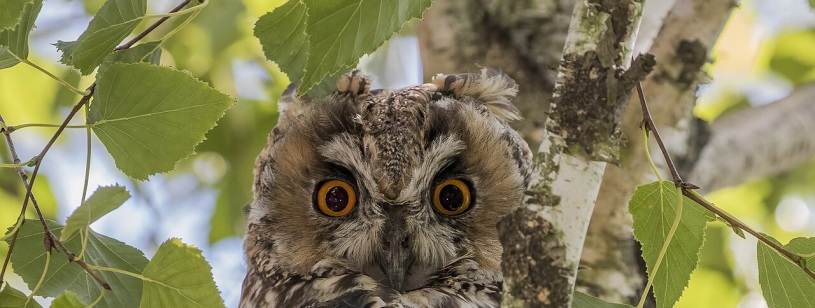
Long-eared owl (Asio otus) hidden in a tree. · Charles J. Sharp / CC BY-SA 4.0 (https://creativecommons.org/licenses/by-sa/4.0). Cropped and resized.
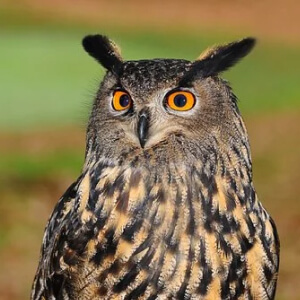
The long-eared owl is a slender owl with two long feather tufts on its head and orange eyes. The tufts look like ears, but the real ears are hidden under the facial feathers. It hunts over fields at night and hides in dense trees by day.
Quick facts
| Common name | Long-eared owl |
| Scientific name | Asio otus |
| Lifespan | Usually a few years in the wild |
| Length | About 31–40 cm |
| Weight | About 210–435 g |
| Diet | Carnivore, mainly voles |
| Predators | Eagle owls, goshawks and martens |
| Conservation status | Least Concern (LC), globally |
| Distribution | Europe, Asia, North Africa and North America |
| Habitat | Small woods, plantations and parks next to open fields |
| Family | Strigidae |
| Nest | Old crow or magpie nests |
- Primary category:Birds
- Explore this animal's categories:
Interesting facts
- When threatened, it stretches upright against a trunk to look like a branch.
- In winter, dozens can roost in the same group of trees, even in village centres.
- The head tufts have nothing to do with hearing.
- It builds no nest and moves into another bird’s old nest.
Characteristics
The long-eared owl has an elongated body and long wings. Its plumage is buff-brown with dark streaks. The facial disc is rusty orange, and the eyes are orange.
The tufts rise when the bird is alert or alarmed and lie flat when it is relaxed. The female is slightly larger and darker than the male.
Behaviour
It is nocturnal and flies low and slowly over fields, listening for rodents. Its hearing is sharp enough to catch prey in complete darkness.
In winter it becomes social, gathering in communal roosts in conifers, willows or trees in parks and yards. In the Serbian town of Kikinda, on the Pannonian Plain, hundreds winter this way. In spring, the male gives a deep “hoo”, repeated every few seconds.
Habitat and distribution
The species lives in Europe, Asia, North Africa and North America. Northern populations move south in winter.
In Romania it breeds mainly in lowlands and hills, in small woods, shelterbelts and plantations next to farmland. Numbers rise in winter as northern birds arrive.
Diet and feeding
Its diet is dominated by voles. In years with many voles, long-eared owls raise more chicks.
It also takes wood mice, shrews and small birds, especially in winter when rodents hide under snow. Prey is swallowed whole and remains are coughed up as pellets. Researchers study pellets under winter roosts to learn which rodents live nearby.
Reproduction and life cycle
It builds no nest, using old nests of crows, magpies or other birds in dense trees or shrubs.
The female usually lays 4–6 white eggs and incubates alone for 25–30 days while the male brings food. Chicks leave the nest at about three weeks, before they can fly, and climb along branches. Their begging call sounds like a squeaky gate.
Name and history
The scientific name Asio otus comes from Latin and Greek words for an eared owl.
The Romanian name “ciuf” refers to the tuft on the head. A close relative, the short-eared owl (Asio flammeus), has much shorter tufts and also hunts by day.
Conservation and threats
The species is assessed globally as Least Concern. Populations rise and fall with rodent numbers.
Main threats include rodent poisons, removal of tree clumps in farmland and disturbance at winter roosts. Like all birds of prey, it is protected in Romania.
Frequently asked questions
Does the long-eared owl have ears?
Yes, real ears are hidden under the facial feathers. The long head tufts are just feathers.
Why do long-eared owls roost together in winter?
Communal roosts offer shelter and safety, as more birds can spot a predator sooner.
What does the long-eared owl eat?
Mostly voles, plus other small rodents and small birds.
Does it build a nest?
No. It uses old nests of crows, magpies or other birds.