Leopard geckoEublepharis macularius
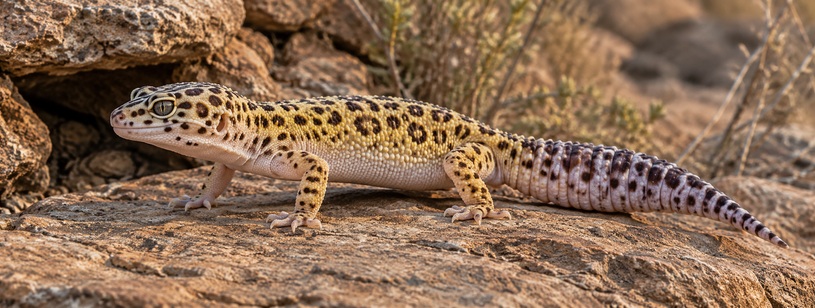
The leopard gecko (Eublepharis macularius) is a small Asian lizard recognised by its dark spots, movable eyelids and thick tail. It lives mainly on the ground in dry, rocky habitats, hunting mostly insects and other invertebrates.
A familiar terrarium animal, it needs controlled temperatures, hiding places, suitable food and a humid hide for shedding. It can shed its tail when threatened and grow a replacement, although the new tail does not perfectly reproduce the original structure.
Quick facts
| Common name | Leopard gecko |
| Scientific name | Eublepharis macularius |
| Typical lifespan | Can reach around 20 years in captivity, according to the Royal Veterinary College |
| Length | Often around 15–25 cm including the tail; some individuals are larger |
| Diet type | Primarily insects and other invertebrates |
| Conservation status | Least Concern (LC) globally |
| Geographical distribution | Pakistan, Afghanistan and northwestern India, with records from Nepal. |
| Habitat | Arid and semi-arid country, rocky ground, scrub and dry grassland |
| Other names | Common leopard gecko; spotted fat-tailed gecko |
| Origin | Asia: Pakistan, Afghanistan and northwestern India, with records from Nepal |
| Typical appearance | Yellow or cream with dark spots; young animals have more obvious bands |
| Movement | Mainly terrestrial; clawed toes without adhesive pads |
| Activity | Mostly evening, night and around dawn |
| Social life | Generally solitary; individuals may be territorial |
| Defence | Hiding and shedding the tail when threatened |
| Reproduction | Egg-laying; usually two eggs per clutch |
| Incubation | Several weeks; San Diego Zoo gives 45–53 days under the conditions described |
- Primary category:Reptiles
- Explore this animal's categories:
Interesting facts
- It can blink. Movable eyelids distinguish it from many other gecko species.
- It cannot climb glass like a gecko with adhesive pads. Small claws provide grip on rough surfaces.
- The tail contains fat reserves. Losing it also means losing stored energy.
- Young animals have a different pattern from many adults. Dark body bands become less prominent as a spotted pattern develops.
- A replacement tail can grow. Research shows that its internal structure differs from the original.
- Incubation temperature influences hatchling sex. The relationship is more complex than “warmer always means male”.
Characteristics
What does a leopard gecko look like?
It has a relatively broad head, small scales and raised skin bumps called tubercles. The familiar colour is yellow or cream with black or dark-brown spots. The underside is pale.
A healthy original tail is thicker towards the base and tapers to a point. Rings and dark bands may be visible. Young geckos have stronger body bands, and their pattern changes as they grow.
Eyelids and toes
| Body part | Characteristics |
|---|---|
| Eyes | Movable eyelids and vertical pupils, whose appearance varies with light |
| Toes | Five on each limb, with small claws and no adhesive pads |
| Skin | Fine scales and more prominent tubercles on the upper body |
| Tail | Fat reserves and the ability to regenerate after shedding |
This lizard is primarily adapted to ground-level life. It can climb rough objects but does not grip smooth surfaces like geckos with specialised adhesive pads.
Captive colour varieties
Selective breeding has produced many colour and pattern varieties, often called morphs. Some have few spots or colours unlike the familiar form. These varieties are not automatically separate species.
Appearance varies with age and between individuals. A different pattern alone does not reliably identify species, sex or health.
Habits and behaviour
When is it active?
During the day, it often shelters beneath stones, in crevices or in burrows to avoid heat and predators. Activity is concentrated around evening, night and dawn, varying with temperature and local conditions.
Like other reptiles, it relies on environmental heat to regulate body temperature. It moves between warmer and cooler places; its entire enclosure should not be kept at one uniformly high temperature.
Does it live alone?
Leopard geckos are generally solitary. Encounters with other individuals may involve breeding or competition. Males can be territorial, and captive cohabitation can lead to stress, bites and unequal access to food.
Individual housing makes feeding easier to monitor and reduces conflict. A pet does not need a companion simply because it lives alone.
Why does it lose its tail?
Tail shedding is called autotomy. It may occur when the gecko is caught or threatened. The detached tail can keep moving, distracting a predator and giving the lizard time to escape.
The replacement is functional but differs in shape, scales and internal organisation. Never grab a gecko by its tail. Support the body when lifting it, keeping handling calm and brief.
Habitat and geographical distribution
Where does it live in the wild?
Its range includes Pakistan, parts of Afghanistan and northwestern India, with records from Nepal. It occupies dry and semi-arid country with rocks, gravel, scrub and grassland.
Its habitat is not limited to sand dunes. Rocky and underground shelters offer protection and more stable conditions than fully exposed ground. Its colour and markings help camouflage it.
What makes a suitable enclosure?
Floor space, hiding places and opportunities to choose different temperatures are essential. The Royal Veterinary College recommends a minimum enclosure of 36 × 18 × 18 inches, approximately 91 × 46 × 46 cm. A larger, well-furnished enclosure offers more opportunities for movement.
- A warm zone and a cooler zone, with hiding places in both.
- A humid hide for shedding, without making the entire enclosure excessively damp.
- Thermostatically controlled heating and temperatures checked with thermometers.
- Suitable lighting, including species-appropriate UVB, with shade available and darkness at night.
- Fresh water and a safe substrate that supports movement and natural behaviour.
Heat and light
The Royal Veterinary College guide gives a basking area of around 32°C and a cooler end of around 25°C. Check conditions where the animal can actually go; surface and air temperatures can differ.
Heat sources and lamps must suit the enclosure and equipment instructions. Contact with an excessively hot surface can cause burns. Leaving a light on continuously does not provide a normal day–night cycle.
Diet and feeding
What does a leopard gecko eat?
It feeds mainly on insects and other invertebrates. This small predator tracks and catches appropriately sized prey. Other small animals may also be eaten in the wild when available.
Captive diets use insects bred for feeding reptiles, including crickets, locusts and suitable larvae. Offering one insect type indefinitely without balancing the diet does not automatically provide complete nutrition.
Variety and calcium
| Component | Role in care |
|---|---|
| Appropriately sized insects | Allow capture and swallowing without difficulty |
| Feeding insects before offering them | Improves their nutritional contribution to the lizard |
| Calcium and vitamins | Tailor to diet, age, UVB exposure and veterinary advice; avoid indiscriminate supplementation |
| Clean water | Available in a shallow container that is cleaned regularly |
Feeder insects often contain little calcium relative to phosphorus. Veterinary guides recommend appropriate dietary correction and supplementation. Combining more supplements does not automatically improve care.
How often should it eat?
Young geckos need more frequent feeding than adults. Adjust portions and timing to age, weight and health. Remove uneaten live insects so they cannot disturb or injure the animal.
A thick tail is not a reason to overfeed. Monitoring weight and appetite helps reveal changes; progressive weight loss needs assessment by a veterinarian experienced with reptiles.
Reproduction and life cycle
Eggs and hatching
Females usually lay two eggs per clutch, meaning a set of eggs laid together. More than one clutch may be produced during a breeding season, but numbers vary between individuals and conditions.
Eggs are laid in suitable sites and left to develop. San Diego Zoo gives an incubation period of 45–53 days; this is not a fixed duration under every temperature or circumstance.
Temperature influences hatchling sex
Embryonic temperature influences the proportion of females and males. Experiments have identified temperatures favouring one sex or the other, and the relationship can shift again at very high temperatures.
Raising temperature does not always produce more males. Unsuitable temperatures can harm development and survival, so this biological finding should not become an improvised incubation recipe.
Hatchlings and shedding
Young geckos have a more strongly banded pattern than many adults and receive no continuing parental care. As they grow, they shed their outer skin and their markings change.
A humid hide helps the outer skin detach. Retained skin constricting toes or the tail tip can cause injury and should not be pulled away forcibly.
How long does a leopard gecko live?
It can reach around 20 years in captivity, according to the Royal Veterinary College. Lifespan varies with health, diet and husbandry. This is neither a guaranteed age nor a maximum species record.
Names and history
| Classification level | Name |
|---|---|
| Class | Reptilia — reptiles |
| Order | Squamata — lizards and snakes |
| Family | Eublepharidae |
Why is it called a leopard gecko?
Dark spots against a yellowish background explain the familiar common name. Its scientific name is Eublepharis macularius, with the authority Blyth, 1854.
It was originally described as Cyrtodactylus macularius. Current classification places it in Eublepharidae. The word macularius refers to its spotted appearance.
A lizard studied by scientists
Leopard geckos feature in research on tail regeneration, development and behaviour. Their ability to rebuild several tissue types helps researchers investigate regeneration.
Conservation and threats
Is it endangered?
Eublepharis macularius is globally classified as Least Concern (LC). This does not mean every local population is free from threats.
Habitat destruction, including quarrying or other extraction in some areas, and excessive collection can affect wild populations. Choosing a captive-bred animal with a known origin reduces pressure from direct collection in the wild.
Risks in captivity
- Unbalanced diets, inadequate available calcium and unsuitable lighting or temperature can affect bones and health.
- Uncontrolled heating can cause burns or overheating.
- Shedding problems can leave skin constricting toes.
- Conflict between individuals can lead to bites, stress and tail loss.
Prolonged loss of appetite, weight loss, difficulty walking and wounds need veterinary assessment. Treatments and doses should not be chosen from a photograph or general online advice.
In popular culture
A familiar terrarium animal
Leopard geckos are widely kept in terrariums. Their colour varieties have attracted many enthusiasts, but responsible keeping requires meeting their biological needs.
They also feature in reptile education programmes, such as the one described by Belfast Zoo. Small size does not make constant handling or housing without suitable equipment appropriate.
Frequently asked questions
Is a leopard gecko a lizard?
Yes. Eublepharis macularius is an Asian lizard in the family Eublepharidae.
What does it eat?
Primarily insects and other invertebrates. Captive diets need variety and appropriate calcium and vitamins.
How long does a leopard gecko live?
It can reach around 20 years in captivity, although lifespan varies with health and care.
Can it climb glass?
It lacks the adhesive pads found in other geckos. Claws help on rough surfaces but do not give the same grip on glass.
Why does it lose its tail?
It can shed the tail when caught or threatened, a defence called autotomy. Never hold it by the tail.
Will the tail grow back?
It can regenerate a replacement, but the new tail differs from the original in appearance and internal structure.
Does it need another gecko for company?
No. It is generally solitary, and individual housing reduces conflict and makes feeding easier to monitor.
Does it need heat and UVB?
It needs warm and cooler areas with controlled heating. Veterinary guides recommend species-appropriate UVB, access to shade and darkness at night.
Did you know? About leopard geckos
- Leopard geckos have movable eyelids and can blink.
- Their clawed toes have no adhesive pads.
- A replacement tail differs structurally from the original.
- They are generally solitary and mainly hunt insects.