Red foxInteresting facts and information
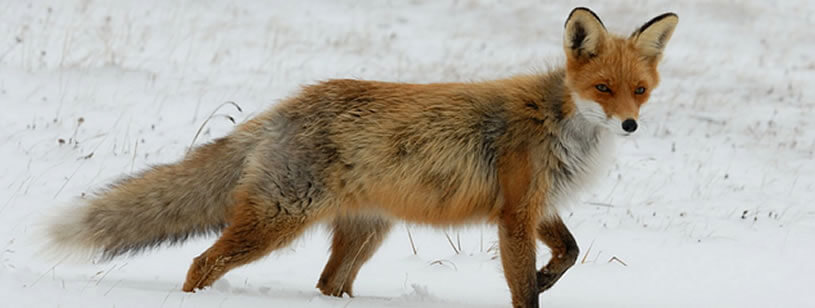
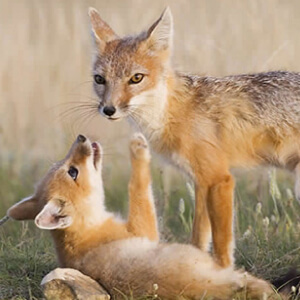
The red fox (Vulpes vulpes) is a widespread mammal found across much of the Northern Hemisphere, with introduced populations elsewhere. It uses many kinds of habitat, including towns, and eats both animal and plant food.
Red foxes have a bushy tail and a varied diet that includes small mammals, birds, invertebrates, fruit and food waste.
Quick facts
| Common name | Red fox |
| Scientific name | Vulpes vulpes |
| Typical lifespan | 2-5 years in the wild, up to about 14 years in captivity |
| Maximum speed | Up to about 50 km/h over short distances |
| Length | 45-90 cm (without the tail) |
| Tail length | 30-55 cm |
| Weight | 3-14 kg (depending on the region) |
| Diet | Omnivore (small mammals, birds, fruit, insects) |
| Main predators | Wolves, lynxes, large birds of prey and other predators; humans are a separate source of pressure |
| Conservation status | Least Concern (IUCN); local conditions and pressures vary |
| Distribution | Europe, Asia, North America and North Africa; introduced to Australia |
| Habitat | Forests, steppes, tundra, towns and cities |
- Primary category:Mammals
- Explore this animal's categories:Animals of AfricaAnimals of AsiaAnimals of AustraliaAnimals of EuropeAnimals of North AmericaAnimals of RomaniaAnimals of Romania’s forestsAnimals of Romania’s grasslands and plainsAnimals of the Danube DeltaBurrowing animalsCanidsForest animalsFurry animalsInsect-eating animalsLive-bearing animalsMammalsMammals of RomaniaMountain animals of RomaniaNocturnal animalsOmnivoresPredatory animals of RomaniaRRed and reddish animalsTypes of foxesVertebratesWild animals
Interesting facts
- It may use the Earth's magnetic field when pouncing - Studies suggest that red foxes are more successful when they jump at hidden prey in a north-easterly direction, possibly guided by the magnetic field.
- It has a large vocabulary - Red foxes make around 20 different calls, including barks, screams and chattering sounds.
- Its tail doubles as a blanket - The bushy tail helps with balance and communication, and in winter the fox wraps it around its body to keep warm.
- It is one of the most adaptable mammals in the world - Red foxes live everywhere from the Arctic tundra and deserts to busy cities.
- It can hear prey underground - Its very sensitive hearing lets it locate small rodents moving under the soil or beneath thick snow.
- It moves stealthily - A hunting fox walks softly and places its feet carefully, so it is very hard to hear.
Records and remarkable features
Physical Features and Single Adaptations
The red fox (Vulpes vulpes) is known for its elegant appearance and impressive agility. Several physical features help it adapt to a wide range of environments.
Key physical adaptations
- Light, flexible body - Allows fast movements and long leaps, essential for hunting and escaping predators.
- Thick, insulating fur - Protects against extreme cold, especially in northern regions.
- The bushy tail helps with balance and communication and can cover the fox when it rests.
- Strong claws - Help the fox dig dens and grip the ground.
- Large, pointed ears - Pick up high-pitched sounds, so the fox can hear rodents underground.
- Eyes with vertical slit pupils - Give good vision in dim light, suited to hunting at night and at dusk.
Colour variations
Most red foxes have reddish-orange fur, but there are several other colour forms:
| Colour form | Description |
|---|---|
| Classic red | Orange-red fur with a white belly and a white tail tip |
| Silver | Black fur with silvery tips; rare in the wild |
| Cross fox | Reddish-brown fur with a dark cross over the shoulders and back |
| Very pale or white | Rare; caused by unusual genes such as albinism |
Habits and behaviour
The red fox is an intelligent, opportunistic and highly adaptable animal whose flexible behaviour lets it survive in many different environments.
Way of life
- Usually hunts alone - Unlike wolves, red foxes normally hunt on their own, although they often live as a pair or in a small family group.
- Mostly active at night and at dusk - Foxes can be seen during the day, but they prefer to hunt at night, when their prey is more active.
- Dens - Foxes dig their own dens or move into burrows dug by badgers or rabbits.
- Tail signals - The tail is held in different positions to show alertness, fear or excitement.
Social interactions
- Family groups - In some areas, a breeding pair lives with a few non-breeding females, often their daughters from earlier years, which help raise the cubs.
- Males help - The male brings food to the female while she is nursing and later helps feed the cubs.
- A wide range of calls - Foxes bark, scream, whine and make chattering sounds to communicate.
Defence techniques
- Camouflage - Its reddish fur blends in well with autumn leaves and dense vegetation.
- Speed and agility - Red foxes can run at up to about 50 km/h and leap more than 2 metres.
- Dodging - When chased, they make sudden jumps and sharp turns to escape.
Habitat and geographic distribution
The red fox is the most widespread fox species and the most widely distributed wild carnivore in the world. It lives in North America, Europe, Asia and North Africa, and it was introduced to Australia.
Distribution
| Region | Situation |
|---|---|
| Europe | Common in forests, farmland and towns |
| North America | Widespread; competes with the coyote in some areas |
| Asia | Widespread, from Siberia to the Himalayas |
| North Africa | Present in Morocco, Algeria, Tunisia and Egypt |
| Australia | Introduced in the 19th century; now a harmful invasive species |
Habitats
- Deciduous and coniferous forests - Foxes favour wooded areas where they can hide and hunt easily.
- Steppes and plains - They also do well in open country, where they can spot prey from a distance.
- Tundra and Arctic regions - In cold areas, their fur grows thicker for protection.
- Towns and cities - Many foxes have adapted to city life, feeding on scraps and rodents.
Impact of climate change and human activity
- Moving north - As the climate warms, red foxes are spreading into the Arctic, where they compete with and sometimes kill Arctic foxes.
- City life - Foxes have adapted to towns, but they face traffic and conflicts with people.
- Changing food supply - Changes in ecosystems can affect the foxes' prey, pushing them towards other foods, including human food waste.
Diet and feeding
The red fox is an opportunistic omnivore with an extremely varied diet. It eats small mammals, birds, insects and fruit, and in towns it also eats human food.
What does the red fox eat?
| Type of food | Examples | How often |
|---|---|---|
| Small mammals | Voles, mice, rats, rabbits | Very often |
| Birds | Pheasant chicks, ducks, songbirds | Often |
| Amphibians and reptiles | Small snakes, frogs, lizards | Occasionally |
| Fish and crustaceans | Freshwater fish, crayfish | Occasionally |
| Insects and other invertebrates | Beetles, crickets, earthworms | Seasonal |
| Fruit | Apples, grapes, blueberries, blackberries | Seasonal |
| Other food | Carrion, human food waste | Occasionally |
Hunting methods
- Stalking and ambush - The fox hides and waits for the right moment, then catches its prey with a precise leap.
- The "mousing" pounce - The fox leaps high into the air and lands precisely on prey hidden in grass or snow.
- Caching food - It buries extra food to eat later, when hunting is difficult.
- Urban foraging - In cities, foxes look for scraps and hunt rodents near homes.
Reproduction and life cycle
Red foxes are usually monogamous for at least one breeding season: a male and a female pair up and raise the cubs together.
Breeding season
- Mating takes place between December and February, and each female is fertile for only about three days.
- Males become more aggressive and defend their territories against rivals.
- Pairs form for the breeding season, and the male helps feed the cubs.
Pregnancy and birth
| Feature | Details |
|---|---|
| Pregnancy | 49-55 days |
| Cubs per litter | Usually 4-6 |
| Weight at birth | About 100-150 g |
| Nursing period | About 6-8 weeks |
Raising the cubs
- Cubs are born blind and deaf and depend completely on their mother.
- At about two weeks, their eyes open and their fur becomes thicker.
- At about four weeks, they come out of the den to explore.
- At 8-10 weeks, they start learning to hunt with their parents.
- By autumn they are independent, and they can breed at about one year old.
Survival
- Many cubs die in their first year because of predators, disease, traffic and lack of food.
- In the wild, most foxes live only 2-5 years, but in captivity they can live up to about 14 years.
Name and history
Origin of the name
- The English word "fox" is very old and comes from the Germanic languages; a female is called a vixen.
- The scientific name Vulpes vulpes comes from the Latin word for fox, vulpes; the genus Vulpes also includes other "true" foxes.
- In French, the red fox is called renard roux.
Taxonomic classification
| Classification | Name |
|---|---|
| Kingdom | Animalia |
| Phylum | Chordata |
| Class | Mammalia |
| Order | Carnivora |
| Family | Canidae |
| Genus | Vulpes |
| Species | Vulpes vulpes |
Evolution and fossils
- The red fox evolved in Eurasia and has existed for at least several hundred thousand years.
- Fossils from Europe and North America show how foxes spread and adapted to different climates.
- Foxes split from the ancestors of wolves and dogs millions of years ago.
- For centuries, foxes have been hunted for their fur and as a sport.
Cultural significance and mythology
- A trickster in folklore - In European tales, the fox is a clever trickster; the best known is Reynard the Fox from medieval stories.
- Fables - In Aesop's fables, such as "The Fox and the Grapes", the fox stands for cunning and sometimes for vanity.
- East Asia - In Japanese and Chinese folklore, foxes (kitsune in Japan) are magical beings that can change shape; in Japan they are also linked with the god Inari.
Conservation status and threats
The red fox is not threatened with extinction, but several factors affect its numbers in some regions.
Conservation status
| Region | Status | Trend |
|---|---|---|
| Europe | Least Concern | Stable |
| North America | Least Concern | Stable |
| Asia | Least Concern | Generally stable |
| Australia | Introduced invasive species | Actively controlled |
Main threats
- Hunting and trapping - In some countries, foxes are hunted for their fur or to protect livestock.
- Habitat loss - Deforestation and the spread of cities reduce the space available to foxes.
- Disease and parasites - Foxes can catch and spread rabies, mange and other diseases.
- Conflict with farmers - Some foxes kill poultry, which leads to control measures.
- Competition with other species - In North America, red foxes compete with coyotes.
Protection and management
- Hunting rules - In many European countries, fox hunting is regulated.
- Rabies vaccination - Several countries drop vaccine baits from the air, which has eliminated fox rabies from much of Western Europe.
- Protected areas - National parks help maintain healthy fox populations.
In popular culture
- Fantastic Mr Fox - Roald Dahl's 1970 children's book about a clever fox, made into an animated film in 2009.
- The Fox and the Hound (Disney, 1981) - An animated film about the friendship between Tod, a red fox, and a hound puppy.
- Robin Hood (Disney, 1973) - Robin Hood is shown as a cunning fox.
- Zootopia (Disney, 2016) - Nick Wilde, one of the main characters, is a red fox.