StarfishInteresting facts and information
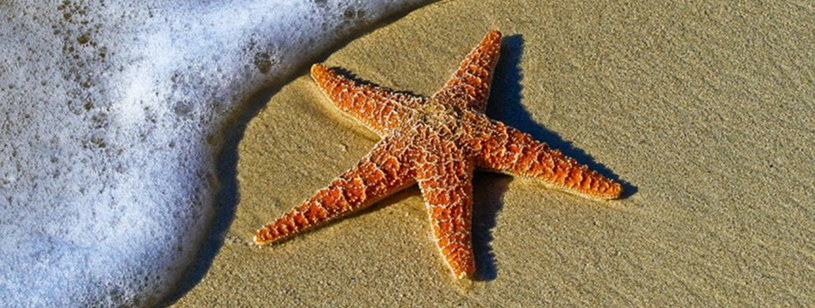
Sea stars, also called starfish, are marine echinoderms in the class Asteroidea. They move with small tube feet and are not fish. Many have five arms, but some species have more.
They are famous for their ability to regenerate: many species can regrow lost arms, and a few can even grow a whole new body from a single arm.
Sea stars play a key role in marine ecosystems by eating molluscs, sea urchins and other animals. Some species have been badly hit by disease and warming seas.
Quick facts
| Common name | Starfish (sea star) |
| Scientific name | Asteroidea |
| Typical lifespan | Often 5 - 35 years (depending on species) |
| Maximum speed | Varies with species or individual, distance and conditions |
| Size | About 1 - 100 cm across |
| Weight | From a few grams to about 5 kg |
| Diet type | Mostly carnivores and scavengers (molluscs, crustaceans, sea urchins, coral, organic matter) |
| Main predators | Fish, crabs, sea otters, seabirds, other sea stars |
| Conservation status | Assess separately by species and population; different taxa and regions have different needs |
| Distribution | All oceans, from the tropics to the Arctic and Antarctic |
| Habitat | Coral reefs, rocky shores, sandy or muddy seabed, deep sea |
- Primary category:Invertebrates
- Explore this animal's categories:
Interesting facts
- Hundreds of tube feet - Sea stars move on hundreds of tiny tube feet worked by water pressure, not by swinging their arms.
- Regrowing arms - Many sea stars can regrow lost arms, and a few, such as Linckia, can grow a whole new sea star from a single arm.
- No brain and no blood - Sea stars have a ring of nerves instead of a brain, and they use seawater pumped through their bodies instead of blood.
- Eyes on the tips of their arms - Each arm ends in a small eye that can sense light and dark and even see rough shapes.
- Eating with a stomach outside the body - Many sea stars push their stomach out through the mouth and digest prey outside their body.
- A giant - The sunflower sea star (Pycnopodia helianthoides) can have up to 24 arms and measure about 1 metre across.
Records and remarkable features
- Sea stars, also called starfish, are marine echinoderms in the class Asteroidea. They move with small tube feet and are not fish. Many have five arms, but some species have more.
Characteristics
Sea stars are echinoderms with a body arranged around a central point, usually in five parts. Although most have five arms, some species have many more, up to about 40 or even 50.
Main physical characteristics:
| Characteristic | Details |
|---|---|
| Body shape | Radial symmetry, star-shaped |
| Size | About 1 cm to 1 m across |
| Weight | From a few grams to about 5 kg |
| Colour | Red, orange, blue, purple, green, brown, yellow |
| Arms | Usually 5, but some species have many more |
| Tube feet | Used for movement, gripping and feeding |
| Circulation | A water vascular system; no blood like ours |
| Internal organs | A stomach that can be pushed outside; no brain or heart |
| Eyes | A simple eye at the end of each arm |
Special adaptations:
- Water vascular system - Seawater moves through canals in the body and works the tube feet.
- Regeneration - Most species can regrow a lost arm, and some can regrow a whole body from an arm with part of the central disc, or even without it.
- An outside stomach - To eat, many sea stars push their stomach out over the prey and digest it with enzymes.
- A skeleton of small plates - Their bodies are supported by many small chalky plates under the skin.
Habits and behaviour
Sea stars live on the seabed, where they play an important role in food webs, especially by eating molluscs.
Social behaviour:
- Usually solitary - Most species live alone, but some gather in large numbers where food is plentiful or to spawn.
- No territory - They move slowly in search of food.
- Sensing light - They use the eyes at the tips of their arms to find shelter and navigate.
Feed and hunting methods:
- Predators of molluscs - Many feed on clams, mussels, snails and sea urchins; some eat coral.
- External digestion - They push their stomach over the prey and turn its soft parts into a soup that they absorb.
- Opening shells - Sea stars pull steadily on shells with their tube feet until the mollusc tires and opens slightly.
Defence and survival strategies:
- Dropping arms - When attacked, some sea stars can drop an arm and grow a new one.
- Camouflage - Some species have colours that help them blend in with rocks and coral.
- Spines and toxins - The crown-of-thorns starfish (Acanthaster planci) has sharp, venomous spines that deter predators.
Habitat and geographic distribution
Sea stars live in all the world's oceans, from tropical coral reefs to polar seas and from rock pools to the deep sea.
Habitats:
| Habitat | Species predominant |
|---|---|
| Coral reefs | Linckia laevigata, Acanthaster planci |
| Rocky shores | Pisaster ochraceus, Marthasterias glacialis |
| Sandy seabed | Luidia clathrata, Astropecten species |
| Deep sea (over 1,000 m) | Hymenaster species, brisingid sea stars |
Geographical distribution:
- Atlantic, Pacific and Indian Oceans - Sea stars are common in tropical and temperate seas.
- Arctic and Antarctic - Many species live in very cold water, such as Odontaster validus in Antarctica.
- Coral reefs - Many colourful species live on the Great Barrier Reef and other Indo-Pacific reefs.
- Deep water - Some species live more than 5,000 metres deep, where the water is close to freezing.
Impact of climate change and human activities:
- Sea star wasting disease - Since 2013, this disease has killed billions of sea stars along the Pacific coast of North America.
- Ocean warming - Warmer water seems to have made the disease worse and stresses many species.
- Coral-eating outbreaks - Outbreaks of the crown-of-thorns starfish, a native species on Indo-Pacific reefs, can destroy large areas of coral.
- Collection - Some species are collected for aquariums and dried as souvenirs.
Sea stars are resilient animals, but disease and climate change can have devastating effects on some populations.
Diet and feeding
Most sea stars are predators or scavengers. They eat molluscs, crustaceans, other invertebrates and dead animals, and some feed on organic matter.
Food types consumed:
| Food type | Examples |
|---|---|
| Molluscs | Mussels, clams, oysters, snails |
| Crustaceans | Small crabs, barnacles |
| Other echinoderms | Sea urchins, other sea stars |
| Organic matter | Detritus and films of algae and bacteria, eaten by some species |
| Corals | The crown-of-thorns starfish (Acanthaster planci) eats coral polyps |
| Carrion | Dead fish and other animals |
Method of feeding:
- Pushing out the stomach - Sea stars push their stomach over their prey and digest it before absorbing it.
- Opening shells - With their tube feet, they pull on shells until they open a tiny gap, enough for the stomach to slip in.
- Swallowing whole - Some species, such as sand stars, swallow small prey whole.
- Eating coral - A single crown-of-thorns starfish can eat several square metres of coral in a year.
As predators, sea stars help control populations of mussels and other animals, but some can damage coral reefs during outbreaks.
Reproduction and life cycle
Sea stars can reproduce sexually, and some species also reproduce asexually by splitting or regrowing from a lost arm.
Life cycle stages:
| Stage | Approximate duration | Characteristics |
|---|---|---|
| Spawning | Seasonal | Eggs and sperm are released into the water, where fertilisation takes place. |
| Planktonic larva | Several weeks to months | Tiny larvae feed on plankton and drift with the currents. |
| Metamorphosis | At the end of the larval stage | The larva turns into a tiny sea star and settles on the seabed. |
| Sexual maturity | About 2-5 years | Sea stars can breed; some species live for more than 30 years. |
Reproductive methods:
- Separate sexes - Most sea stars are male or female, but some change sex or are hermaphrodites.
- External fertilisation - Males and females release eggs and sperm into the water, often at the same time.
- Brooding - Some species, especially in cold seas, keep their eggs and young under their bodies.
- Asexual reproduction - Some species split in two or grow a new individual from a lost arm.
Factors affecting reproduction:
- Water temperature - Many species spawn in spring and summer.
- Food - Populations grow when there is plenty of food for larvae and adults.
- Pollution and acidification - Can affect the survival of the larvae.
Thanks to regeneration, sea stars can recover from injuries, but their populations are still vulnerable to disease and climate change.
Name and history
Sea stars are very old animals: their ancestors lived in the seas more than 450 million years ago.
Origin and etymology of the name:
- "Starfish" - The common name comes from their star-like shape, although they are not fish.
- "Sea star" - Many scientists prefer this name because sea stars are echinoderms, related to sea urchins.
- The scientific name Asteroidea comes from the Greek aster, "star", and eidos, "form".
Taxonomic classification:
| Taxonomic category | Name |
|---|---|
| Kingdom | Animalia |
| Phylum | Echinodermata |
| Class | Asteroidea |
Sea stars in history and culture:
- Science - In the 1960s, the ecologist Robert Paine showed that removing the ochre sea star (Pisaster ochraceus) changed the whole rocky shore, giving rise to the idea of the "keystone species".
- Symbols - The starfish is a popular symbol of the sea and the beach in art and decoration.
- "The Star Thrower" - Loren Eiseley's 1969 essay about a man throwing stranded starfish back into the sea inspired a famous story about making a difference, one starfish at a time.
Sea stars remain important animals for science, but some species are threatened by disease and climate change.
Conservation status and threats
Most sea stars are not assessed, but some species have been hit very hard by disease, warming seas and other pressures.
Conservation status
| Species | Status |
|---|---|
| Crown-of-thorns starfish (Acanthaster planci) | Not threatened; outbreaks can damage coral reefs |
| Sunflower sea star (Pycnopodia helianthoides) | Critically Endangered (IUCN) |
| Ochre sea star (Pisaster ochraceus) | Not assessed; badly affected by wasting disease in some areas |
Main threats:
- Disease - Sea star wasting disease killed more than 90% of sunflower sea stars along the Pacific coast of North America.
- Climate change - Marine heatwaves stress sea stars and may make disease outbreaks worse.
- Ocean acidification - Changes in seawater chemistry can affect the chalky plates of their skeleton and their larvae.
- Collection - Some species are collected for aquariums and souvenirs.
- Habitat destruction - Pollution and damage to reefs and shores reduce their habitats.
Conservation efforts:
- Monitoring - Scientists and volunteers count sea stars along coasts to follow their recovery.
- Protected areas - Marine reserves protect reefs and rocky shores.
- Captive breeding - Laboratories are breeding sunflower sea stars to help return them to the wild.
- Reef protection - In Australia, divers remove crown-of-thorns starfish from important reefs during outbreaks.
The recovery of the sunflower sea star is important, because it eats sea urchins and helps protect kelp forests.
In popular culture
Sea stars in animation
- "SpongeBob SquarePants" (1999) - Patrick Star, SpongeBob's best friend, is a pink starfish.
- "Finding Nemo" (2003) - Peach, a starfish, lives in the dentist's aquarium with Nemo.
Sea stars as symbols
- The beach - The starfish is one of the best-known symbols of the seaside.
- Hope - "The Star Thrower" story has made the starfish a symbol of small acts that make a difference.