Flying squirrelPteromyini — habitat, diet and reproduction
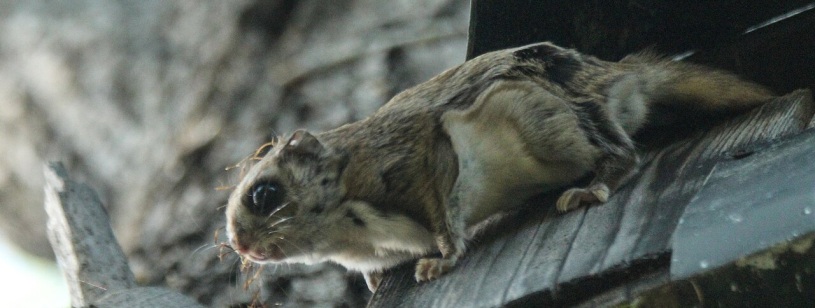
Siberian flying squirrel (Pteromys volans). · Andrew Bazdyrev / CC BY 4.0 (https://creativecommons.org/licenses/by/4.0). Cropped and resized.
Flying squirrels are a group of about 50 rodent species that glide between trees at night. A membrane of skin stretches between their front and hind legs like a parachute when they jump. They do not flap like bats but glide from one trunk to the next.
Quick facts
| Common name | Flying squirrel |
| Scientific name | Pteromyini (tribe); in Europe Pteromys volans |
| Lifespan | About 5–6 years in the wild; longer in captivity |
| Length | From about 10 cm to over 60 cm including the tail, by species |
| Weight | From about 25 g to over 1.5 kg, by species |
| Diet | Omnivore: seeds, nuts, buds, catkins, fungi, insects |
| Predators | Owls, martens, cats, snakes |
| Conservation status | Most species Least Concern (LC) |
| Distribution | Asia, northern Europe and North America |
| Habitat | Old forests with tree holes |
| Family | Sciuridae |
| Activity | Nocturnal |
- Primary category:Rodents
- Explore this animal's categories:
Interesting facts
- Some large Asian flying squirrels can glide more than 100 metres.
- In 2019, researchers found that American flying squirrels glow pink under ultraviolet light.
- A flattened tail helps them brake and steer in the air.
- Only one species lives in Europe, the Siberian flying squirrel in the north-east.
Characteristics
Flying squirrels have dense, soft fur, large eyes for night vision and a long, usually flattened tail. The gliding membrane, called the patagium, stretches from the wrist to the ankle.
A small spur-like bone at the wrist extends the membrane edge. Size varies hugely: some species are mouse-sized, while Asian giant flying squirrels weigh over a kilogram.
Behaviour
Almost all species are nocturnal, sleeping by day in tree holes, twig nests or bird boxes.
To travel, they climb high on a trunk, jump and spread the membrane, steering with legs and tail before landing head-up on another trunk. Some species huddle together in winter for warmth.
Habitat and distribution
Most species live in the forests of southern and eastern Asia. North America has three species of Glaucomys.
In Europe the only species is the Siberian flying squirrel, found in Finland, Estonia, Latvia and Russia. Flying squirrels do not live in Romania.
Diet and feeding
Diet varies by species: seeds, nuts, acorns, buds, birch and alder catkins, leaves, fungi and lichens.
Some species also catch insects or eat bird eggs. The Siberian flying squirrel stores catkins in tree holes for winter.
Reproduction and life cycle
Females usually have 2–4 young once or twice a year in a lined tree hole. Newborns are hairless with closed eyes.
They start gliding after a few weeks and become independent at about two to three months. A mother may move her young to another hole if she senses danger.
Name and history
The scientific name Pteromys comes from Greek and means “winged mouse”, although the membrane is not a true wing like a bat’s.
Gliding evolved separately in several animal groups. Australia’s sugar glider looks very similar, although it is a marsupial, not a rodent.
Conservation and threats
Most species are assessed as Least Concern, but some Asian species are endangered, and the Siberian flying squirrel is declining in Finland and Estonia.
The main threat is felling of old forests with the hollow trees they need for shelter. Many countries protect them, and trade in wild-caught animals as pets is a problem.
Frequently asked questions
Do flying squirrels really fly?
They do not flap wings. They glide using a skin membrane stretched between their legs.
How far can a flying squirrel glide?
Usually tens of metres; some large Asian species exceed 100 metres.
Do flying squirrels live in Romania?
No. Europe has only one species, in the north-east of the continent.
What do flying squirrels eat?
Seeds, nuts, buds, catkins, fungi and sometimes insects.