DragonflyInteresting facts and information
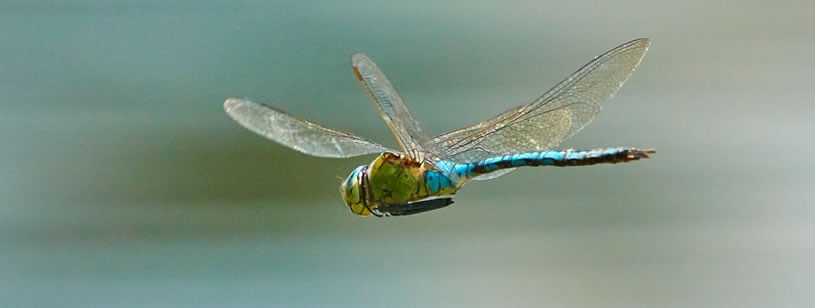
Dragonflies are insects in the group Anisoptera, within the order Odonata. Their larvae usually live in water, while adults fly and catch other insects. They develop without the pupal stage seen in butterflies.
Dragonflies are important indicators of healthy freshwater habitats, because they need clean water to breed and develop. They appear in folklore and art around the world, often as symbols of change and adaptability.
Quick facts
| Common name | Dragonfly |
| Scientific name | Anisoptera (within Odonata) |
| Typical lifespan | From a few months to several years, mostly as underwater larvae; adults live weeks to a few months |
| Maximum speed | Fast fliers; some reach about 50 km/h |
| Dimensions | About 2-12 cm long, wingspan up to about 16 cm |
| Weight | Usually less than 1 gram |
| Diet type | Carnivorous (adults eat flying insects; larvae eat water animals) |
| Main predators | Birds, frogs, spiders, fish, larger dragonflies |
| Conservation status | Assess separately by species and population; different taxa and regions have different needs |
| Distribution | All continents except Antarctica |
| Habitat | Wetlands: lakes, rivers, streams, marshes, ponds |
- Primary category:Insects
- Explore this animal's categories:
Interesting facts
- Fliers like helicopters - Dragonflies can move each of their four wings separately, which lets them hover, turn sharply and even fly backwards.
- Almost all-round vision - Their huge compound eyes, with up to about 30,000 tiny lenses each, give them a field of view of almost 360 degrees.
- Expert hunters - Some dragonflies catch more than 90% of the prey they chase, making them among the most successful predators in the animal world.
- An ancient group - Their relatives, the griffinflies, flew about 300 million years ago, and some had wingspans of about 70 cm.
- A long life underwater - Dragonflies spend most of their lives as underwater larvae, called nymphs, sometimes for several years, before becoming flying adults.
Records and remarkable features
- Dragonflies are insects in the group Anisoptera, within the order Odonata. Their larvae usually live in water, while adults fly and catch other insects. They develop without the pupal stage seen in butterflies.
- The globe skimmer (Pantala flavescens) makes the longest known insect migration: over several generations, it travels between India and Africa across the Indian Ocean, a round trip of about 14,000-18,000 km.
- Some of the largest dragonflies, such as the giant petaltail of Australia, have a wingspan of about 15-16 cm.
Characteristics
Dragonflies are fast, agile insects with long bodies, see-through wings and huge eyes that give them an almost complete view of their surroundings. These features make them some of the most effective predators among insects.
Main physical characteristics
| Feature | Details |
|---|---|
| Size | About 2-12 cm long |
| Wingspan | Up to about 16 cm |
| Weight | Usually less than 1 gram |
| Colour | Many colours: blue, green, red, yellow, brown, black, often metallic |
| Wings | Two pairs of clear wings that can move independently |
| Eyes | Huge compound eyes with up to about 30,000 lenses each, which often touch on top of the head |
| Antennae | Very short; dragonflies rely mainly on sight |
| Legs | Spiny legs that form a "basket" to grab prey in flight |
Special adaptations
- Remarkable flight - Dragonflies can fly forwards, backwards, sideways and up and down, and hover in one place.
- Strong jaws - They can bite and chew insects very quickly.
- A streamlined body - Helps them fly fast; some dragonflies can reach about 50 km/h.
- Warming up - On cool mornings, dragonflies "shiver" their wings or bask in the sun to warm their flight muscles.
Dragonflies combine speed, excellent eyesight and hunting skill like few other insects.
Habits and behaviour
Dragonflies are active predators that spend much of their time hunting smaller insects or patrolling their territory. They are active by day and need sunshine and warmth to fly.
Social behaviour
- Territories - Males often defend a stretch of shoreline where females come to lay eggs.
- Mostly solitary - Dragonflies do not live in groups, but many may gather where food is plentiful, and some species migrate in swarms.
- Courtship - Males chase rivals and grab females in flight; mating pairs fly linked together in a "wheel" or in tandem.
Hunting methods
- Meat-eaters - Adults eat other insects, such as mosquitoes, midges, flies, moths and flying ants.
- Hunting in the air - They catch prey in flight with their spiny legs and then bite it with their jaws.
- Eating on the wing - They can eat small prey in mid-air without landing.
Defence and survival strategies
- Fast, unpredictable flight - Makes them hard for birds and other predators to catch.
- Camouflage - Some species, and many larvae, blend in with plants, mud or stones.
- Fast reflexes - Dragonflies react almost instantly to the movements of prey and predators.
Dragonflies are top predators of the insect world, with one of the most effective hunting systems in nature.
Habitat and geographic distribution
Dragonflies live on every continent except Antarctica. Because they lay their eggs in water, they are closely linked to wetlands.
Habitat types
| Habitat | Examples of regions |
|---|---|
| Lakes and rivers | North America, Europe, Asia |
| Marshes and ponds | All continents except Antarctica |
| Tropical wetlands | The Amazon, the Congo Basin, Southeast Asia |
| Forest streams | Temperate and tropical forests |
Geographic distribution
- North America - Many species, from swamp dwellers to mountain species.
- Europe - Most species live near lakes, ponds and rivers with plenty of plants.
- Asia and Africa - Home to many species, including migrants such as the globe skimmer.
- Australia - Home to many species found nowhere else, including the giant petaltails.
Impact of human activities on dragonflies
- Habitat loss - Draining wetlands for towns and farms destroys breeding sites.
- Water pollution - Toxic substances kill dragonfly larvae, reducing the number of adults.
- Climate change - Changes the timing of breeding and the places where dragonflies can live.
Dragonflies are indicators of healthy freshwater habitats, and their decline can signal serious pollution problems.
Diet and feeding
Dragonflies are carnivores that eat almost only other insects. Because they fly fast and catch prey in the air, they help control insects such as mosquitoes and midges.
Types of food
| Food group | Examples and context |
|---|---|
| Flying insects (adults) | Mosquitoes, midges, flies, moths, small butterflies |
| Water animals (larvae) | Mosquito larvae, other insect larvae, tadpoles, small fish |
| Other insects | Flying ants, termites, small bees and wasps, even other dragonflies |
Feeding methods
- Catching prey in flight - Dragonflies seize prey in the air with their legs and eat it quickly.
- Patrolling - "Hawkers" fly back and forth looking for prey, while "perchers" wait on a stem and dart out when an insect passes.
- A deadly mask - Larvae have a folding lower lip, called a mask, which shoots out in a split second to grab prey underwater.
Adaptations for feeding
- Exceptional eyesight - Their compound eyes let them see prey from almost any angle.
- Precise flight - Dragonflies can predict where their prey is going and fly to intercept it.
- High success rate - Some species catch more than 90% of the prey they chase.
Dragonflies are important predators that help keep insect populations in balance.
Reproduction and life cycle
Dragonflies have an unusual life cycle with a long underwater larval stage and incomplete metamorphosis: they change from nymph to adult without a pupa.
Life cycle stages
| Stage | Approximate duration | Details |
|---|---|---|
| Mating | Spring or summer | Males defend territories and grab females in flight |
| Eggs | A few days to several weeks | The female lays eggs in water, in mud or inside water plants |
| Larva (nymph) | A few months to several years | Lives underwater, breathes through gills and hunts other water animals |
| Emergence | A few hours | The nymph climbs out of the water, its skin splits and the adult crawls out |
| Adult life | A few weeks to a few months | Flies, hunts insects and breeds |
Reproductive behaviour
- Males defend territories - They patrol areas of water where females come to lay eggs.
- The mating wheel - When mating, the male holds the female behind her head, and the pair forms a heart-shaped "wheel".
- Laying eggs - Some females tap their abdomen on the water to drop eggs, while others insert eggs into plants; some males stay attached to guard them.
- Fierce larvae - Dragonfly nymphs are skilled predators that catch prey with their extendable lower lip.
The dragonfly's life cycle is a remarkable example of an animal that lives in water as a youngster and in the air as an adult.
Name and history
Dragonflies have been noticed and admired since ancient times and appear in the art and myths of many cultures, often as symbols of change and renewal.
Origin of the name
- The English name "dragonfly" probably comes from the insect's fierce look and hunting habits; in Romanian, it is called libelulă, from the Latin libellula, a word linked to libella, "level".
- The scientific name Anisoptera comes from Greek and means "unequal wings", because the hind wings are broader than the front wings.
- Other names - Libellule in French, libélula in Spanish and tonbo in Japanese.
Taxonomic classification
| Taxonomic category | Name |
|---|---|
| Kingdom | Animalia |
| Phylum | Arthropoda |
| Class | Insecta |
| Order | Odonata |
| Suborder | Anisoptera (true dragonflies); damselflies form the related suborder Zygoptera |
Dragonflies in history
- Japan - One of the ancient names for Japan is Akitsushima, "Island of Dragonflies", from a legend about the first emperor.
- Folk names in Europe and America - Dragonflies were once feared and given names such as "devil's darning needle" and "horse stinger", although they cannot sting.
- Science - Carl Linnaeus named the genus Libellula in 1758.
People have been fascinated by dragonflies for thousands of years, and they remain symbols of change and adaptability.
Cultural significance and mythology
In many cultures, dragonflies are symbols of change, freedom and clarity. Because they spend their youth underwater and then turn into agile hunters of the air, they are linked with renewal and transformation.
Dragonflies in mythology and folk belief
- Japan - The dragonfly (tonbo) is a symbol of courage, strength and victory, because it only flies forwards and never retreats; samurai often decorated their helmets and armour with dragonflies.
- Europe and North America - Old folk names, such as "devil's darning needle", come from the belief that dragonflies could sew up the lips of children who lied or told off their parents.
- Native American peoples - For peoples such as the Zuni and the Hopi, dragonflies are linked with water, rain and purity and often appear on pottery.
Dragonfly symbolism
- Change and adaptability - The dragonfly's transformation is a symbol of personal growth.
- Clarity and perception - Because of their amazing eyesight, dragonflies stand for awareness and insight.
- Freedom - Their fast, agile flight is linked with a free spirit.
In most cultures today, dragonflies are positive symbols, linked with beauty, change and speed.
Conservation status and threats
Many dragonfly species are still common, but habitat loss, pollution and climate change are causing others to decline. An IUCN assessment in 2021 found that about one in six species of dragonflies and damselflies is threatened with extinction.
Conservation status
| Species | Situation |
|---|---|
| Giant dragonfly (Petalura gigantea) | Endangered in New South Wales, Australia, because of the loss of swamps |
| Hine's emerald dragonfly (Somatochlora hineana) | Endangered under US law |
| Four-spotted chaser (Libellula quadrimaculata) | Common; Least Concern |
Main threats
- Habitat loss - Draining marshes and destroying ponds and lakes reduce breeding areas.
- Water pollution - Pesticides and other chemicals kill dragonfly larvae.
- Climate change - Rising temperatures and droughts change dragonflies' ranges and breeding cycles.
- Introduced fish - Fish stocked in ponds and lakes eat large numbers of dragonfly larvae.
Conservation efforts
- Restoring wetlands - Protecting and creating ponds, lakes and marshes gives dragonflies places to breed.
- Reducing pollution - Limiting pesticides and fertilisers keeps water clean.
- Monitoring - Volunteers and scientists count dragonflies to see how climate change is affecting them.
Because dragonflies are sensitive to environmental change, protecting them also helps protect healthy freshwater ecosystems.
In popular culture
Dragonflies appear in art, literature, games and modern design because of their elegance and symbolism.
Dragonflies in literature
- Dragonfly in Amber (Diana Gabaldon, 1992) - The second novel in the Outlander series, in which a dragonfly preserved in amber is an important symbol.
- Japanese haiku - Dragonflies are favourite subjects of Japanese poets, linked with late summer and autumn.
Dragonflies in science and technology
- NASA's Dragonfly - A NASA mission planned to send a flying drone named Dragonfly to explore Titan, Saturn's largest moon.
- Drones - The flight of dragonflies inspires engineers designing small flying robots.
Dragonflies in video games
- Spyro the Dragon (1998 - present) - Sparx, a dragonfly, is Spyro's loyal companion and protector.
- Animal Crossing (Nintendo) - Players can catch and collect many kinds of dragonflies.
Dragonflies as a cultural symbol
- Jewellery - Around 1900, the French jeweller René Lalique made famous Art Nouveau jewels in the shape of dragonflies.
- Art and decoration - Dragonflies appear in paintings, ceramics and fabric patterns inspired by nature.
- Tattoos - The dragonfly is a popular symbol of change and freedom.