GoldfishCarassius auratus — habitat, diet and reproduction
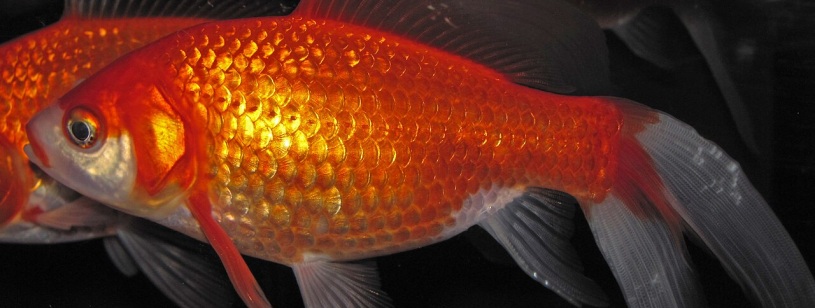
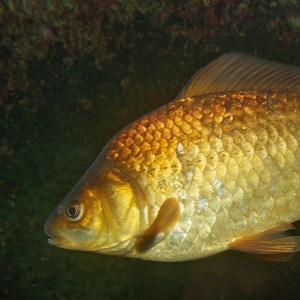
Goldfish (Carassius auratus) with orange scales. · James St. John / CC BY 2.0 (https://creativecommons.org/licenses/by/2.0). Cropped and resized. Source: https://commons.wikimedia.org/wiki/File:Carassius_auratus_auratus_(goldfish)_2.jpg
Goldfish (Carassius auratus) are freshwater fish domesticated in China and bred into many ornamental varieties. They can learn spatial tasks and live for more than a decade with appropriate care. Their colours and shapes reflect a long history of selective breeding.
Quick facts
| Common name | Goldfish |
| Scientific name | Carassius auratus |
| Lifespan | Around 10–15 years with good care; some live longer |
| Length | Often 15–20 cm; some forms exceed 30 cm |
| Diet | Plant material and small aquatic animals |
| Predators | Predatory fish and fish-eating birds in outdoor waters |
| Conservation status | Least Concern, according to the assessment cited by FishBase |
| Distribution | Asian origin; widely kept and introduced |
| Habitat | Quiet freshwater, managed ponds and suitable aquariums |
| Family | Cyprinidae |
| Behaviour | Social and capable of learning |
| Reproduction | Adhesive eggs deposited on vegetation or other surfaces |
- Primary category:Fish
- Explore this animal's categories:
Interesting facts
- Goldfish can learn to estimate swimming distances.
- Ornamental varieties belong to the same species.
- Small juveniles can grow into much larger adults.
- Domestication in China extends back more than a thousand years.
Records and extremes
RSPCA describes roughly 10–15 years with appropriate care, with some varieties reaching 30 years. Longevity depends on health and conditions.
USGS reports a maximum length of 59 cm, compared with the more frequent 15–20 cm range. Extreme measurements do not describe every ornamental variety.
Characteristics
Common goldfish have elongated bodies and single tails. Selective breeding has also produced rounded bodies, double tails and long fins. Colours include orange, red, white and black.
Goldfish lack the barbels found beside the mouths of carp and koi. They are related to Prussian carp but are a separate species.
Common, Comet and Fantail forms illustrate the range of body and tail shapes.
Behaviour
Goldfish explore, forage and interact socially. They can learn associations between signals and food.
Oxford researchers trained nine fish to swim 70 cm. Most continued estimating the distance after the turn cue was removed; altered wall patterns affected performance.
Another experiment allowed goldfish to control a wheeled platform by moving inside its water-filled tank. The animals learned to approach a visual target while remaining underwater.
Habitat and distribution
Domestic goldfish have Asian origins. Quiet freshwater with aquatic vegetation provides typical habitat, and ornamental keeping has spread them widely.
Housing should account for adult size, variety and group size. Active, elongated forms may require a suitably managed pond.
Filtration, water monitoring, swimming space and appropriate cover are essential. A small bowl makes these needs difficult to meet.
Diet and feeding
Goldfish eat algae, organic material, small crustaceans, worms and aquatic insects. They forage through the water and around the bottom.
Captive diets should use suitable foods and avoid excess leftovers. Uneaten material decomposes and contributes to poor water quality.
Reproduction and life cycle
Eggs are deposited in shallow vegetated water and fertilised externally. Males follow females during spawning, and adhesive eggs attach to plants or other surfaces.
Several batches may be produced during a season. Temperature and parental condition influence development.
Adults may eat eggs and fry, so early life stages need protection in managed breeding systems.
Name and history
Goldfish have undergone more than 1,000 years of domestication and selective breeding. A PNAS genomic study compared domestic varieties with wild relatives to investigate this history.
Selection produced distinctive pigmentation, bodies and fins. Exaggerated traits can also compromise swimming, vision or health in some varieties.
Conservation and threats
FishBase cites Least Concern for Carassius auratus. Captive welfare depends on suitable housing, water quality and health.
Released ornamental fish can establish introduced populations. Minnesota DNR documents sediment disturbance and competition with native animals.
Fish that can no longer be kept should be rehomed in suitable managed systems instead of released into natural waters.
Frequently asked questions
Do goldfish forget everything after three seconds?
Learning and navigation experiments contradict that claim. They can retain associations and spatial information.
Are koi and goldfish the same species?
They are different cyprinids; koi have barbels beside the mouth, while goldfish lack them.
Is a small bowl suitable?
Goldfish need swimming space, filtration and stable water conditions that a small bowl poorly provides.
Do all varieties have identical needs?
Elongated and rounded forms can differ in swimming ability and care requirements.
Why remove uneaten food?
Its decomposition contributes to deteriorating water quality.
Can a pet goldfish be released into a lake?
Release can damage ecosystems. Seek suitable rehoming in a managed aquarium or pond.