ScorpionInteresting facts and information
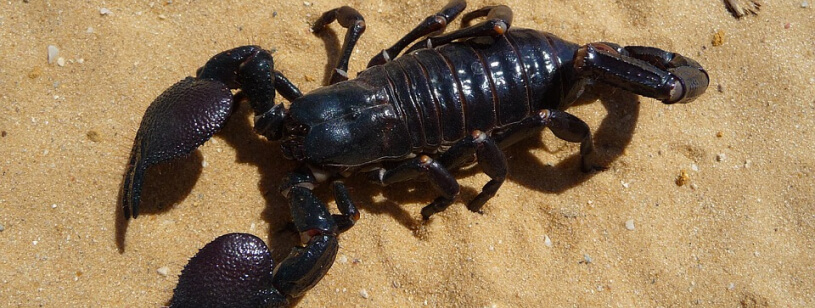
Scorpions are arachnids, related to spiders rather than insects. They have eight legs, grasping pincers and a venomous sting at the end of the abdomen. Females give birth to live young, which initially ride on their mother.
The effects of scorpion stings differ between species. Some can cause serious illness in people. Scorpions also feed on insects and other small animals.
Quick facts
| Common name | Scorpion |
| Scientific name | Scorpiones |
| Typical lifespan | Usually about 2-10 years; up to about 25 years in some species |
| Maximum speed | Usually slow; some desert species run short distances quickly |
| Size | About 1 cm - 23 cm (from tiny species to Heterometrus swammerdami) |
| Weight | Less than 1 g to about 30 g (depending on species) |
| Diet type | Carnivore (insects, spiders, small vertebrates) |
| Main predators | Owls, lizards, meerkats, centipedes, tarantulas, other scorpions |
| Conservation status | Assess separately by species and population; different taxa and regions have different needs |
| Geographical distribution | All continents except Antarctica |
| Habitat | Deserts, tropical forests, savannas, caves, rocky areas |
| Social behaviour | Mostly solitary, except during mating or care of the young |
| Special adaptations | Venom, tough outer skeleton, ability to survive without food for months |
- Primary category:Arachnids
- Explore this animal's categories:
Interesting facts
- Living without food - Some scorpions can survive for up to a year without eating, because their metabolism is very slow.
- They glow under ultraviolet light - Chemicals in their outer skeleton make scorpions glow blue-green under UV light; scientists still do not know exactly why.
- Tough survivors - In one experiment, scorpions frozen overnight walked away when they thawed the next day.
- Caring mothers - Females give birth to live young and carry them on their backs until the young are ready to live alone.
- Mostly harmless - Of about 2,700 species, only about 25-50 have venom strong enough to be dangerous to people.
- The most dangerous - Species such as the Indian red scorpion (Hottentotta tamulus) and the deathstalker (Leiurus quinquestriatus) have very powerful venom.
- The longest scorpion - The giant forest scorpion (Heterometrus swammerdami) of India and Sri Lanka can reach about 23 cm.
Records and remarkable features
- Scorpions are arachnids, related to spiders rather than insects. They have eight legs, grasping pincers and a venomous sting at the end of the abdomen. Females give birth to live young, which initially ride on their mother.
- An ancient group - Scorpions appeared more than 430 million years ago and were among the first animals to live on land.
- Giant ancestors - Some ancient scorpions, such as Pulmonoscorpius from Scotland, were about 70 cm long.
- The heaviest - The African emperor scorpion is one of the heaviest scorpions, weighing up to about 30 g.
Characteristics
Scorpions are tough survivors, with a hard outer skeleton, a segmented body and a venomous sting. These features make them among the most successful invertebrate predators.
Physical aspect
- Segmented body - It has a front part (cephalothorax) and a long abdomen, the back of which forms the "tail" with a sting at the tip.
- Strong pincers (pedipalps) - Used to catch and hold prey.
- Four pairs of legs - Adapted for walking on sand and rocks, and for climbing.
- A hard outer skeleton - Protects the body and reduces water loss, which is vital in deserts.
- Several eyes - Most scorpions have two eyes on top of the head and two to five pairs at the sides, but their eyesight is poor; they rely on feeling vibrations.
- The tail (metasoma) - Ends in a sting (telson) used for hunting and defence.
Special adaptations
- Fluorescence under ultraviolet light — substances in the outer skeleton can glow blue-green under UV illumination. This is different from producing light by bioluminescence.
- Saving water - Their waxy outer skeleton and efficient body let them live in very dry deserts.
- Sensing vibrations - Fine hairs on the legs and comb-like organs under the body, called pectines, sense movements and chemicals on the ground.
- Book lungs - Scorpions breathe through four pairs of "book lungs", made of thin, leaf-like layers.
Habits and behaviour
Most scorpions are solitary and nocturnal, spending the day hidden under rocks, in sand, under bark or in burrows.
Social behaviour
- Living alone - Most scorpions live and hunt alone, although a few species live in groups.
- Dangerous mates - After mating, the female sometimes attacks and eats the male.
- Mothers and young - The young ride on their mother's back until their first moult.
Survival Techniques
- Saving energy - Scorpions spend most of their time waiting motionless, which saves energy.
- Feeling vibrations - They detect prey and predators by the vibrations they make.
- Camouflage - Their colours help them blend in with sand, rocks and leaves.
- Saving venom - Scorpions often use only their pincers on small prey, saving venom for large prey or for defence.
Habitat and geographic distribution
Scorpions live on every continent except Antarctica and are found in some of the harshest habitats on Earth.
| Region | Example species | Habitat Preferred |
|---|---|---|
| North America | Arizona bark scorpion (Centruroides sculpturatus) | Deserts, rocky areas, houses |
| South America | Brazilian yellow scorpion (Tityus serrulatus), Bothriurus bonariensis | Grasslands, forests, towns |
| Africa | Emperor scorpion (Pandinus imperator), deathstalker (Leiurus quinquestriatus) | Rainforests, savannas, deserts |
| Asia | Giant forest scorpion (Heterometrus swammerdami), Chinese scorpion (Mesobuthus martensii) | Tropical forests, dry plains |
| Europe | European yellow-tailed scorpion (Euscorpius flavicaudis) | Rocky areas, old walls |
| Australia | Desert scorpion (Urodacus yaschenkoi) | Sandy deserts |
Types of Habitat
- Deserts - Species such as the deathstalker and the Arizona bark scorpion are adapted to extreme heat and drought.
- Tropical forests - The emperor scorpion and the giant forest scorpion live in warm, humid forests.
- Caves and mountains - Some species live in caves, and others high in the mountains.
Human Impact and Threats
- Habitat loss - Deforestation and urban growth destroy scorpion habitats.
- The pet trade - Species such as the emperor scorpion are collected for sale as pets.
- Fear - People often kill scorpions out of fear, even though most species are not dangerous.
- Climate change - May affect their food and habitats.
Diet and feeding
Scorpions are carnivorous predators that eat mainly insects and other invertebrates, and sometimes small vertebrates. They hunt at night, using their pincers and venom to catch prey.
What does the scorpion eat?
| Type of food | Example species |
|---|---|
| Insects (crickets, cockroaches, beetles, termites) | All species |
| Spiders and other arachnids | Many species |
| Other invertebrates (centipedes, worms, larvae) | Many species |
| Other scorpions | Many species, including their own kind |
| Small vertebrates (lizards, small snakes, young mice) | Large species, such as the emperor scorpion |
Feeding techniques
- Grabbing - The scorpion seizes its prey with its pincers.
- Stinging - It injects venom to paralyse or kill larger or struggling prey.
- Liquid meals - Scorpions cannot chew; they tear their prey with small mouthparts, cover it with digestive juices and suck up the liquid.
- Ambush - They wait hidden and attack prey that comes close.
Adaptation to Food Availability
- Scorpions can survive for months without food.
- When food is scarce, they lower their metabolism and use very little energy.
- In hard times, scorpions may eat other scorpions.
Reproduction and life cycle
Scorpions have an unusual way of reproducing: they give birth to live young, and mothers carry their babies on their backs.
| Characteristic | Details |
|---|---|
| Age of sexual maturity | About 1-3 years (some species longer) |
| Breeding season | Often in warm months |
| Type of reproduction | Live birth (the young develop inside the mother) |
| Number of young | About 5-100, depending on species |
| Pregnancy duration | Several months to more than a year |
| Care of the young | Carried on the mother's back until their first moult (about 1-3 weeks) |
| Life expectancy | Usually about 2-10 years; up to about 25 years in some species |
Mating
- A dance - The male holds the female's pincers and leads her in a "dance" that can last hours.
- The male drops a packet of sperm on the ground and guides the female over it so that she can take it up.
- The female carries her young on her back after birth and protects them.
Strategy for the survival of the young
- The mother protects her young from predators while they ride on her back.
- The young are very vulnerable until their first moult, when their outer skeleton hardens.
- If food is very scarce, mothers sometimes eat some of their young.
Name and history
Scorpions have been known since ancient times and appear in religious texts, myths and medicine.
Origin and etymology of the name
- The word "scorpion" comes from the Greek skorpios, through the Latin scorpio.
- The order name Scorpiones is used for all scorpions, a group more than 430 million years old.
Scorpion in the History of Humanity
- Ancient Egypt - The scorpion goddess Serket protected people from venomous bites and stings.
- Greek mythology - In one story, a giant scorpion killed the hunter Orion; both were placed in the sky as constellations, on opposite sides so that they never meet.
- The Bible - Scorpions appear as symbols of pain and danger.
- Medicine - Scorpions have long been used in traditional Chinese medicine, and scientists now study scorpion venom to develop new medicines.
Scorpion in Folklore and Superstition
- "The Scorpion and the Frog" - In this famous fable, a scorpion stings the frog carrying it across a river, even though both will drown, because "it is my nature".
- Protection - Amulets shaped like scorpions were used in ancient Egypt and the Middle East to ward off danger.
Cultural significance and mythology
Scorpions are feared and admired as symbols of danger, protection and death, and they appear in the stars, religions and stories of many cultures.
- The zodiac - Scorpio is one of the twelve signs of the zodiac, linked to the constellation Scorpius.
- Food - In some parts of China and Thailand, fried scorpions are eaten as street food, and scorpion wine is made in China.
- A world record - In 2009, the Thai performer Kanchana Ketkaew lived for 33 days in a glass room with over 5,000 scorpions.
Conservation status and threats
Most scorpions are not known to be threatened, but very few species have been assessed, and some are at risk from habitat loss and collection for the pet trade.
| Status | Species Affected | Affected Regions |
|---|---|---|
| Protected from overcollection (CITES Appendix II) | Emperor scorpion (Pandinus imperator) | West Africa |
| Protected from overcollection (CITES Appendix II) | Pandinus dictator, Pandinus gambiensis | West and Central Africa |
| Not assessed | Most of the world's scorpion species | Worldwide |
Main threats
- Habitat loss - Clearing forests and building on natural land destroy scorpion habitats.
- Collection - Some species are collected in large numbers for the pet trade.
- Killing out of fear - People kill scorpions even when they are harmless.
- Pollution and climate change - May harm their habitats.
Conservation efforts
- Protecting habitats - Protected areas help rare species.
- Trade rules - CITES controls the international trade in some species.
- Education - Teaching people that most scorpions are harmless and useful predators of insects.
In popular culture
- The Scorpion King (2002) - An action film starring Dwayne Johnson as a legendary warrior king.
- Mortal Kombat - Scorpion, a ninja with the famous cry "Get over here!", is one of the best-known video game characters.
- Scorpions - A famous German rock band, known for songs such as "Wind of Change".
- "The Scorpion and the Frog" - This fable is often quoted in films, such as The Crying Game (1992), to describe someone who cannot change their nature.