SwordfishInteresting facts and information
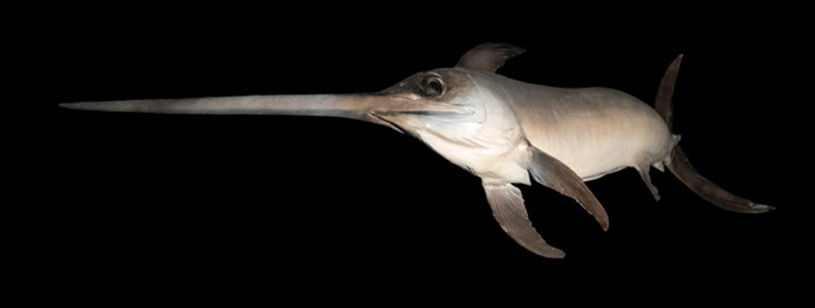
The swordfish (Xiphias gladius) is a large marine fish with a long, flattened bill. It hunts fish and squid and occurs across tropical and temperate oceans. It uses its bill to strike prey.
Adult swordfish have no scales, no teeth and no pelvic fins. They are powerful, fast swimmers and can dive to great depths, keeping their eyes and brain warm with a special heater organ.
The swordfish has long been prized by fishermen. Some stocks were heavily overfished in the past, and today swordfish fishing is managed with quotas and other rules.
Quick facts
| Common name | Swordfish |
| Scientific name | Xiphias gladius |
| Typical lifespan | Usually 9 - 15 years |
| Maximum speed | Very fast; often quoted figures of about 100 km/h are not reliably measured |
| Size | Commonly about 1.2 - 3 metres; up to about 4.5 metres |
| Weight | Commonly about 50 - 200 kg; up to about 650 kg |
| Diet type | Carnivorous (fish, cephalopods) |
| Main predators | Large sharks, orcas, humans (fishing) |
| Conservation status | Least Concern (IUCN); some stocks have been overfished |
| Distribution | Tropical and temperate parts of the Atlantic, Pacific and Indian Oceans and the Mediterranean |
| Habitat | Open ocean, from the surface to depths of several hundred metres or more |
- Primary category:Fish
- Explore this animal's categories:
Interesting facts
- A fast fish - Swordfish are powerful, fast swimmers; speeds of about 100 km/h are often quoted, but they have never been reliably measured.
- A built-in heater - Swordfish have a special organ that warms their eyes and brain up to about 10-15 °C above the temperature of the water, helping them see well in cold, deep water.
- Hunting with the "sword" - The swordfish slashes its bill sideways through schools of fish and squid, stunning or injuring its prey.
- No scales or teeth as adults - Young swordfish have scales and teeth, but adults lose them, and they also have no pelvic fins.
- Leaping out of the water - Swordfish sometimes leap completely out of the water, possibly to get rid of parasites.
Records and remarkable features
- The swordfish (Xiphias gladius) is a large marine fish with a long, flattened bill. It hunts fish and squid and occurs across tropical and temperate oceans. It uses its bill to strike prey.
- Swordfish bills have been found stuck in the wooden hulls of ships, and in 1967 a swordfish attacked the research submarine Alvin.
Characteristics
The swordfish is a large ocean predator with a streamlined body and a long, flat bill shaped like a sword.
Main physical characteristics:
| Characteristic | Details |
|---|---|
| Body shape | Long, rounded and streamlined |
| Size | Commonly about 1.2-3 metres; up to about 4.5 metres |
| Weight | Commonly about 50-200 kg; up to about 650 kg |
| Colour | Dark purplish-brown or blue-black back, lighter belly |
| Fins | Tall, rigid first dorsal fin; crescent-shaped tail; no pelvic fins |
| Bill ("sword") | Long and flat; about a third of the total length |
| Eyes and brain | Kept up to about 10-15 °C warmer than the surrounding water |
| Teeth and scales | Absent in adults |
Special adaptations:
- The "sword" - It is not used to spear prey but to slash it, like a club.
- Fast swimming - Its streamlined body and large, crescent-shaped tail make it one of the fastest fish.
- A heater organ - A special tissue next to the eyes produces heat and keeps the eyes and brain warm.
- Huge eyes - Its eyes, as large as oranges in big fish, help it see in dark, deep water.
Habits and behaviour
The swordfish is a solitary predator that travels long distances and moves up and down in the water each day.
Social behaviour:
- Mostly solitary - Swordfish usually live alone, although several may gather where food is plentiful.
- No territory - They do not defend a fixed area and move widely in search of food.
- Daily migrations - They often spend the day in deep water and come up towards the surface at night.
Feed and hunting techniques:
- Predators - They feed on fish and squid.
- Using the sword - They slash their prey and then swallow it whole.
- Deep hunting - By day they can hunt at depths of several hundred metres, sometimes more than 1,000 metres.
Self-defense and survival:
- Speed and power - Adults have few predators apart from large sharks and orcas.
- Countershading - Their dark back and paler belly make them harder to see.
- Leaping - Swordfish sometimes leap out of the water, perhaps to get rid of parasites.
Habitat and geographic distribution
The swordfish is a pelagic fish: it lives in the open ocean, mostly in tropical and temperate waters, and sometimes enters cold waters.
Habitats:
| Habitat | Who lives there |
|---|---|
| Warm surface waters | Young swordfish and adults at night |
| Deep water (several hundred metres) | Adults hunting during the day |
| Temperate and tropical areas | The largest populations |
| Open seas and oceans | Swordfish of all ages |
Geographical distribution:
- Atlantic, Pacific and Indian Oceans - Swordfish are found worldwide in tropical and temperate seas, including the Mediterranean.
- Water temperature - They are most common in waters of about 18-22 °C at the surface, but can dive into much colder water.
- Seasonal movements - Many swordfish move to cooler waters in summer to feed and to warmer waters to spawn.
Impact of climate change and human activities:
- Ocean warming - Can change migration routes and spawning areas.
- Fishing - The swordfish is an important commercial fish, and some stocks have been heavily overfished in the past.
- Mercury - Large swordfish build up mercury in their bodies, so pregnant women and children are advised not to eat them.
- Bycatch - Longlines set for swordfish also catch turtles, sharks and seabirds, and swordfish are caught in fisheries for other species.
Diet and feeding
The swordfish is a top predator in the open ocean. It feeds mainly on fish and squid, which it hunts at different depths.
Food types consumed:
| Food type | Examples |
|---|---|
| Pelagic fish | Mackerel, herring, hake, barracudas, young tuna |
| Cephalopods | Squid, sometimes octopus |
| Crustaceans | Shrimps (occasionally) |
Method of feeding:
- Opportunistic hunter - It eats whatever suitable prey is available.
- Slashing with the sword - The swordfish strikes prey with sideways movements of its bill, injuring or stunning it.
- Hunting at different depths - By day it hunts in deep water, and at night it hunts closer to the surface.
- Speed - Its speed and quick reactions help it catch fast prey.
As a large predator, the swordfish helps keep populations of fish and squid in balance.
Reproduction and life cycle
Swordfish spawn in warm waters, releasing eggs and sperm into the sea, where fertilisation takes place.
Life cycle stages:
| Stage | Approximate duration | Characteristics |
|---|---|---|
| Spawning | Seasonal, or all year in the tropics | Females release millions of eggs in several batches. |
| External fertilisation | Minutes | The eggs are fertilised in the water and float near the surface. |
| Planktonic larvae | Several weeks | Tiny larvae, only a few millimetres long, feed on plankton and soon on other larvae. |
| Juvenile | Months to years | Young swordfish already have a long bill and grow quickly. |
| Sexual maturity | About 4-5 years (females) | The swordfish becomes able to reproduce. |
| Lifespan | Usually 9-15 years | Females grow larger and live longer than males. |
Reproductive behaviour:
- Warm-water spawning - Swordfish spawn in tropical and subtropical waters where the surface temperature is high.
- Many eggs - A large female can produce millions of eggs a year.
- Fast growth - Young swordfish grow quickly in their first years.
Thanks to fast growth and high numbers of eggs, swordfish stocks can recover when fishing is well managed.
Name and history
The swordfish has been hunted by people since ancient times, for its size, strength and tasty meat.
Origin and etymology of the name:
- "Swordfish" - The name comes from its long, sword-like bill.
- The scientific name is Xiphias gladius: xiphias comes from the Greek word for sword, and gladius is the Latin word for sword.
Taxonomic classification:
| Taxonomic category | Name |
|---|---|
| Kingdom | Animalia |
| Phylum | Chordata |
| Class | Actinopterygii |
| Order | Istiophoriformes (billfishes; formerly placed in Perciformes) |
| Family | Xiphiidae |
| Genus | Xiphias |
| Species | Xiphias gladius |
Swordfish in history and culture:
- Ancient times - Greek and Roman writers described swordfish fishing with harpoons in the Mediterranean.
- The Strait of Messina - Fishermen in Sicily and Calabria still hunt swordfish with harpoons from special boats with tall lookout masts.
- Relatives - The swordfish's closest relatives are the marlins, sailfish and spearfish, the other billfishes.
- Modern fishing - In the 20th century, longline fishing greatly increased swordfish catches.
The swordfish remains one of the most admired ocean predators, but it needs careful management.
Cultural significance and mythology
The swordfish has long been a symbol of strength and speed, especially in the fishing traditions of the Mediterranean.
Swordfish in traditions and popular beliefs:
- The Strait of Messina - Swordfish hunting with harpoons is an old tradition, linked with songs, rituals and local festivals.
- Ancient writers - Aristotle and other ancient authors wrote about the swordfish and its parasites.
- Sport fishing - The swordfish is one of the most prized big-game fish because of its size and strength.
Swordfish symbolism:
- Strength and speed - The swordfish is associated with power and agility.
- Endurance - Its long migrations make it a symbol of endurance.
- The sword - Its bill makes it a symbol of combat in maritime art.
Conservation status and threats
The swordfish is not globally threatened, but some stocks have been heavily overfished, and fishing must be carefully managed.
Conservation status
| Region | Status |
|---|---|
| Global | Least Concern (IUCN) |
| North Atlantic | Overfished in the past; rebuilt under fishing quotas by the late 2000s |
| Mediterranean | Overfished for many years; under a recovery plan |
| Pacific and Indian Oceans | Status varies between stocks |
Main threats:
- Overfishing - Swordfish are caught in large numbers for the global seafood market.
- Catching young fish - Many swordfish are caught before they have had a chance to breed.
- Mercury - Swordfish build up mercury, which affects their value as food for people.
- Climate change - Ocean warming may change their migrations and spawning areas.
Conservation efforts:
- Fisheries management in the Atlantic involves the International Commission for the Conservation of Atlantic Tunas (ICCAT), whose work also includes swordfish. Measures vary by stock, area and date.
- Minimum sizes and closed seasons - Help protect young fish and spawning periods.
- Sustainable fishing - Certification programmes, such as the Marine Stewardship Council, encourage better fishing practices.
- Research - Satellite tags show how swordfish move and dive.
Good management has helped some swordfish stocks recover, but others still need careful monitoring.
In popular culture
The swordfish often appears in books, films and art as a symbol of the power of the ocean.
Swordfish in literature:
- "The Perfect Storm" (Sebastian Junger, 1997) - A book about the swordfishing boat Andrea Gail, lost in a storm in 1991; it was made into a film in 2000.
- "The Old Man and the Sea" (Ernest Hemingway, 1952) - The giant fish in this famous story is a marlin, a close relative of the swordfish.
Swordfish in cinematography and television:
- "The Perfect Storm" (2000) - The film follows the crew of a swordfishing boat.
- Nature documentaries show swordfish hunting in the deep ocean.
Swordfish as a cultural symbol:
- Speed and agility - The swordfish appears in logos and names of sports teams and brands.
- Sport fishing - It is one of the most sought-after species in big-game fishing.
- Art - The swordfish appears in sculptures, paintings and nautical decorations.