Western capercaillieTetrao urogallus — habitat, diet and reproduction
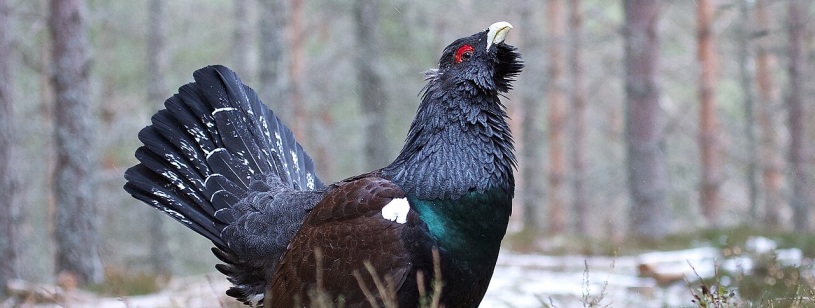
Male western capercaillie (Tetrao urogallus) displaying. · Simon Bailey / CC BY 2.0 (https://creativecommons.org/licenses/by/2.0). Cropped and resized.
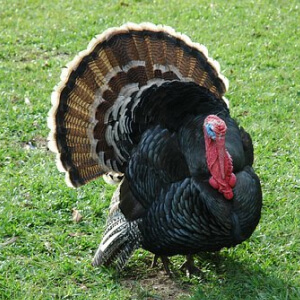
The western capercaillie is a large bird of conifer forests, a wild relative of the chicken. The black male, with red eyebrows, can weigh as much as a small turkey. In spring, at dawn, males gather in clearings for a courtship display.
Quick facts
| Common name | Western capercaillie |
| Scientific name | Tetrao urogallus |
| Lifespan | A few years in the wild; few exceed 10 years |
| Length | Male about 74–85 cm, rarely up to 100 cm; female about 54–63 cm |
| Weight | Male about 4 kg on average, at most about 6.7 kg; female about 1.5–2.5 kg |
| Diet | Herbivore: conifer needles, buds, bilberries; chicks eat insects |
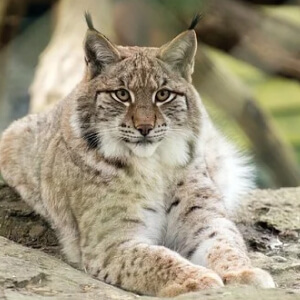
| Predators | Foxes, martens, lynx, golden eagles; wild boar at nests |
| Conservation status | Least Concern (LC) globally; declining in Europe |
| Distribution | Northern and central Europe, European mountains, Siberia |
| Habitat | Old conifer forest with bilberry |
| Family | Phasianidae |
| Nest | On the ground, under trees or shrubs |
- Primary category:Birds
- Explore this animal's categories:
Interesting facts
- The male is twice the size of the female.
- In winter it can survive almost entirely on pine and spruce needles.
- During part of its song, the male hears poorly for a few seconds.
- In winter, horny fringes grow on its toes, helping it walk on snow.
Characteristics
The male has blackish-grey plumage, a metallic green breast, red eyebrows and a strong pale bill. Its long tail can fan out.
The female is much smaller, with mottled rusty-brown plumage that hides her on the nest and an orange breast patch. Both sexes have feathered legs.
Behaviour
In spring, before dawn, males gather at display grounds called leks. They raise their tails, puff out their throats and give a strange song of clicks, a cork-popping sound and a grinding wheeze.
Females visit the lek and choose a male. Males may fight fiercely for the best spots. The rest of the year the bird is discreet, staying on the ground or feeding in trees in winter.
Habitat and distribution
The species lives in conifer forests across northern Europe and Siberia. In central and southern Europe it survives mainly in mountains: the Alps, Pyrenees and Carpathians.
In Romania it lives in old spruce and mixed forests in the Carpathians, usually above 1,000 m. It needs quiet forests with old trees and bilberry-rich clearings.
Diet and feeding
In summer it eats leaves, flowers, buds and berries, especially bilberries. In winter it feeds almost only on pine and spruce needles, digested with a very long gut.
It swallows grit to help grind food. Chicks first eat many insects, especially ants and caterpillars, which are rich in protein.
Reproduction and life cycle
The female nests on the ground in a simple scrape hidden under low branches or by a trunk. She usually lays 5–12 eggs and incubates alone for about four weeks.
Chicks can walk and feed themselves soon after hatching, guided and warmed by the female. Cold, wet weather kills many chicks in their first weeks.
Name and history
The scientific name Tetrao urogallus comes from Latin: “tetrao” was a name for a similar bird, and “urogallus” can be translated as “wild cock”.
Males were once highly prized hunting trophies, and the spring display features in many Carpathian hunting stories.
Conservation and threats
The species is assessed globally as Least Concern thanks to large populations in Russia and Scandinavia. In central and western Europe it has vanished from many regions or become very rare.
Threats include felling of old forests, forest roads, disturbance of leks by visitors and predators favoured by people. In the European Union it is listed in Annex I of the Birds Directive, which requires protection of its habitats.
Frequently asked questions
Where does the capercaillie live in Romania?
In old spruce and mixed forests in the Carpathians, usually above 1,000 m.
What is a lek?
A display ground where males perform at dawn in spring, with fanned tails and a song of clicks and pops.
How much does a capercaillie weigh?
Males average about 4 kg, the largest up to about 6.7 kg; females only 1.5–2.5 kg.
What does it eat in winter?
Almost only pine and spruce needles picked from trees.