CaracalCaracal caracal — habitat, diet and reproduction
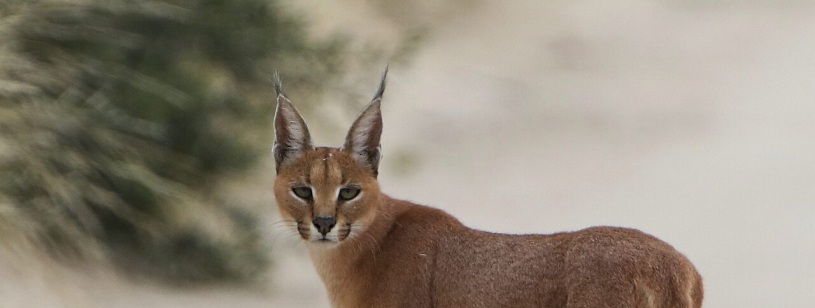
Caracal with reddish fur and long black tufts at the tips of its ears. · Derek Keats / Wikimedia Commons / CC BY 2.0 (https://creativecommons.org/licenses/by/2.0/). Cropped and resized. Source: https://commons.wikimedia.org/wiki/File:Caracal_on_the_road,_early_morning_in_Kgalagadi_(36173878220).jpg
The caracal (Caracal caracal) is a wild cat recognised by long black ear tufts. Its reddish coat, long legs and slender body suit stealthy hunting. It captures mammals and birds with powerful leaps. Its range spans Africa and parts of Asia.
Quick facts
| Common name | Caracal |
| Scientific name | Caracal caracal |
| Lifespan | Can reach around 12 years in the wild; more than 20 years documented in captivity |
| Length | 61–106 cm head and body, plus a roughly 20–34 cm tail |
| Weight | Females around 6–16 kg; males 8–20 kg |
| Diet | Small and medium mammals, birds and other animals |
| Predators | Lions, leopards and hyenas where ranges overlap |
| Conservation status | Least Concern globally; regional situations vary |
| Distribution | Africa, the Middle East and parts of Asia to India |
| Habitat | Savanna, scrub, dry woodland, rocky country and semi-desert |
| Family | Felidae |
| Reproduction | Usually 1–3 kittens; gestation approximately 68–81 days |
- Primary category:Felids
- Explore this animal's categories:
Interesting facts
- Its name comes from a Turkish term meaning black-eared.
- Strong hindquarters power leaps after birds.
- Adults generally hunt alone, and females raise the young.
- Research in Cape Town tracks how caracals use urban-edge landscapes.
Records and extremes
San Diego Zoo describes leaps reaching around 3 m. Powerful hind legs allow a caracal to strike at a bird taking flight.
AnAge records a captive female that reached 20.3 years. Reliable lifespan data from wild populations are more limited.
Characteristics
The short coat varies from sandy to reddish, with a paler, sometimes spotted underside. Black-and-white facial markings frame the eyes and muzzle.
Long black tufts extend the ears. Their precise role remains debated, with visual communication a leading explanation. Males are generally larger.
Although sometimes called a desert lynx, the caracal belongs to Caracal rather than Lynx.
Behaviour
Usually solitary, caracals mark territories with scent and scratches. Meows, growls and other calls also convey information.
Activity often peaks at night or dusk, though quiet areas and cool weather allow daytime hunting. Dense vegetation, rock crevices and abandoned shelters provide resting places.
Mostly terrestrial, they can also climb. A quiet stalk ends in a leap or short chase.
Habitat and distribution
The range extends through much of Africa and the Middle East towards Central Asia and India. Distribution is uneven, with many Asian populations scarce.
Savannas, scrub, dry woods and rocky hills provide cover. Extreme desert and dense tropical rainforest are generally avoided.
Around Cape Town, reserves, vineyards and other edge habitats are used. Connections between habitat patches support movement, while roads can interrupt routes.
Diet and feeding
Rodents, hares, hyraxes, small antelope and birds form the diet, varying by region. Reptiles and other small animals are occasional prey.
Mammals remain important despite the caracal’s reputation for catching birds. A stealthy approach and short attack secure prey, sometimes larger than the cat.
Occasional livestock predation creates conflict, while rodent consumption forms part of its ecological role.
Reproduction and life cycle
A female chooses an abandoned burrow or sheltered cavity. Gestation lasts around 68–81 days, with 1–3 kittens common in the wild.
Newborns have closed eyes and depend on their mother. Meat is introduced after the first weeks while nursing continues. Play and following the mother help develop hunting skills.
Independence comes towards one year. Males generally take no part in raising kittens.
Name and history
Johann Christian Daniel von Schreber described the species in 1776 as Felis caracal. Its current name is Caracal caracal.
In India and Persia, caracals were historically trained to hunt birds. Their jumping ability was valued, though they remain wild animals with specialised needs.
Conservation and threats
The global classification is Least Concern. Some African populations are relatively numerous, whereas many Asian populations are rare.
Habitat loss, prey depletion and retaliation over livestock threaten local populations. Urban areas add roads, traps and dogs.
University of Cape Town research has documented exposure to rodent poisons through contaminated prey. Habitat connections and reduced conflict support coexistence.
Frequently asked questions
Is it a type of lynx?
It belongs to Caracal, a separate genus from Lynx.
How high can it jump?
Zoological sources describe leaps of up to approximately 3 m.
What are the ear tufts for?
Their precise role is debated, but visual communication is a leading explanation.
Does it eat only birds?
Mammals such as rodents, hares and small antelope are important foods.
Does it hunt only at night?
Daytime activity also occurs, depending on temperature and disturbance.
Is it threatened?
It is globally Least Concern, but some regional populations are rare and declining.