House dust mitesDermatophagoides spp. — habitat, diet and reproduction
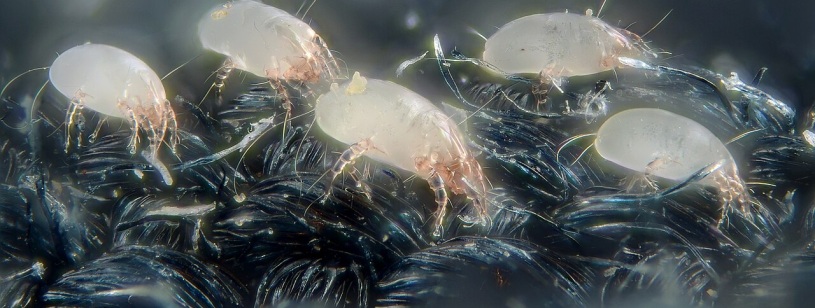
Dermatophagoides pteronyssinus photographed through a light microscope, greatly enlarged. · Gilles San Martin from Namur, Belgium / CC BY-SA 2.0 (https://creativecommons.org/licenses/by-sa/2.0). Cropped and resized.
House dust mites are tiny arachnids living among dust particles and textile fibres. Species of Dermatophagoides feed mainly on microscopic flakes of shed skin. They do not bite people, but proteins in their bodies and waste can trigger allergic reactions in susceptible individuals.
Quick facts
| Common name | House dust mites |
| Scientific group | Dermatophagoides spp.; photograph shows D. pteronyssinus |
| Typical lifespan | Around two months, depending on species and conditions |
| Diet | Detritivore; mainly shed skin flakes |
| Conservation context | Common indoor organisms; this article covers several species |
| Distribution | Homes across many world regions |
| Habitat | Mattresses, textiles and upholstery, especially in humid conditions |
| Length | Around 0.3 mm; usually below 0.5 mm |
| Class | Arachnida |
| Legs | Adults have eight legs |
| Reproduction | Eggs and juvenile stages |
| Relationship with people | Do not bite; can produce allergens |
- Primary category:Arachnids
- Explore this animal's categories:
Interesting facts
- A dust mite is much smaller than one millimetre.
- Adults have eight legs rather than the six of insects.
- Their main food includes shed skin, not blood.
- Allergens can remain in dust after a mite dies.
Characteristics
The small oval body is pale, with fine surface markings visible under magnification. Dust mites have no wings.
At around 0.3 mm long, their details are difficult to see unaided. Microscope photographs greatly enlarge the animals and do not show life size. Mites are arachnids, as are spiders, but not every mite is a house dust mite: other groups have different diets, hosts and relationships with people.
Behaviour
Dust mites move among fibres and particles that provide many small shelters. They neither jump nor fly. Moisture is important, and warm humid places with food can support more mites than dry exposed surfaces.
They cannot be identified from a supposed bite mark because they do not bite. Itching or sneezing alone also cannot establish their involvement; many factors cause similar symptoms.
Habitat and distribution
Mattresses, bedding, upholstery and some carpets provide food and refuge. Frequently used areas accumulate organic particles, including shed skin cells.
Indoor conditions matter beyond the mere presence of dust. Humidity, temperature and furnishings affect the habitat. These organisms occur in homes across many regions, but an ordinary photograph of dust cannot automatically identify a speck as a mite.
Diet and feeding
The main food includes flakes of skin shed by people and animals. Other microscopic materials, including pollen and fungal spores, may also be consumed.
Unlike blood-feeding or skin-burrowing parasites, house dust mites use organic material in their surroundings. This contributes to the breakdown of fine debris. Their health significance comes from allergenic proteins rather than attacks on skin during feeding.
Reproduction and life cycle
Females lay eggs that produce juvenile stages. Development involves changes and moults before adulthood. Under favourable conditions, reaching adulthood can take approximately one month. Lifespan is measured in months but varies with species and surroundings.
A population may contain eggs, juveniles and adults together. Living mite numbers are not the same as allergen levels: body fragments and waste can persist after the animals die.
Name and history
The common name refers to their household habitat. Dermatophagoides is a genus, and Dermatophagoides pteronyssinus is the species pictured here.
Research into household dust helped establish links with some allergies. Scientists can measure allergenic proteins in samples without seeing each animal separately. Although all mites are arthropods, differences between their groups matter when discussing food and effects on people.
Conservation and threats
For household dust mites, the main concern is their relationship with indoor environments and allergic individuals. Proteins in bodies, secretions and waste can trigger symptoms in susceptible people.
Reducing dampness and regularly caring for textiles can limit suitable habitat and allergen accumulation. Completely removing every mite from a home is unrealistic. Persistent symptoms warrant medical assessment to identify their cause; these animals are not biting or stinging insects.
Frequently asked questions
Do house dust mites bite?
No. They can produce allergens but do not bite or feed on blood.
Can they be seen without magnification?
They are very small, usually below 0.5 mm, and details require magnification.
What do they eat?
Mainly already-shed skin flakes and other microscopic material.
Do allergens disappear when a mite dies?
Not immediately. Allergenic proteins can remain in body fragments and waste in dust.