TermiteInteresting facts and information
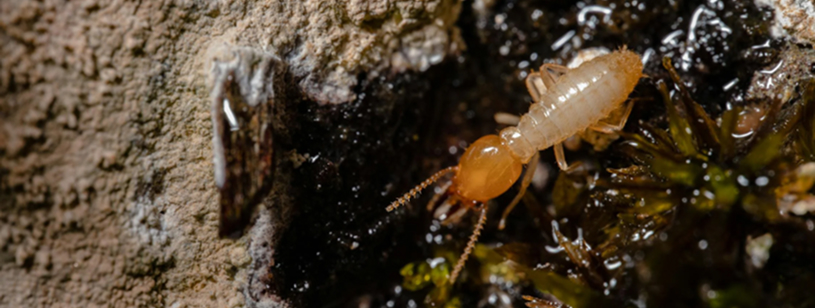
Termites are highly organized social insects known for their ability to consume and digest wood due to the symbiotic microorganisms in their digestive system. Although they are often considered pests, they play an essential role in the ecosystem, helping to break down dead plant matter and recycle nutrients into the soil.
Termites live in complex colonies, where each individual has a well-defined role. Large colonies can contain millions of individuals and survive for decades.
Over time, these insects have influenced ecosystems and even human architecture, as some species build impressive mounds of earth, while others can cause significant damage to wooden buildings.
Quick facts
| Common name | Termite |
| Scientific name | Isoptera, a termite group within the order Blattodea |
| Typical lifespan | Months to a couple of years (workers and soldiers); 20 years or more (queens of some species) |
| Length | About 4-15 mm (workers); up to about 100 mm (queens of some species) |
| Weight | A few milligrams (workers); several grams (large queens) |
| Diet type | Plant-based material; diets can include wood, grass, leaf litter, soil organic matter or cultivated fungi, depending on species |
| Main predators | Ants, birds, lizards, aardvarks, aardwolves, pangolins, chimpanzees |
| Conservation status | Varies by species; termites do not have a single group-wide conservation status |
| Distribution | Every continent except Antarctica, especially tropical and subtropical regions |
| Living environment | Forests, savannas, deserts, temperate regions, buildings |
- Primary category:Insects
- Explore this animal's categories:
Interesting facts
- An ancient lineage – Termites evolved from cockroach ancestors. Their history extends back to the age of dinosaurs; the oldest known termite fossils are about 130 million years old.
- Long-lived queens – Termite queens are among the longest-lived insects; in some species they live for 20 years or more and lay millions of eggs.
- Giant mounds – Some African termites build mounds up to about 8 metres high, home to millions of termites.
- A division of labour – Workers build, clean and feed the others, soldiers defend the colony, and the king and queen produce the young.
- Important for soil – Termites recycle dead plant matter and mix and aerate the soil with their tunnels.
Records and remarkable features
- A giant mound field – In north-eastern Brazil, an area of about 230,000 km² is covered with around 200 million regularly spaced termite mounds; some are about 4,000 years old.
- Tall mounds – Some termite species build mounds several metres tall; height varies with species and environment.
- Very productive queens – A queen of some large African species can lay tens of thousands of eggs a day.
- Drywood termites can live inside completely dry wood, without contact with the soil.
- A serious pest – The Formosan subterranean termite (Coptotermes formosanus) forms huge colonies and can cause major damage to wooden buildings.
Physical characteristics and adaptations
Termites are small social insects with bodies adapted to life in dark tunnels, nests and wood. Although they look a little like ants, they are closely related to cockroaches.
Key physical adaptations
- A soft, pale body – Workers are usually soft and whitish, and they need humid conditions to avoid drying out.
- Strong jaws – Workers use their jaws to chew wood and other plant material.
- Sensitive antennae – Used for smell, touch and chemical communication.
- Specialised soldiers – Soldiers have large, hard heads with powerful jaws, or a nozzle that sprays sticky or toxic fluid at enemies.
- A giant queen – In some species, the queen's swollen abdomen makes her up to about 10 cm long, many times larger than a worker.
Differences between castes
| Category | Characteristics |
|---|---|
| Workers | Small, pale, wingless and usually blind; gather food, build and care for the young |
| Soldiers | Large heads with powerful jaws or a chemical-spraying nozzle; defend the colony |
| Queen | Huge abdomen; in some species lays thousands of eggs a day |
| King | Stays with the queen for life and mates with her regularly |
| Winged termites (alates) | Winged reproductive forms disperse to establish colonies; wings are shed after the flight |
Habits and behaviour
Termites are social insects that live in colonies with a clear division of labour and complex communication.
Daily life
- They live underground, in wood or in mounds built from soil, saliva and droppings.
- Each member of the colony has a role, depending on its caste.
- Most avoid light and dry air and stay inside their nests and tunnels.
Communication and organization
- They use pheromones to mark trails to food, raise the alarm and recognise nestmates.
- Soldiers bang their heads against the tunnel walls, sending vibrations that warn the colony of danger.
- Workers and soldiers cannot survive for long outside the colony.
Survival strategies
- Staying hidden – Living inside nests and tunnels protects them from predators and drying out.
- Chemical defence – Soldiers of some species spray a sticky liquid that traps attackers such as ants.
- Covered tunnels – When they need to cross open surfaces, termites build mud tubes to stay hidden.
Habitat and geographic distribution
Termites live on every continent except Antarctica. They are most common in warm, humid regions, but some species live in dry areas.
Distribution context
| Region | Population information | Habitat examples |
|---|---|---|
| South America | Very many species | Tropical forests, savannas |
| Africa | Very many species, including mound-builders | Savannas, equatorial forests |
| Southeast Asia | Many species | Rainforests and wetlands |
| North America | Mainly in the south | Warm and temperate regions |
| Europe | Few species, mainly in the south | Mediterranean woodland, buildings |
| Australia | Many species, including mound-builders | Tropical savannas and deserts |
Habitat types
- Tropical forests – Many species live where there is plenty of rotting wood and leaf litter.
- Savannas and dry regions – Here termites build large earth mounds.
- Houses and wooden structures – Some species live alongside people and can become serious pests.
Environmental change
- Deforestation changes termite communities, and forest species are replaced by others.
- Warmer temperatures may allow some pest termites to spread to new areas.
- Global trade has carried pest termites, such as the Formosan subterranean termite, to many countries.
Diet and feeding
Termites are detritivores: they feed mainly on wood and other dead plant material containing cellulose. They play an important role in breaking down dead plants and recycling nutrients.
What do termites eat?
| Food group | Examples |
|---|---|
| Dead and rotten wood | Fallen trunks, dead roots |
| Wooden structures | Buildings, furniture, fences |
| Dry leaves and grass | Dead vegetation and leaf litter |
| Paper and cardboard | Cellulose-based products |
| Soil and dung | Some species eat organic matter in soil or herbivore dung |
How can termites digest wood?
Termite digestion involves enzymes and symbiotic microorganisms. Different termite groups have different digestive partners; not all depend on the same protozoa.
Feeding methods
- Workers share food with other colony members through trophallaxis, which can involve mouth-to-mouth or other food exchanges.
- Fungus-growing termites, mainly in Africa and Asia, grow fungus gardens on chewed plant material inside their nests and eat the fungus.
- Some species collect grass and store it in their nests.
Reproduction and life cycle
A termite colony is founded by a king and a queen. In large species, a mature colony can contain millions of termites and last for decades.
Mating season
- In mature colonies, winged termites (called alates) leave the nest to form new colonies.
- After a dispersal flight, a male and female usually shed their wings, pair and begin a new nest.
- A colony usually begins with a queen and king. Some species can also produce replacement or additional reproductives.
Developmental stages
| Stage | Duration | Characteristics |
|---|---|---|
| Egg | Varies with species and conditions | Laid by the queen, often in large numbers |
| Early immature stage | Varies with species and conditions | Goes through several moults |
| Later immature stage | Varies with species and developmental pathway | Development can lead to worker, soldier or reproductive roles, depending on the species |
| Adult | Lifespan varies by species and colony role | Workers and soldiers usually live from months to a couple of years; the queen can live for decades |
Survival strategies
- The reproductive response to colony losses depends on the species and the colony’s condition.
- Some termites can develop replacement reproductives if the original queen or king is lost.
Name and history
Origin of the name
- The word "termite" comes from the Latin termes, meaning "woodworm".
- Termites are sometimes called “white ants”, but they belong to the cockroach lineage rather than the ant family.
Taxonomic classification
| Classification | Name |
|---|---|
| Kingdom | Animalia |
| Phylum | Arthropoda |
| Class | Insecta |
| Order | Blattodea |
| Infraorder | Isoptera |
Evolution and fossils
- Termites evolved from cockroach ancestors, probably during the Jurassic or Cretaceous; they are not known from 250-million-year-old termite fossils.
- They are close relatives of cockroaches, not ants; their closest living relatives are wood-eating cockroaches.
- There are about 3,000 known species of termites.
Cultural significance and mythology
People have long seen termites both as destructive pests and as admirable examples of teamwork and building skill.
Termites in myth and symbolism
- Destruction and time – Because they can destroy buildings, books and valuables, termites are often linked with decay.
- Food – In many parts of Africa, Asia and South America, winged termites are collected and eaten as a nutritious food.
- Building material – In Africa, soil from termite mounds has been used to make bricks, plaster and pottery.
- Tool use by chimpanzees – In 1960, Jane Goodall saw chimpanzees "fishing" for termites with twigs, one of the first records of tool use by an animal other than humans.
Conservation status and threats
Some termite species are serious pests, but most are harmless and important for natural ecosystems. Habitat loss affects termite communities in many tropical regions.
Main pressures
- Deforestation and habitat loss – In tropical regions, forest destruction affects the termites that help break down plant matter.
- Pesticides – Termite control in towns and on farms kills termites and can harm other animals.
- Climate change – Changes in temperature and rainfall can affect colonies and their life cycles.
Ecological benefits
- They help break down dead wood and plants, returning nutrients to the soil.
- Their tunnels aerate the soil and help rainwater soak in.
- They are food for many animals, including birds, ants, aardvarks, aardwolves and pangolins.
Protective measures
- Protecting natural forests and savannas, which support many termite species.
- Reducing pesticide use and using targeted control methods only where termites cause damage.
- Research on how termites improve soil and help crops in dry regions.
Termites in popular culture
As some of the best-organised insects, termites have inspired books, films and even architecture.
Termites in literature
- "The Soul of the White Ant" (1925) – A book by the South African writer Eugène Marais, who described the termite colony as a single living organism.
- "The Life of the Termite" (1926) – A book by the Belgian writer Maurice Maeterlinck.
Termites in movies and animations
- "Antz" (1998) – In this animated film about ants, the ant army fights a battle against termites.
Termites as a source of inspiration
- Architecture inspired by nature – Termite mounds have influenced ideas about building ventilation, for example in the Eastgate Centre in Harare, Zimbabwe. Engineered buildings use their own systems, and the comparison is not an exact copy of a mound.
- Termite-inspired robots – Researchers have built small robots that follow simple termite-like rules to build structures without central control.