Stick insectPhasmatodea — habitat, diet and reproduction
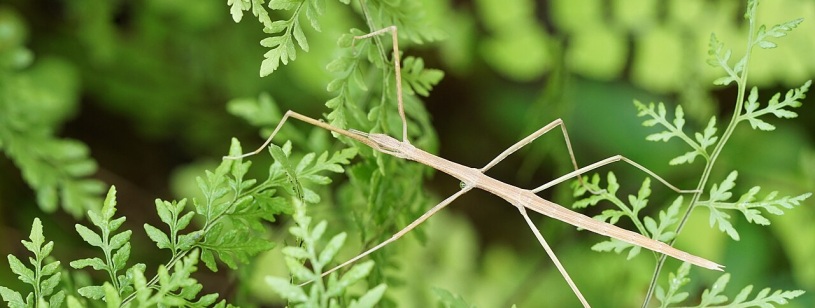
Stick insect (Phasmatodea) among ferns. · Vengolis / CC BY-SA 4.0 (https://creativecommons.org/licenses/by-sa/4.0). Cropped and resized.
Stick insects, also called phasmids, have long, thin bodies that look like dry or green twigs. They stay motionless for hours and sway gently like a branch in the wind to avoid birds. There are more than 3,000 species, mostly in tropical forests, and some are kept as pets.
Quick facts
| Common name | Stick insect, phasmid |
| Scientific name | Phasmatodea (order) |
| Lifespan | Usually several months to a year or more |
| Length | From a few centimetres to over 50 cm, by species |
| Diet | Herbivore: bramble, raspberry, oak, eucalyptus leaves |
| Predators | Birds, lizards, monkeys, bats |
| Conservation status | Varies; a few species are endangered |
| Distribution | Tropical and warm temperate regions on all continents |
| Habitat | Forests, shrubs, grassland with bushes |
| Family | Several families in the order Phasmatodea |
| Defence | Camouflage, stillness, shedding legs |
- Primary category:Insects
- Explore this animal's categories:
Interesting facts
- One of the longest known insects is a Chinese stick insect over 60 cm long with legs outstretched.
- In many species, females can produce young without males; the offspring are then all female.
- If a predator grabs a leg, the stick insect can shed it, and in young insects it regrows.
- Some species’ eggs look like seeds, and ants carry them into their nests, where they are safe from predators.
Characteristics
Stick insects have long, thin, cylindrical bodies, brown or green, with long twig-like legs. Some have spines or growths that mimic moss or lichen. Their close relatives, leaf insects, look like leaves.
Some species have wings and can fly; others cannot. Females are usually larger and thicker than males.
Behaviour
They are active mainly at night, when they eat leaves. By day they stay still on branches, front legs stretched forward to look like a twig.
When touched, some drop and play dead, staying rigid. Others release an unpleasant smell or flash coloured wings to startle predators.
Habitat and distribution
Stick insects live mainly in the tropical forests of South-East Asia, Australia, South America and Africa. A few species live in southern Europe, in countries such as Italy, France and Spain.
In Romania, they are known mainly as pets kept in terrariums.
Diet and feeding
Stick insects are herbivores that eat leaves. In the wild they prefer local plants, and in captivity many species eat bramble, raspberry, rose, oak or ivy leaves.
They also need moisture; in terrariums, leaves are misted with water and the insects drink the drops.
Reproduction and life cycle
Females lay from a hundred to over a thousand eggs, dropping them to the ground, gluing them to plants or burying them. Eggs hatch after weeks or months.
In many species, females can breed without males through parthenogenesis. Young look like small adults and grow through several moults. In one species, a pair was observed mating for 79 days, an insect record.
Name and history
The scientific name Phasmatodea comes from the Greek “phasma”, meaning phantom or apparition, because the insects seem to appear and vanish among branches.
Stick insects are distant relatives of mantises and grasshoppers.
Conservation and threats
Most species are not assessed. Some, such as the Lord Howe Island stick insect of Australia, were almost wiped out by rats brought by people and saved by captive breeding.
As pets, stick insects are easy to care for, but individuals or eggs must never be released into the wild, where they may become invasive.
Frequently asked questions
What do stick insects eat?
Leaves; in captivity many species eat bramble, raspberry, rose or oak leaves.
Can I keep a stick insect at home?
Yes, some species are easy to keep in terrariums with fresh leaves and moisture. They must not be released.
How do stick insects breed without males?
Through parthenogenesis: females lay unfertilised eggs that hatch into females.
Do stick insects live in Romania?
There are no widespread native species; a few species live in southern Europe, in countries such as Italy and France.