Hummingbird hawk-mothInteresting facts and information
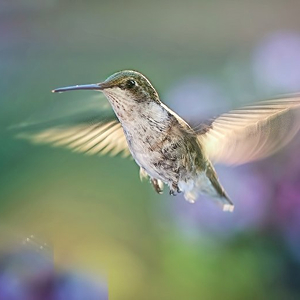
AI-generated illustration of a hummingbird hawk-moth.
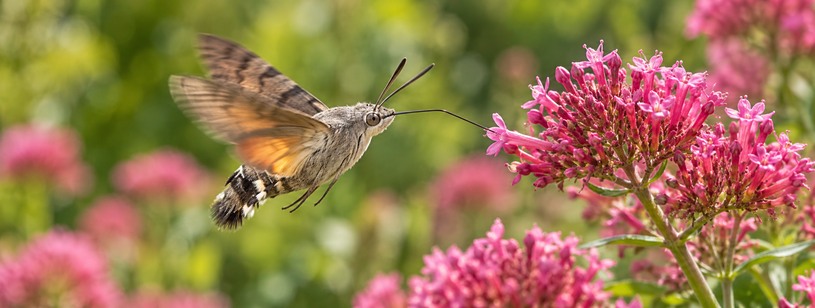
The hummingbird hawk-moth (Macroglossum stellatarum) is a mainly day-flying moth that drinks nectar while hovering in front of flowers. Its hovering flight and long feeding tube bring a hummingbird to mind, but this animal is an insect in the family Sphingidae.
It also occurs in Romania. Look for its grey body, orange hindwings and black-and-white tuft at the end of its abdomen. Adults visit flowers, while caterpillars eat plants, particularly bedstraws in the genus Galium.
Quick facts
| Common name | Hummingbird hawk-moth |
| Scientific name | Macroglossum stellatarum |
| Class / order / family | Insecta / Lepidoptera / Sphingidae |
| Wingspan | Approximately 4–6 cm |
| Distribution | Europe, northern Africa and parts of Asia |
| Found in Romania? | Yes |
| Habitat | Gardens, meadows, parks, clearings and woodland edges |
| Adult diet | Nectar |
| Caterpillar diet | Mainly Galium plants; also Rubia in some regions |
| Activity | Mainly during the day |
| Reproduction | Lays eggs; complete metamorphosis |
| Movement | Hovering flight and migration |
| Overwintering | Can overwinter as an adult in favourable conditions |
| Ecological role | Flower visitor and pollinator of some plants |
- Primary category:Insects
- Explore this animal's categories:
Interesting facts
- It is a moth that flies during the day. The simple division of “butterflies by day, moths by night” has exceptions, and this species is one of them.
- It does not need to land on a flower to feed. It stays airborne and extends its proboscis towards the nectar.
- It has a little “fan” at the end of its body. From a distance, the black-and-white tuft can look like a bird's tail.
- It can learn to associate colours with food. Experiments with artificial flowers have shown that it adjusts its choices according to the reward it receives.
- Adults and caterpillars have different diets. A flower-filled garden may feed adults, but caterpillars also need suitable food plants.
Records and remarkable abilities
One of its most striking abilities is precise feeding in mid-air. Its body must stay close to a flower while the tip of its proboscis searches for a tiny opening. This takes remarkable coordination for such a small insect.
A study published in 2024 showed that the hummingbird hawk-moth uses vision to guide the movements of its proboscis. Researchers filmed the insects with high-speed cameras as they approached artificial flowers. When visual information was restricted, their search for nectar became less precise.
The insect combines movements of its whole body with finer movements of its proboscis. This is rather like bringing your hand close to an object and then adjusting your fingers. The comparison helps explain the movement; it does not show that the insect thinks like a human.
Characteristics
The hummingbird hawk-moth has a stout body covered in fine hairs and two pairs of wings. The forewings are greyish-brown with darker lines. The orange hindwings are particularly noticeable in flight.
| Feature | What to look for |
| Size | The wingspan is approximately 4–6 cm; measurements vary between individuals and identification sources. |
| Forewings | Greyish-brown with subtle, darker markings. |
| Hindwings | Orange with a darker edge. |
| Tip of the abdomen | A broad tuft of hairs with black and white patches. |
| Feeding apparatus | A long proboscis, coiled when not in use. |
The proboscis works as a tube for drinking liquids. It is neither a beak nor a sting. The insect uncoils it to reach nectar inside a flower. Its large eyes, antennae and six legs provide further clues that you are looking at an insect.
The caterpillar looks very different. It is often green with pale stripes along its sides and a small “horn” at the rear. Reddish-brown forms also occur. Identification depends on a combination of features rather than colour alone.
Habits and behaviour
It is mainly active during the day and can be seen moving quickly from flower to flower. Hovering means that it stays in roughly the same position relative to a flower, even though its wings keep moving.
Vision plays an important part in flower choice. In experiments, the insects learned to associate particular colours with food. Research has also shown that they can use scents, depending on the combination of signals a flower provides.
The hummingbird hawk-moth is also migratory. Individuals move into more northerly regions during favourable seasons. The number seen in any one place can vary greatly from year to year.
Some individuals spend the winter as adults in sheltered places. Survival depends on the climate, with mild winters offering better chances. Seeing an adult in summer does not automatically mean that the species can overwinter successfully in that location.
Habitat and geographical distribution
The species occurs across Europe, northern Africa and large parts of Asia. Migration also takes it into places where it occurs seasonally. In Europe, it lives in natural landscapes as well as close to people.
Its presence in Romania is documented in entomological publications and species distribution lists. An animal does not have to be tropical to look unusual: this moth can appear among the flowers of an ordinary garden.
- Gardens and parks: nectar-rich flowers can attract adults.
- Meadows and roadsides: these may provide both nectar and caterpillar food plants.
- Clearings and woodland edges: the insect uses open spaces with flowers.
Its needs change with its life stage. Adults seek nectar and shelter, while females must find plants on which their caterpillars can feed. Ornamental flowers therefore cannot replace every wild plant.
Diet and feeding
Adults drink nectar, while caterpillars eat leaves and other parts of their host plants. Adult food plants include honeysuckle, red valerian and verbena. Caterpillars mainly use Galium species and, in some regions, Rubia.
- It approaches a flower and adjusts its position in flight.
- It uncoils its proboscis and searches for access to nectar.
- It drinks the liquid, then moves on to another flower.
Hummingbird hawk-moths can contribute to pollination, the transfer of pollen between flowers. Their role has been studied, for example, in the Carthusian pink, Dianthus carthusianorum.
However, visiting a flower does not automatically mean pollinating it. The insect must touch the right parts of the flower and carry pollen onwards. Its effectiveness depends on the flower's shape and the way the insect feeds.
Reproduction and life cycle
The hummingbird hawk-moth undergoes complete metamorphosis: egg, caterpillar, pupa and adult. A caterpillar is not simply a small, wingless adult. It is a life stage with a different shape and diet.
| Stage | What happens |
| Egg | The female lays eggs individually on suitable caterpillar food plants. |
| Caterpillar | It eats, grows and moults; many individuals are green with stripes along their sides. |
| Pupa | It forms close to the ground in a loose silk cocoon among plant debris. |
| Adult | After emerging from the pupa, its wings expand fully; the insect feeds, moves about and reproduces. |
The number of generations and the duration of each stage depend on temperature and region. Several generations may follow one another in warmer areas. A flight calendar from Britain should not automatically be applied to Romania or any other country.
The species can overwinter as an adult. This distinguishes it from insects that spend the winter only as eggs, larvae or pupae. There is no single lifespan shared by every individual: the season and environmental conditions matter.
Name and history
The name “hummingbird hawk-moth” describes its resemblance to a hummingbird when feeding. It does not indicate a close relationship. Hummingbirds are birds native to the Americas, whereas Macroglossum stellatarum is an insect.
The species was described by Carl Linnaeus in 1758 as Sphinx stellatarum. It is now classified in the genus Macroglossum, family Sphingidae and order Lepidoptera.
Its resemblance to a bird illustrates how very different animals can use similar solutions: both the insect and the bird can seek nectar while hovering. Their body structures and flight mechanisms remain different.
Conservation status and threats
The hummingbird hawk-moth has a wide range, but its local presence depends on food, caterpillar host plants and climatic conditions. Rare sightings in one garden do not, by themselves, demonstrate a decline across the species.
Helping flower-visiting insects means keeping both nectar sources and the plants on which their larvae develop. An insect-friendly garden needs more than ornamental flowers alone.
- Keep flowers that bloom at different times to provide nectar throughout the season.
- Leave host plants for caterpillars too, including suitable local Galium species.
- Avoid unnecessary insecticide use, especially on plants visited by insects.
- Watch without catching. A photograph can show the wings and abdominal tuft needed for identification.
Compare this animal with a hummingbird, or discover other insects and migratory animals.
Frequently asked questions
- Is a hummingbird hawk-moth a bird or an insect? It is an insect: a moth in the family Sphingidae, with the scientific name Macroglossum stellatarum.
- Are hummingbird hawk-moths found in Romania? Yes. The species is documented in Romania and can be seen visiting flowers, including those in gardens.
- What do hummingbird hawk-moths eat? Adults drink nectar, while caterpillars eat host plants, particularly species in the genus Galium.
- Why does it hover in front of flowers? It stays airborne while inserting its proboscis into a flower to reach nectar.
- How can you recognise a hummingbird hawk-moth? Look for its hovering flight, grey body, orange hindwings and the black-and-white tuft at the tip of its abdomen.
- Do hummingbird hawk-moths fly only at night? No. They are mainly day-flying moths, although they can also fly at other times.
- Do hummingbird hawk-moths pollinate flowers? They can pollinate some plants. Drinking nectar alone does not guarantee pollen transfer: contact with the flower's reproductive parts matters.
- How can we help them in gardens? Keep nectar sources and caterpillar host plants, and avoid unnecessary insecticide use.
Did you know?
- It is a moth that is mainly active during the day.
- It drinks nectar without landing on the flower.
- It can learn to associate colours with food.
- It can overwinter as an adult in favourable conditions.