SpidersAraneae — anatomy, silk, behaviour and diversity
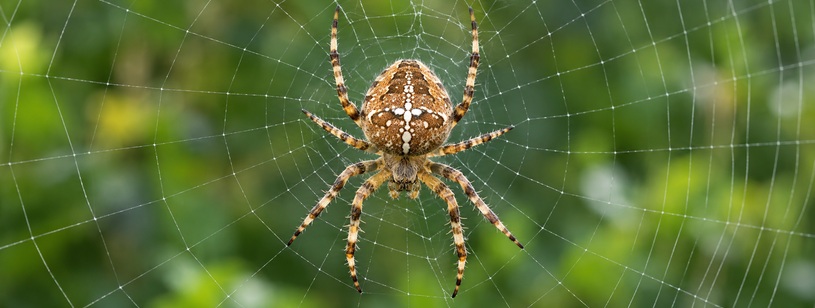
European garden spider (Araneus diadematus), one example of the order Araneae.
Spiders are arachnids with eight walking legs, two main body regions and the ability to produce silk. They make up the order Araneae, containing tens of thousands of species. They are not insects.
Most are predators and help regulate insect populations. Some trap food in webs; others stalk or ambush it. Spiders live in forests, gardens, grassland and buildings, but different species need different conditions.
Quick facts
| Common name | Spider |
| Scientific name | Araneae — the order of spiders |
| Typical lifespan | Varies with species, sex and conditions; no single lifespan applies to the whole order. |
| Length | Varies greatly between species; very small spiders may have a body less than 1 mm long. |
| Diet type | Predominantly carnivorous, mainly insects and other invertebrates |
| Conservation status | Assessed separately for individual species or populations. |
| Geographical distribution | Every continent except Antarctica, which has no established native spider populations |
| Habitat | Mainly terrestrial; some species are closely associated with water |
| Walking legs | Normally four pairs |
| Body | Cephalothorax and abdomen joined by a narrow waist |
| Antennae | Absent |
| Eyes | Often eight, but the number varies; some cave species have none |
| Silk | Made by glands and released through structures on the abdomen |
| Capture webs | Built by only some groups |
| Venom | Present in most species, with exceptions such as Uloboridae |
| Activity | Daytime or nighttime, depending on species |
| Social life | Most are solitary; social species also exist |
| Reproduction | Eggs, usually protected within a silk covering |
| Growth | Through successive moults |
- Primary category:Arachnids
- Explore this animal's categories:Animals of AfricaAnimals of AsiaAnimals of AustraliaAnimals of EuropeAnimals of North AmericaAnimals of RomaniaAnimals of Romania’s gardens and parksAnimals of South AmericaAnimals that regrow body partsArachnidsArthropodsBurrowing animalsCamouflaged animalsCarnivoresEgg-laying animalsForest animalsInsect-eating animalsInvertebratesSSolitary animalsVenomous animalsWild animals
Interesting facts
- Not every spider traps food in a web. Jumping spiders and wolf spiders include hunters that seek or ambush prey.
- Silk has many uses. It can form traps, shelters, egg coverings or safety lines.
- Eight legs do not automatically mean eight eyes. Eye number varies, and some cave species have none.
- Some young spiders travel through the air. Silk threads help them disperse on air currents without wings.
- There is an unusual dietary exception. The jumping spider Bagheera kiplingi eats predominantly plant food.
- A lost leg can regrow through moulting. This depends on species and developmental stage; it does not mean every body part can regenerate.
Records and extremes
What is the largest spider?
The answer depends on mass, body length or the span between leg tips. Guinness World Records identifies the Goliath birdeater as the largest by mass and distinguishes this from leg span.
| Record type | Example and measurements |
|---|---|
| Large mass | Goliath birdeater, Theraphosa blondi: up to around 175 g, according to Guinness |
| Large leg span | Heteropoda maxima: can reach around 30 cm between leg tips |
| Very small body | Male Patu digua have been described with a body length of around 0.37 mm |
Several species compete for the smallest-spider title, which Guinness describes as disputed. Leg span and body length are different measurements.
Characteristics
How is the body organised?
The front region, the cephalothorax, combines head and thorax. It bears the eyes, mouthparts and four pairs of walking legs. A narrow waist connects it to the abdomen.
An external skeleton supports the body. Near the mouth are two shorter appendages called pedipalps, used in sensing and food handling and, in mature males, reproduction.
Mouthparts called chelicerae carry the fangs, connected to venom glands in most species. Silk-release structures are on the abdomen, not in the mouth.
Spider or insect?
| Feature | Spiders and insects |
|---|---|
| Walking legs | Normally eight in spiders; six in adult insects |
| Main body regions | Two in spiders; head, thorax and abdomen in insects |
| Antennae | Absent in spiders; one pair in insects |
| Wings | Spiders have none; many adult insects have wings |
Other arachnids also have eight legs. Leg count is therefore a useful clue, but identification also considers body shape and other features.
How different can spiders be?
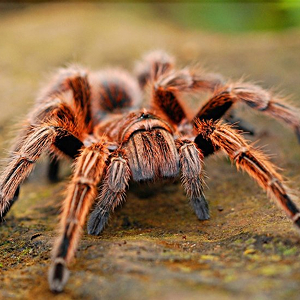
Some have tiny bodies and slender legs; others are robust and densely hairy. The order includes garden spiders and tarantulas, which belong to Theraphosidae.
The illustrated species, Araneus diadematus, can be brown, orange or grey, with white spots forming a cross on the abdomen. This pattern is not shared by all spiders.
Habits and behaviour
When are spiders active?
Activity depends on species. Some hunt by day and rely strongly on vision; others are more active at night. Many detect movement and vibration through sensory hairs and other structures on the body and legs.
A motionless spider may be waiting for prey or hiding. Lack of movement alone does not establish that it is ill or dying.
Why do spiders make silk?
Silk is used for much more than the familiar round garden web. Spiders make sheet webs, irregular constructions, tubes and silk-lined retreats.
- Capturing food: threads can restrain prey or transmit its vibrations.
- Protecting eggs: females may weave a durable covering.
- Shelter: silk lines or reinforces retreats.
- Safety and movement: a thread can arrest a fall or assist dispersal.
Alone or in groups?
Most spiders are solitary. Mating encounters and clusters of newly hatched young do not automatically constitute permanent colonies.
Social species do exist and may cooperate. This is a feature of those species rather than the rule for the whole order.
How do they defend themselves?
They may run, jump, drop on silk or stay hidden. Camouflage can conceal them against leaves, bark or soil. Some adopt warning postures when threatened.
In some species, losing a leg helps escape a predator’s grip. A young individual may regenerate it over later moults, with species-specific limits.
Habitat and geographical distribution
Where do spiders live?
Native populations occur on every continent except Antarctica. Spiders inhabit forests, grassland, deserts, caves and buildings. Each species has its own temperature, moisture and shelter requirements.
Some live on plants, others under stones, in leaf litter or in burrows. Although mainly terrestrial, certain species are adapted to life near water or underwater.
Spiders in Romania
Romania has spiders in gardens, parks, forests, grassland and homes. The European garden spider, Araneus diadematus, is one example documented in European biodiversity records.
A species known from another part of the world should not be assumed present locally just because a photograph looks similar. Reliable identification may require details invisible to the unaided eye.
Why do they appear indoors?
Buildings provide food and shelter for some species. Other spiders arrive accidentally, for example while moving around or when objects are brought inside.
Indoor spiders do not all share the same habits. Colour, size or the presence of a web alone cannot reliably establish species.
Diet and feeding
What do spiders eat?
Most eat insects and other invertebrates. Food varies with size, habitat and hunting method. Some large species catch small vertebrates, but this does not describe every spider’s everyday diet.
A notable exception is Bagheera kiplingi, a Central American jumping spider that feeds predominantly on plant structures produced by acacias. This finding shows why not every species should be called a strict predator.
How do they capture prey?
- Trapping: silk restrains prey and carries vibrations.
- Ambush: the spider waits near a retreat or on vegetation.
- Stalking and jumping: some species actively approach prey.
Venom and silk have different roles in restraint. Uloboridae, for example, lack venom glands and rely on extensive silk wrapping.
How do they digest food?
Digestion begins outside the mouth. Digestive fluid breaks down prey tissues, and the spider takes in liquefied food. Mouthparts may also crush or compress prey, depending on the group.
This is more than drinking blood or juices already present inside an insect. Tissues are digested, and hard indigestible remains may be left behind.
Reproduction and life cycle
Courtship and mating
Males may use vibrations, leg movements or visual signals. Courtship differs substantially between groups. Mature male pedipalps are involved in transferring sperm.
Females do not inevitably eat males. Sexual cannibalism occurs in some species and circumstances, but is not the universal outcome of mating.
Eggs and young
Females lay eggs, usually protected by silk. Numbers vary between species, and some sacs contain hundreds. Depending on the group, females may guard or carry their eggs.
Young spiders may remain together briefly before dispersing. Some walk away; others release silk threads that help them travel on air currents.
Moulting
Spiders grow by replacing their external covering. A new covering develops beneath the old one, which splits so the animal can emerge.
Immediately afterwards, the new covering has not fully hardened and the spider is vulnerable. A spider-shaped shell near a web may be a cast exoskeleton rather than a dead animal.
How long does a spider live?
The order has no single lifespan. Species, sex and conditions all matter. In many species, adult males live for less time than females.
A garden species’ lifespan should not be applied to a tarantula, or vice versa. A useful estimate begins with identifying the group or species.
Names and history
| Classification level | Name |
|---|---|
| Class | Arachnida — arachnids |
| Phylum | Arthropoda — invertebrates with an external skeleton and jointed limbs |
| Families | Many, including Araneidae, Salticidae and Theraphosidae |
What does Araneae mean?
Araneae is the scientific name for the order of spiders. It belongs to the class Arachnida, alongside other groups such as scorpions, mites and ticks.
The study of arachnids is called arachnology. Researchers use body features and modern analytical methods to describe and distinguish species.
Why do species lists change?
New species are discovered, and names are revised when better evidence becomes available. The World Spider Catalog tracks taxonomic literature and these changes.
The exact species total is not fixed. The order contains tens of thousands of species, whose diversity cannot be represented by a single garden spider.
Cultural significance and mythology
The myth of Arachne
In Greco-Roman tradition, Arachne is a weaver transformed into a spider after confronting Athena, known as Minerva in Roman tradition. The story links spiders with weaving and appears in Ovid’s Metamorphoses.
This is mythology rather than a scientific explanation of spider origins. Artists also returned to it, including Velázquez in Las hilanderas, also known as The Fable of Arachne.
Conservation and threats
Are spiders threatened?
There is no single conservation status for all spiders. Some species are widespread, while others depend on very restricted habitats. Assessments concern defined species or populations.
Habitat loss, vegetation degradation and changing local conditions can affect spiders and their food. Protecting leaf litter, vegetation and small refuges helps retain diversity.
Their ecological role
By eating insects and other invertebrates, spiders help regulate prey populations. They are also food for other animals and form part of ecological food webs.
Not every web needs removing and not every spider needs killing. Watching from a distance reveals many of their behaviours.
Are they dangerous to people?
Most have venom for subduing prey, but venom does not automatically imply a major medical danger to humans. Only a small number of species cause serious problems.
Do not pick up an unfamiliar spider by hand or identify the cause of a skin lesion by appearance alone. Severe symptoms after a suspected bite require medical help.
In popular culture
Spider-Man
Spider-Man, the Marvel character, has fictional abilities inspired by spiders. Peter Parker’s story begins with a radioactive spider bite, a fantasy element rather than a real effect of a bite.
Charlotte
In E. B. White’s Charlotte’s Web, Charlotte is a spider who helps Wilbur the pig. The character offers a different image from a spider presented solely as something frightening.
Talking characters and webs carrying written messages belong to fiction. Real spider behaviour is understood through observation and research.
Frequently asked questions
Is a spider an insect?
No. Spiders are arachnids in the order Araneae. They normally have eight walking legs, whereas adult insects have six.
How many legs does a spider have?
Normally eight, arranged in four pairs. An injured individual may have fewer.
Do all spiders make webs?
All produce silk, but only some groups build webs for capturing food.
What do spiders eat?
Most eat insects and other invertebrates. Exceptions include Bagheera kiplingi, which feeds predominantly on plant material.
Do all spiders have venom?
Most have venom glands, but exceptions include Uloboridae. Venom for prey capture does not automatically mean a major danger to humans.
How many eyes does a spider have?
Often eight, but the number varies. Some cave species have none.
What is the largest spider?
Theraphosa blondi is a reference for mass, while Heteropoda maxima is notable for leg span. Body length and leg span are different measurements.
Which spider is shown in the images?
The European garden spider, Araneus diadematus. It is one example; the article covers the order Araneae as a whole.
Did you know? About spiders
- Spiders are arachnids rather than insects.
- All produce silk, but not all build prey-catching webs.
- The number of eyes varies between species.
- Some young spiders disperse on silk carried by air currents.