Smooth newtLissotriton vulgaris — habitat, diet and reproduction
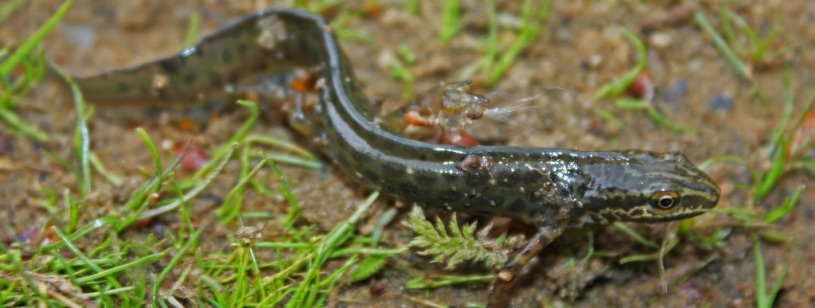
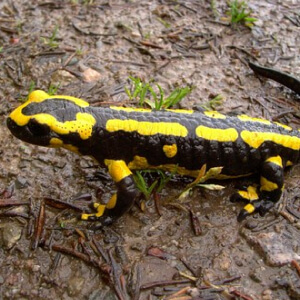
Smooth newt (Lissotriton vulgaris) on damp ground. · Thomas Brown / CC BY 2.0 (https://creativecommons.org/licenses/by/2.0). Cropped and resized. Source: https://commons.wikimedia.org/wiki/File:Smooth_Newt_(Lissotriton_vulgaris)_(8618457437).jpg
The smooth newt (Lissotriton vulgaris) is a small amphibian with four legs and a lifelong tail. It breeds in water and uses damp shelters on land. This account focuses on one member of Salamandridae, whose aquatic larvae have external gills.
Quick facts
| Common name | Smooth newt; common newt |
| Scientific name | Lissotriton vulgaris |
| Lifespan | Around six years on average, according to The Wildlife Trusts |
| Length | Approximately 7–11 cm including the tail |
| Appearance | Grey-brown with a spotted yellow-orange belly |
| Diet | Small invertebrates and sometimes tadpoles |
| Predators | Fish, snakes and birds; aquatic insects also eat larvae |
| Conservation status | Least Concern in the global IUCN assessment published in 2009 |
| Distribution | Much of Europe, including Romania, and parts of Asia |
| Habitat | Vegetated ponds, grassland, woodland and damp gardens |
| Family | Salamandridae |
| Reproduction | Individual leaf-wrapped eggs and aquatic larvae |
- Primary category:Amphibians
- Explore this animal's categories:
Interesting facts
- Females fold plant leaves around individual eggs.
- Breeding males develop a crest along the back and tail.
- Larvae carry feathery external gills behind the head.
- Damp terrestrial shelters are essential beyond the pond.
Records and extremes
Smooth newts usually measure about 7–11 cm including the tail. Great crested newts are larger, reaching around 16 cm.
A female may produce roughly 100–300 eggs over days or weeks. Survival to the juvenile stage depends heavily on predators and habitat.
The Wildlife Trusts gives an average lifespan of about six years. Individuals can participate in several breeding seasons.
Characteristics
The back is brown or grey, while the belly has yellow-orange colouring and dark spots. Breeding males have a continuous, gently wavy crest; females lack it.
Skin may look velvety on land. Four front toes and skin without scales help distinguish newts from typical lizards.
Throat spots help separate smooth from palmate newts, although females may require several features for reliable identification.
Behaviour
Adults leave winter refuges and travel towards water in spring. Timing varies with weather and region; winter shelters provide protection from frost.
Males court females with precise body and tail movements. Tail fanning carries chemical signals through the water towards the female.
On land, activity is more apparent around dusk and at night. Logs, stones and leaf litter provide daytime shelter from drying and predators.
Habitat and distribution
The natural range covers much of Europe and extends into Asia, including Romania. Older literature often uses Triturus vulgaris.
Vegetated ponds provide egg-laying sites and cover for larvae. Garden ponds can also be colonised.
Surrounding grassland, scrub and woodland supply food and winter refuges. Connections between ponds allow movement through the landscape.
Diet and feeding
Smooth newts hunt small animals. Terrestrial foods include insects, worms and slugs; aquatic prey includes small crustaceans, molluscs and tadpoles.
Larvae also hunt small aquatic animals. Food availability affects their growth.
Newts are both predators and prey: fish, snakes and birds capture them, while predatory aquatic insects also consume larvae.
Reproduction and life cycle
Following courtship, the male deposits a sperm packet called a spermatophore, which the female collects. Fertilisation is internal.
Individual eggs are enclosed in folded aquatic leaves. Larvae hatch after several weeks, with timing influenced by temperature.
Front legs develop before hind legs. During metamorphosis, external gills are lost and juveniles can leave the water; staggered egg-laying spreads emergence over time.
Name and history
Linnaeus described the species in 1758. It is now placed in Lissotriton, family Salamandridae, order Caudata. The older combination Triturus vulgaris remains common in publications.
Newt refers to multiple species, including smooth, palmate and great crested newts. Their differences matter for understanding distribution and habitat requirements.
Conservation and threats
The global IUCN assessment published in 2009 lists Least Concern and is marked as needing updating. Regional circumstances differ: Switzerland lists the species as Endangered.
Pond loss and habitat fragmentation can isolate populations. Roads and other barriers may cut routes to breeding sites.
Networks of ponds and terrestrial shelters support the full cycle. Moving animals between ponds can spread disease and does not replace habitat restoration.
Frequently asked questions
Is it a lizard?
No. It is an amphibian with scaleless skin and aquatic larvae.
Does it always live in water?
No. Smooth newts breed in water and spend much time on land.
What are the feathery structures on larvae?
External gills, used to breathe underwater.
Why does a male have a crest?
It develops during the breeding season as part of the breeding appearance.
Where are eggs laid?
Individually on aquatic plants, wrapped in leaves.
Does it occur in Romania?
Yes. Romania is within its natural range.