Monkeys and apesInteresting facts and information
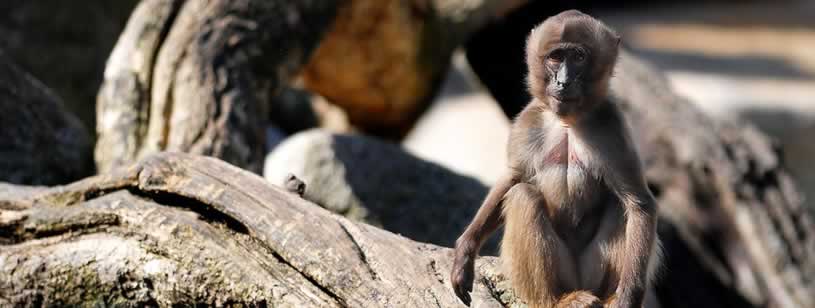
Monkeys and apes belong to the primate group Simiiformes. It includes New World monkeys from the Americas, Old World monkeys such as macaques and baboons, and apes such as gibbons, gorillas and chimpanzees. They live in many habitats, from tropical forests to savannas and mountains.
Monkeys and apes communicate with calls, facial expressions and gestures, and many live in complex social groups. Some use tools. In English, "monkeys" and "apes" are different branches of this wider group: apes have no tail and include humans' closest relatives.
Quick facts
| Common name | Monkeys and apes |
| Scientific name | Simiiformes — an infraorder containing several families |
| Typical lifespan | About 10-60 years, depending on the species |
| Maximum speed | Up to about 55 km/h (patas monkey, Erythrocebus patas) |
| Dimensions | Varies greatly, from tiny marmosets to large apes |
| Weight | From about 100 g (pygmy marmoset) to about 200 kg (large male gorillas) |
| Diet type | Mostly omnivores (fruit, leaves, insects, eggs, nuts, sometimes meat) |
| Main predators | Leopards, eagles, large snakes, people |
| Conservation status | Varies by species; many monkeys and most apes are threatened by habitat loss or hunting |
| Distribution | South and Central America, Africa, Asia, Gibraltar |
| Habitat | Tropical forests, savannas, mountains, dry regions |
Interesting facts
- Great apes recognise themselves in a mirror - Chimpanzees, bonobos, orangutans and some gorillas pass the mirror self-recognition test, a sign of self-awareness; most monkeys do not.
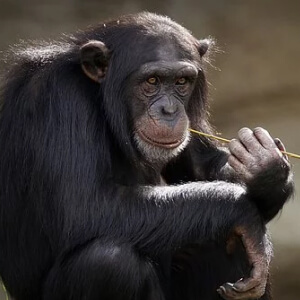
- Many use tools - Chimpanzees poke sticks into termite mounds and use leaves as sponges, and capuchin monkeys crack nuts with stones.
- Apes can learn signs - Gorillas and chimpanzees in captivity, such as Koko and Washoe, have learned hundreds of signs to communicate with people, although scientists still debate how close this is to human language.
- They help each other - Some species share food, groom each other and warn each other of danger.
- They read emotions - Research shows that monkeys and apes can tell when another individual is frightened or angry and change their behaviour.
Records and remarkable features
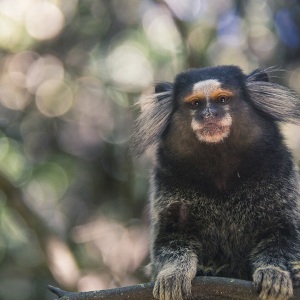
- Smallest monkey – The pygmy marmoset (Cebuella) of South America weighs only about 100 g.
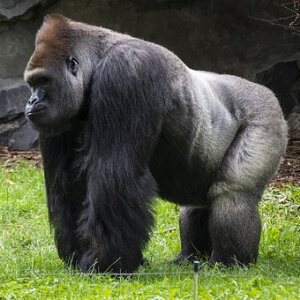
- Largest primate – The eastern gorilla (Gorilla beringei), an ape, is the largest living primate; big males can weigh around 200 kg.
- Different groups — The mandrill (Mandrillus sphinx) is an Old World monkey, while gorillas and chimpanzees are apes, on another branch of the simian primates.
- The fastest monkey - The patas monkey (Erythrocebus patas) can run at about 55 km/h.
- A fifth hand - Spider monkeys have a prehensile tail, longer than their body, that can grip branches like a hand.
Characteristics
Monkeys and apes are primates adapted for life in trees or on the ground, with grasping hands, forward-facing eyes and large brains. They vary greatly in size and behaviour, but most have complex social lives and learn quickly.
Main physical characteristics
| Feature | Details |
|---|---|
| Size | Varies greatly between species, from tiny marmosets to large apes |
| Weight | From about 100 g (pygmy marmoset) to about 200 kg (large male gorillas) |
| Colour | Grey, brown, red, black, golden, sometimes with a brightly coloured face |
| Tail | Prehensile (gripping) in some New World monkeys; long but not gripping in most Old World monkeys; absent in apes |
| Fingers and nails | Grasping hands with flat nails; marmosets and tamarins have claw-like nails on most fingers |
| Teeth | Adapted for chewing fruit, leaves or insects |
| Eyesight | Forward-facing eyes give good depth perception; most see colours well |
| Brain | Large and well developed, allowing problem-solving and tool use |
Special adaptations
- A gripping tail - Some New World monkeys, such as spider monkeys and howler monkeys, use their tail to hold on to branches and keep their balance.
- Limbs for climbing or walking - Tree-dwelling species have long, flexible arms, while ground-dwelling species have sturdy legs for walking and running.
- Facial expressions and gestures - Monkeys and apes use their faces and gestures to show emotions and intentions.
- Advanced thinking - Chimpanzees and other apes can plan, cooperate and use tools.
Habits and behaviour
Monkeys and apes behave in very different ways, depending on the species, environment and social structure. Some live mostly alone or in pairs, while others live in large groups with complex hierarchies.
Social behaviour
- Mostly solitary - Adult orangutans spend much of their time alone, and mothers live with their young.
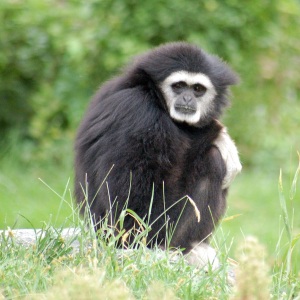
- Pairs and families - Gibbons usually live in small family groups led by a male-female pair.
- Large groups - Baboons and macaques can live in troops of dozens, sometimes over 100 animals, with clear hierarchies.
- Social roles - In many species, dominant males have priority, while related females form strong, long-lasting bonds.
- Rich communication - They use calls, facial expressions and gestures to warn of predators, keep the group together and attract mates.
Feeding and survival methods
- Flexible feeders - Their diet ranges from fruit and leaves to insects, eggs and sometimes meat.
- Tools - Some species use sticks to catch termites and stones to crack nuts.
- Memory and planning - Monkeys and apes remember where food grows and when it will be ripe.
Defence and survival strategies
- Alarm calls - Many monkeys have different calls for different predators, such as eagles, leopards and snakes.
- Escaping - They rely on agility and speed to escape predators.
- Fighting back - Baboons and macaques can gang up to drive away larger predators.
Habitat and geographic distribution
Monkeys and apes live in many habitats, from tropical forests and savannas to mountains and dry regions.
Habitat types
| Habitat | Main regions |
|---|---|
| Rainforests | Amazon, Central Africa, Southeast Asia |
| Savannas and scrubland | Africa, India |
| Mountains and cold regions | Japan (Japanese macaques), China (Tibetan macaques), Ethiopian Highlands (geladas) |
| Dry regions | Northeast Africa and southwest Arabia (hamadryas baboons), India (grey langurs) |
Geographic distribution
- South and Central America - Capuchins, spider monkeys, howler monkeys, marmosets and tamarins.
- Africa - Baboons, colobus monkeys, mandrills, chimpanzees, bonobos and gorillas.
- Asia - Macaques, langurs, gibbons and orangutans.
- Europe - The only wild monkeys are the Barbary macaques of Gibraltar, whose ancestors came from North Africa.
Human impact on monkey populations
- Deforestation - Tropical forests are cleared for farming, destroying monkey habitats.
- Hunting and illegal trade - Monkeys and apes are hunted for bushmeat or captured to be sold as pets.
- Conflict with people - In some towns, macaques are seen as pests because they steal food and can be aggressive.
Monkeys are adaptable, but many species are threatened by habitat loss and human activity.
Diet and feeding
Most monkeys and apes are omnivores and eat a wide range of foods, from fruit and leaves to insects, eggs and meat. Their diet varies with the species, habitat and season.
Types of food
| Food group | Examples of species that eat it |
|---|---|
| Fruit and seeds | Capuchins, spider monkeys, chimpanzees, gibbons |
| Leaves and shoots | Colobus monkeys, howler monkeys, gorillas |
| Insects and other invertebrates | Macaques, capuchins, tamarins, chimpanzees |
| Eggs and small birds | Baboons, capuchins |
| Small mammals | Chimpanzees, baboons |
| Grass and roots | Geladas, baboons |
Feeding methods
- Planning ahead - Monkeys and apes remember where certain fruits grow and plan their routes.
- Using tools - Some species use sticks to fish for termites, stones to crack nuts or leaves to soak up water.
- Hunting together - Chimpanzees sometimes hunt as a group, for example to catch colobus monkeys.
- Self-medication - Chimpanzees swallow rough leaves and chew bitter plants that help get rid of intestinal parasites.
Their varied diet makes monkeys and apes highly adaptable, but environmental change and deforestation reduce their food supply.
Reproduction and life cycle
Monkeys and apes breed slowly compared with most mammals of their size. Depending on the species, the young are raised by the mother alone, by both parents or with help from the group.
Life cycle stages
| Stage | Approximate duration | Details |
|---|---|---|
| Mating | Seasonal or all year | Monkeys and apes use calls, colours and other signals to attract partners |
| Pregnancy | About 4-9 months | Most females give birth to one baby; marmosets and tamarins usually have twins |
| Birth of young | The babies are helpless and depend on their mother | |
| Maternal care | Months to several years | Mothers carry their young in their arms or on their backs; young orangutans stay with their mother for about 7 years |
| Maturity | About 1-15 years | In many species, the young of one sex leave the group when they grow up |
| Lifespan | About 10-60 years | Great apes such as chimpanzees, gorillas and orangutans live the longest |
Reproductive behaviour
- Group-living monkeys - In macaques, baboons and capuchins, dominant males usually father most of the young.
- Pairs and loners - Gibbons usually live in pairs, while orangutans meet mainly to mate; both breed slowly.
- Caring for the young - Mothers do most of the work, but in marmosets and tamarins fathers and older siblings carry the babies.
Because they breed slowly, threatened species of monkeys and apes recover slowly when their habitats are lost.
Name and history
Monkeys and apes belong to the primates, the group that also includes lemurs, lorises and humans.
Origin of the name
- The origin of the English word "monkey" is uncertain; it may come from Low German Moneke, the name of an ape's son in the medieval tales of Reynard the Fox.
- The scientific name Simiiformes comes from the Latin simia, "ape", and refers to the infraorder of simian primates.
- Other names - singe in French, maimuță in Romanian and saru (猿) in Japanese.
Taxonomic classification
| Taxonomic category | Name |
|---|---|
| Kingdom | Animalia |
| Phylum | Chordata |
| Class | Mammalia |
| Order | Primates |
| Infraorder | Simiiformes |
| Main families | Families include Cebidae, Atelidae, Cercopithecidae, Hylobatidae and Hominidae |
| Known species | Hundreds of species in several families |
Monkeys in history and culture
- Hindu mythology - Hanuman, a god with the form of a monkey, stands for strength, loyalty and devotion.
- Relationship to humans – Humans are apes too. Chimpanzees and bonobos are our closest living relatives, and all monkeys and apes share a common ancestor.
Monkeys and apes are among the most studied animals because they are so similar to us, and they are important in both science and culture.
Cultural significance and mythology
In many cultures, monkeys are symbols of cleverness, mischief and energy. Because they look so much like people, they have been honoured, feared or mocked in myths and religions.
Monkeys in mythology and religion
- Hinduism - Hanuman is one of the most loved figures in Indian mythology, a symbol of strength, devotion and protection. In the Ramayana, he helps Lord Rama rescue his wife Sita from the demon king Ravana.
- Japan - The Three Wise Monkeys, carved on the Tōshō-gū shrine in Nikkō, illustrate the saying "see no evil, hear no evil, speak no evil".
- China - The Monkey is one of the twelve animals of the Chinese zodiac, and people born in its years are said to be clever, creative and playful.
Monkey symbolism
- Cleverness and cunning - Monkeys are often linked with tricks and quick thinking.
- Energy and curiosity - They are seen as agile, playful and mischievous.
- A link between humans and nature - Because they resemble humans, monkeys are often seen as a bridge between the animal and human worlds.
Conservation status and threats
Many species of monkeys and apes are threatened, mainly by deforestation, hunting and illegal trade.
Conservation status
| Group | Status (IUCN) |
|---|---|
| Gibbons | Almost all species are Endangered or Critically Endangered |
| Orangutans | All three species are Critically Endangered |
| Gorillas and chimpanzees | Gorillas Critically Endangered; chimpanzees Endangered |
| Colobus monkeys | Varies; several red colobus species are Endangered or Critically Endangered |
| Capuchins | Varies by species, from Least Concern to Endangered |
| Macaques | Varies; some are widespread, while others, such as the Barbary macaque, are Endangered |
Main threats
- Deforestation - Habitat loss is the main cause of the decline of monkeys and apes.
- Hunting and illegal trade - Monkeys and apes are captured for meat, traditional medicine or the pet trade.
- Conflict with people - In some areas, monkeys raid crops and are killed by farmers.
- Climate change - Rising temperatures and extreme weather affect food supplies and breeding.
Conservation efforts
- Protected areas - National parks and reserves, such as those in Borneo and Central Africa, protect threatened species.
- Rescue and release - Orangutans rescued from the pet trade or from destroyed forests are cared for and returned to the wild.
- Fighting illegal trade - International agreements and organisations work to stop the trafficking of monkeys and apes.
- Research and monitoring - Scientists use camera traps, GPS collars and surveys to follow populations and protect them better.
Although many species are declining, conservation work gives hope for their future.
In popular culture
Monkeys and apes appear in films, books, comics and video games, often as funny, clever or villainous characters.
Monkeys in literature
- Planet of the Apes (Pierre Boulle, 1963) - A science-fiction novel about a planet where apes rule over humans.
- The Jungle Book (Rudyard Kipling, 1894) - The Bandar-log monkeys are shown as noisy and chaotic.
- Journey to the West (China, 16th century) - Its hero, the Monkey King Sun Wukong, is a clever and powerful monkey from Chinese legend.
- Curious George (H. A. and Margret Rey, from 1941) - Picture books about a curious little monkey and his adventures.
Monkeys and apes in film and television
- Planet of the Apes (1968 - present) - A series of films in which intelligent apes take over the world.
- King Kong (1933 and later remakes) – Kong is a giant ape, not a monkey.
- Tarzan (Disney, 1999) – Tarzan is raised by a family of gorillas.
- Curious George (2006 - present) - A film and an animated series based on the classic books.
Monkeys in video games and comic books
- Donkey Kong - One of the most famous video game characters, an ape who first appeared in 1981.
- Super Monkey Ball - A video game in which players roll monkeys inside balls through obstacle courses.
- Detective Chimp (DC Comics) - A highly intelligent chimpanzee who solves mysteries.
Monkeys as a cultural symbol
- In logos and advertising - Monkeys stand for energy, cleverness and fun.
- In design and fashion - Pictures of monkeys appear on clothes, accessories and decorations because of their playful image.
- In science - Monkeys and apes are studied to understand human behaviour and evolution.
Did you know? About monkey
- Monkeys and apes are not the same: apes, such as gibbons, orangutans, gorillas and chimpanzees, have no tail.
- The pygmy marmoset, the smallest monkey, weighs only about 100 g.
- Howler monkeys are among the loudest land animals; their calls can be heard several kilometres away.
- Japanese macaques, also called snow monkeys, bathe in hot springs to keep warm in winter.
- Some monkeys have different alarm calls for different predators, such as eagles, leopards and snakes.
- Marmosets and tamarins usually give birth to twins, and the father carries them on his back.
- Young orangutans stay with their mother for about seven years, longer than almost any other animal apart from humans.
- Capuchin monkeys use stones as hammers to crack open hard nuts.
- Barbary macaques in Gibraltar are the only wild monkeys in Europe.