CrocodileInteresting facts and information
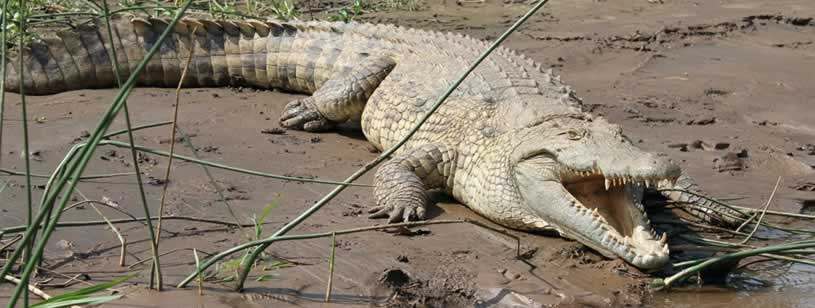
Crocodiles are semi-aquatic reptiles in the family Crocodylidae. They are related to alligators, caimans and gharials, which together form the crocodilians. The living crocodile species differ in size, habitat and conservation needs.
Crocodiles live mainly in tropical and subtropical regions of Africa, Asia, the Americas and Australia. Their lineage is very ancient, but today's species evolved long after the age of the dinosaurs.
Quick facts
| Common name | Crocodile |
| Scientific name | Crocodylidae |
| Typical lifespan | Often 35-70 years in the wild; some may live longer in captivity |
| Maximum speed | About 25-30 km/h in water in short bursts; much slower on land |
| Length | About 1.5-7 m (depending on the species) |
| Weight | From about 20 kg (dwarf crocodile) to about 1,000 kg (large saltwater crocodiles) |
| Diet type | Carnivore (fish, mammals, birds, reptiles) |
| Main predators | Adults have few apart from humans; eggs and young are eaten by monitor lizards, birds, fish and other crocodiles |
| Conservation status | Varies by species: Nile and saltwater crocodiles Least Concern; several species Critically Endangered (IUCN) |
| Distribution | Africa, Asia, the Americas, Australia |
| Habitat | Rivers, swamps, lakes, mangroves, estuaries |
- Primary category:Reptiles
- Explore this animal's categories:
Interesting facts
- An ancient lineage - The ancestors of crocodiles appeared more than 200 million years ago, at the time of the early dinosaurs, although today's species evolved much later.
- The strongest bite ever measured - A saltwater crocodile's bite has been measured at about 16,000 newtons (around 3,700 pounds-force), the strongest of any living animal tested.
- Long dives - Thanks to their slow metabolism and slow heartbeat, resting crocodiles can stay underwater for more than an hour.
- They have a third eyelid - A clear membrane protects their eyes underwater.
- They swallow stones - These "gastroliths" may help grind food in the stomach and possibly help with balance in water.
- They may use tools - Mugger crocodiles and American alligators have been seen balancing sticks on their snouts during the nesting season, possibly to lure birds looking for nest material.
- They can go months without food - Their slow metabolism lets them survive long periods without eating.
- The temperature of the nest decides the sex of the young - In many crocodiles, middle temperatures produce mostly males, while cooler and hotter nests produce mostly females.
- Crocodiles really do "cry" while eating - Their tear glands can release tears as they feed, although this has nothing to do with emotions.
- Caring parents - Unlike most reptiles, crocodile mothers guard their nests and help their young reach the water.
Records and remarkable features
- Saltwater crocodiles are very large living reptiles. Size varies greatly between species and individuals.
- The saltwater crocodile is the largest living reptile; big males can reach 6 m or more and weigh about 1,000 kg.
- Lolong, a saltwater crocodile captured in the Philippines in 2011, measured 6.17 m, one of the longest crocodiles ever reliably measured.
Characteristics
Crocodiles are among the best-adapted predatory reptiles, with features that make them effective both in water and on land. Their sturdy bodies, armoured skin and very strong jaws place them at the top of the food chain where they live.
Main physical characteristics
- A long, muscular body - Well adapted for swimming and for sudden attacks on prey.
- Skin with hard scales and bony plates (osteoderms) - Protects the crocodile in fights and in its harsh environment.
- Very powerful jaws - Crocodiles have the strongest bite measured in any living animal, but the muscles that open the mouth are relatively weak.
- Sharp, replaceable teeth - Crocodiles replace their teeth throughout life and may grow thousands of teeth over the years.
- A strong tail - Pushes the crocodile quickly through the water and can strike prey or rivals.
- Eyes and nostrils on top of the head - Let the crocodile lie almost completely underwater, nearly invisible to prey.
- A protective eye membrane - Protects the eyes underwater and from debris.
Special adaptations for survival
- A slow metabolism - They can survive for months without food because they use very little energy.
- Natural camouflage - Their green, brown or grey colours help them hide in water and vegetation.
- Controlled breathing underwater - A valve at the back of the throat lets them open their mouth underwater without drowning, and their heart can slow to just a few beats per minute.
- Speed over short distances - In water, crocodiles can reach about 25-30 km/h in short bursts; on land they can make short dashes but tire quickly.
Habits and behaviour
Crocodiles mostly hunt alone, but several may live close together, especially where food is plentiful. They are territorial and can be very aggressive when defending their territory or their young.
Social behaviour
- Solitary, but often in groups - Where food is plentiful, crocodiles tolerate each other and may gather in large numbers.
- Territories - Dominant males defend their territory with calls, displays and fights.
- Sounds and vibrations - They slap the water with their heads, roar and make low vibrations that ripple the water's surface to warn rivals or attract mates.
- Clear hierarchies - Larger males are dominant and get priority access to food and mates.
Breeding season
- It varies with the species and region; many crocodiles nest in either the dry season or the wet season.
- Courtship - Males attract females with sounds, water displays and by rubbing heads and snouts.
- Defending territory - Males defend their territory from rivals during this time.
Defence and survival methods
- Waiting in ambush - They keep still and attack prey suddenly from the water.
- Using the tail - A powerful swipe of the tail can injure a rival or predator.
- Retreating into water - When in danger, crocodiles usually slip into the water rather than fight.
Habitat and geographic distribution
Crocodiles live in tropical and subtropical regions, in rivers, lakes, swamps and coastal areas. Most species live in fresh water, while others, such as the saltwater crocodile, also live in estuaries and the sea.
Habitat types
- Rivers and lakes - Most crocodiles prefer fresh water, where they hunt and breed.
- Swamps and wetlands - Dense vegetation provides good hiding places.
- Mangroves and estuaries - Some species, such as the saltwater crocodile, can live in both fresh and salt water.
- Coasts and tropical islands - Saltwater crocodiles can swim long distances at sea, riding ocean currents between islands.
Geographic distribution
| Region | Examples of species | Situation |
|---|---|---|
| Africa | Crocodylus niloticus (Nile crocodile), Osteolaemus tetraspis (dwarf crocodile) | The Nile crocodile is widespread; forest species are less well known |
| The Americas | Crocodylus acutus (American crocodile), Crocodylus intermedius (Orinoco crocodile) | The American crocodile is Vulnerable; the Orinoco crocodile is Critically Endangered |
| Asia | Crocodylus porosus (saltwater crocodile), Crocodylus siamensis (Siamese crocodile) | Many populations are reduced; the Siamese crocodile is Critically Endangered |
| Australia | Crocodylus porosus, Crocodylus johnstoni (freshwater crocodile) | Protected and recovered; about 100,000 saltwater crocodiles live in the Northern Territory alone |
Impact of climate change and human activities
- Habitat loss - Drainage and building destroy the wetlands that crocodiles need for breeding.
- Poaching - Illegal hunting for crocodile skins and meat has caused many populations to decline.
- Conflict with people - As people move into crocodile habitats, attacks increase, and crocodiles are often killed in return.
- Climate change and incubation - Because nest temperature decides the sex of the young, rising temperatures could upset the balance of males and females.
Crocodiles are very tough reptiles that can survive difficult conditions, but human activities and climate change seriously threaten some species.
Diet and feeding
Crocodiles are opportunistic predators that eat almost any animal they can catch. All are carnivores, but their diet changes with the species, age and habitat.
Main food
- Mammals - Antelopes, buffalo, wild pigs, monkeys and rodents.
- Birds and reptiles - Water birds, turtles, snakes and lizards.
- Fish and amphibians - Catfish, tilapia and frogs.
- Carrion - Crocodiles also eat dead animals, which helps keep rivers clean.
- Stones - They swallow stones (gastroliths), which may help digestion and balance in water.
Diet by age
| Age | Type of food |
|---|---|
| Hatchlings (0-1 year) | Insects, spiders, small crabs, small frogs |
| Juveniles (1-5 years) | Fish, small birds, rodents |
| Adults (5+ years) | Large mammals, birds, turtles, large fish |
Hunting methods
- Ambush - They hide in the water with only their eyes and nostrils showing, then attack in a flash.
- The "death roll" - They grab prey and spin their whole body to drown it or to tear off pieces of meat.
- Teamwork - Nile crocodiles sometimes cooperate, for example by forming a line across a river to trap fish.
- Dealing with big prey - Since they cannot chew, crocodiles shake large prey or tear it apart, sometimes sharing a carcass with other crocodiles.
Reproduction and life cycle
Unlike most reptiles, crocodiles care for their young, guarding the nest and protecting the hatchlings from predators.
Mating
- Breeding season - Depends on the species and climate.
- Dominant males - Defend their territory and compete for females with deep calls and fights.
- Complex courtship - Males make vibrations in the water and rub heads with females before mating.
Egg-laying and incubation
- Nests - Nile crocodiles dig holes in sandy riverbanks, while saltwater crocodiles build mounds of plants and mud. A nest usually contains about 20-80 eggs.
- Temperature decides the sex of the young - In many species, nests at around 31-33 °C produce mostly males, while cooler or hotter nests produce mostly females.
- Incubation lasts about 2-3 months, while the female guards the nest.
Hatching and development
- Before hatching, the young call from inside their eggs, telling their mother to dig them out.
- The mother gently carries the hatchlings to the water in her mouth.
- Few survive - Only about 1% of hatchlings reach adulthood; the rest are eaten by birds, fish, mammals and even other crocodiles.
- Fast growth - In their first years, young crocodiles can grow about 30 cm a year.
Longevity
- In the wild - Many large crocodiles live 35-70 years.
- In captivity - Some saltwater crocodiles are thought to have lived more than 100 years, but their exact ages are hard to confirm.
Name and history
People have known, feared and honoured crocodiles for thousands of years, and they play an important role in mythology, culture and science.
Origin of the name
- The word "crocodile" comes from the Greek krokodeilos, meaning "pebble worm", perhaps because of the crocodile's bumpy skin or its habit of basking on stones.
- The scientific name Crocodylidae is the name of the family of true crocodiles.
Taxonomic classification
| Taxonomic category | Name |
|---|---|
| Kingdom | Animalia |
| Phylum | Chordata |
| Class | Reptilia |
| Order | Crocodylia |
| Family | Crocodylidae |
| Main species | Crocodylus porosus, Crocodylus niloticus, Crocodylus acutus |
Discovery and documentation
- The age of dinosaurs - The relatives of crocodiles first appeared more than 200 million years ago; their closest living relatives are birds.
- Ancient Egypt - Crocodiles were sacred to the god Sobek, who was shown with a crocodile's head.
- The Greek and Roman world - Crocodiles were described by writers such as Herodotus and Aristotle.
- The Middle Ages - European books often showed crocodiles as strange, fabulous beasts.
- The 19th century - Naturalists began detailed scientific studies of crocodiles.
The role of crocodiles in mythology and culture
- Ancient Egypt - Sobek, the crocodile god, was linked with the Nile, fertility and the power of the pharaohs.
- Aztec mythology - The crocodile-like monster Cipactli was believed to have been used to create the Earth.
- "Crocodile tears" - The phrase comes from the old belief that crocodiles weep while eating their victims; today it means false sorrow.
- African traditions - In some places, crocodiles are believed to be linked with the spirits of ancestors.
Crocodiles have long been symbols of strength, danger and survival, and people have studied and respected them since ancient times.
Cultural significance and mythology
Crocodiles have been honoured, feared and mythologised in many cultures. These powerful predators are linked with strength, danger and protection, and their image appears in religion, symbols and folklore.
Crocodiles in mythology and religion
- Ancient Egypt - Crocodiles were sacred, and the god Sobek had a crocodile's head. He was linked with fertility, the protection of the pharaohs and military power. In the city that the Greeks called Crocodilopolis, in the Faiyum, and at the temple of Kom Ombo, crocodiles were kept, honoured and mummified.
- Aztec mythology - In Aztec creation stories, the crocodile-like monster Cipactli was torn apart by the gods to create the Earth and the sky.
- Australian Aboriginal traditions - Crocodiles are important ancestral beings in the stories of many Aboriginal peoples of northern Australia.
- African traditions - At the sacred crocodile ponds of Paga in Ghana, people believe that crocodiles carry the souls of their ancestors and live peacefully alongside them.
- Hindu mythology - The Makara, a crocodile-like sea creature, is the mount of the water god Varuna and the river goddess Ganga.
Crocodile symbolism
- Strength and endurance - Because crocodiles are tough and long-lived.
- Protection and authority - In some cultures, crocodiles are seen as guardians of waters and sacred places.
- Danger and deceit - The phrase "crocodile tears" comes from the old belief that crocodiles cry while eating their prey, and it stands for false sorrow.
Conservation status and threats
Although crocodiles have a very long history, many species are now seriously threatened by human activities.
Conservation status
- Least Concern (e.g. Nile crocodile, saltwater crocodile) - Populations are large overall but come into conflict with people.
- Vulnerable (e.g. American crocodile) - Habitat loss and poaching affect populations.
- Critically Endangered (e.g. Siamese crocodile, Philippine crocodile, Cuban crocodile, Orinoco crocodile) - Very few remain because of hunting and habitat loss.
Main threats
- Habitat destruction - Draining wetlands and building along rivers reduce the places where crocodiles live and breed.
- Poaching for skins and meat - Crocodile skin is valued in the fashion industry, and the meat is eaten in some countries.
- Conflict with people - Attacks on people have led to crocodiles being killed in large numbers in some regions.
- Climate change - Rising temperatures can change the ratio of males to females at hatching.
- Pollution and overfishing - Polluted water and fewer fish put pressure on crocodiles.
Conservation efforts
- Protected areas - Many countries have national parks that protect crocodile habitats.
- Captive breeding - Endangered species are bred in special centres and released into the wild.
- Education and prevention - Local communities learn how to live safely alongside crocodiles.
- Regulating the skin trade - The CITES convention controls international trade in crocodiles and their skins.
In popular culture
Crocodiles are among the most feared and respected reptiles in the world and often appear in books, films, cartoons and video games.
Crocodiles in literature
- Peter Pan (J. M. Barrie, 1904) - A crocodile that once ate Captain Hook's hand follows him everywhere; it also swallowed a clock, so it ticks.
- The Enormous Crocodile (Roald Dahl, 1978) - A children's story about a greedy crocodile who plans to eat children but is punished in the end.
- African and Asian legends - Crocodiles often appear in traditional stories as guardians of rivers or as symbols of danger.
Crocodiles in film and television
- Crocodile Dundee (1986) - A classic 1980s comedy about an Australian crocodile hunter who visits New York.
- The Crocodile Hunter (1996-2007) - Steve Irwin's famous TV series made crocodiles popular around the world.
- Lake Placid (1999) - A horror comedy about a giant crocodile in a lake in Maine, USA.
- The Rescuers (Disney, 1977) - The villain Madame Medusa keeps two crocodiles, Brutus and Nero, as guards.
Crocodiles in video games and comics
- Resident Evil 2 - A giant mutant alligator attacks the heroes in the sewers.
- Donkey Kong Country - The Kremlings, a gang of crocodile-like creatures led by King K. Rool, are the main enemies.
- Killer Croc (DC Comics) - A Batman villain, a man with a rare condition that gives him crocodile-like scales and great strength.
Crocodiles in sport and as emblems
- The Florida Gators (USA) - The University of Florida's teams have an alligator, a close relative of the crocodile, as their mascot.
- Lacoste - The famous crocodile logo comes from the nickname of the French tennis player René Lacoste, "the Crocodile".
Crocodiles in music and art
- "See You Later, Alligator" (Bill Haley & His Comets, 1956) - A rock 'n' roll hit based on the popular farewell "See you later, alligator" - "In a while, crocodile".
- Egyptian art - Crocodiles often appear in ancient Egyptian temples, statues and paintings.