ToucanInteresting facts and information
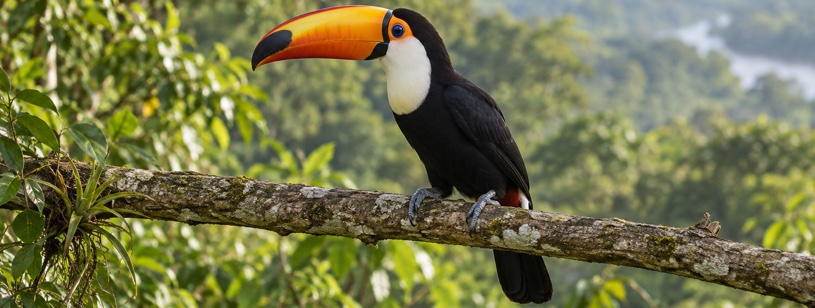
AI illustration of a toco toucan, used as an example of the toucan family.
Toucans are tropical American birds known for their large, colourful bills. The name covers several species in Ramphastidae, rather than one single species. They eat mainly fruit, but can also take insects, eggs and small animals.
The toco toucan (Ramphastos toco), illustrated here, is the largest member of the family. It has a black body, a white throat and chest, and an orange bill with a dark patch near the tip. Other toucans differ in size, colour and habitat.
Quick facts
| Group / family | Toucans / Ramphastidae |
| Class / order | Aves / Piciformes |
| Illustrated example | Toco toucan, Ramphastos toco |
| Distribution | Central and South America |
| Habitat | Mainly tropical forests; some species also use more open landscapes |
| Diet | Omnivorous, with fruit predominant |
| Activity | Mainly during the day |
| Movement | Flying between trees and hopping along branches |
| Nest | Usually a cavity |
| Size — toco example | Approximately 55–61 cm long and 500–860 g |
| Reproduction — toco example | Usually 2–4 eggs; incubation about 17–18 days |
| Conservation | Varies by species; the toco toucan is Least Concern (LC) |
Curiosities and fascinating facts
- The bill is lighter than it looks. Its interior contains a fine supporting structure and air spaces, rather than solid bone throughout.
- Two toes point forward and two backward. This arrangement helps a toucan grip branches.
- It can help forests regenerate. After eating fruit, toucans can transport and disperse plant seeds.
- A chick does not hatch with an adult-sized bill. The small bill grows as the young bird develops.
- The toco toucan's bill helps with cooling. Researchers have shown that the bird can alter blood flow through this structure.
Records and remarkable features
The toco toucan is the largest toucan species. Its total length is around 55–61 centimetres and its weight can reach about 860 grams. These measurements do not describe the whole family, which also includes much smaller birds.
A male toco's bill can exceed 20 centimetres. It allows the bird to reach fruit on slender branches without moving its whole body onto twigs that might not support its weight.
Heat exchange through the bill is another remarkable feature. Research on toco toucans demonstrates a role in temperature regulation, rather than simply an effect of the bill's striking colour or outline.
Physical characteristics
Toucans have long bills, relatively compact bodies and feet suited to life in trees. Bill and feather colours vary between species. Some birds are mainly black; others also show green, yellow or red.
| Feature | How it is used |
|---|---|
| Large, lightweight bill | Grasping and handling food; in the toco, also exchanging heat |
| Fine, serrated bill edges | Helping grip and process fruit |
| Long, narrow tongue | Fringed edges give it a feather-like appearance |
| Toes pointing in two directions | Providing a firm grip on branches |
The outer covering of the bill contains keratin, a material also found in human nails. A lightweight internal framework supports a large structure without the weight its size might suggest.
In the toco toucan, coloured skin around the eye can create the impression of a blue eye, but the iris itself is brown. Males and females look similar, with males tending to be slightly larger.
Habits and behaviour
Toucans are mainly active during the day. They may search for food in pairs or groups, moving between trees with ripe fruit. They hop between branches and fly between trees.
They are not silent birds. Depending on the species, calls can sound like croaks, grunts or harsh notes. Communication can also involve clapping the two parts of the bill together.
Partners may offer each other food and preen one another's feathers. Zoo observations also show curiosity towards their surroundings, but the behaviour of one bird in human care does not describe every wild toucan.
When resting, toucans can turn their heads and tuck their bills close to their bodies. This compact posture helps them fit into shelters that seem surprisingly small for a bird with such a large bill.
Habitat and geographical distribution
Toucans are native to tropical regions of the Americas. Their range includes Central America, which is geographically part of North America, and South America. They are not native birds of Romania.
Many species depend on tropical forests with large trees that supply food and nesting cavities. The family contains birds with different requirements, so a dense-jungle image does not explain the distribution of every toucan.
- Forest species depend on vegetation that provides food and places to nest.
- Mountain toucans inhabit higher-elevation forests in the Andes.
- The toco toucan also uses forest edges, patches of trees and wooded savannas.
Toco toucans occur in South America, including parts of Brazil, Bolivia, Paraguay and northern Argentina. Their use of more open landscapes distinguishes them from many other toucans.
Diet and feeding
Fruit is the main food, but toucans are omnivores. They may also eat insects, small lizards, eggs and sometimes the chicks of other birds. The proportions depend on the species and available food.
- The bird selects a fruit and grips it with the tip of its bill.
- It detaches or manipulates the food with the long bill.
- It lifts and moves its head to carry the food towards its throat.
Its ecological role can appear contradictory: it disperses seeds but can also raid nests. Toco toucans disperse the seeds of manduvi trees, whose hollows provide nesting sites for hyacinth macaws. The same toucans may eat eggs from macaw nests.
For other examples, explore the birds category. Toucans are not parrots; they belong to a different zoological order.
Reproduction and life cycle
Toucans usually nest in cavities. A female toco toucan normally lays two to four white eggs, with both parents sharing incubation and care of the chicks. Breeding seasons vary between regions.
| Stage — the toco toucan example | What happens |
|---|---|
| Incubation | Approximately 17–18 days. |
| Hatching | The chicks are featherless and have closed eyes. |
| Growing in the nest | They depend on their parents for food and protection. |
| Leaving the nest | Around 6–8 weeks in observations from managed care. |
The bill continues to develop after the first weeks of life. A small-billed chick does not necessarily belong to a small species: age greatly changes the bird's appearance.
There is no single lifespan for the entire family. Data from birds in managed care should also not be treated as a reliable average for all wild toucans.
Name and history
The name “toucan” comes from a Tupi name used in Brazil. It entered other languages and became the familiar name for these large-billed birds.
The family is Ramphastidae, while the toco toucan's species name is Ramphastos toco. Its scientific description dates to 1776. A family name and a species name represent different levels of classification.
Toucans belong to Piciformes, the order that also includes woodpeckers. Their resemblance to hornbills, which also have impressive bills, does not place the two groups in the same family.
Cultural significance and mythology
The toucan has also reached the map of the sky. Tucana, whose name means “the Toucan”, is one of the 88 constellations recognised by the International Astronomical Union.
This is a cultural and astronomical connection. It does not demonstrate a single toucan myth shared by all American communities. Different peoples' traditions cannot be combined into one story simply because they feature the same bird.
Conservation status and threats
Toucans do not share one conservation status. Assessments concern particular species. The toco toucan is classified as Least Concern (LC), while other members of the family face greater conservation risks.
- Forest loss can reduce food sources and nesting places.
- Removing old trees can eliminate the cavities birds need.
- Capture for the animal trade puts pressure on wild populations.
- Hunting remains a pressure in some regions.
Least Concern does not mean that every local population is safe. Habitat protection and reducing capture remain important even for relatively widespread species.
Zoos also participate in coordinated programmes for the toco toucan, including Saint Louis Zoo. Managing healthy populations in human care complements other conservation work.
In popular culture
A familiar example is Toucan Sam, the Froot Loops cereal mascot introduced in 1963. The large bill makes the character recognisable, but its colours and behaviour are stylised.
Cartoons, mascots and educational material can encourage interest in nature. Understanding a real toucan still requires attention to the particular species: its food, habitat, bill and living needs.
Frequently asked questions
- Where do toucans live? They are native to Central and South America. Habitats vary between species.
- What do toucans eat? Mainly fruit, with insects, eggs and small animals also included. They are omnivores.
- Why is the bill so large? It helps handle and reach food. In toco toucans, a role in heat exchange has also been demonstrated.
- Can toucans fly? Yes. They fly between trees and also hop along branches.
- Which is the largest toucan? The toco toucan, Ramphastos toco, at approximately 55–61 centimetres in total length.
- How many eggs do they lay? It depends on the species. Toco toucans usually lay two to four, incubated by both parents.
- Are toucans endangered? It depends on the species. The toco is Least Concern, while other species face higher risks.
- Is a toucan a parrot? No. Toucans belong to Ramphastidae and Piciformes, the order that also includes woodpeckers.
Did you know? About toucan
- Toucans belong to the same order as woodpeckers, rather than parrots.
- The toco toucan’s bill helps regulate body temperature.
- A toucan can disperse seeds after eating fruit.
- The constellation Tucana is named after the toucan.