Eurasian golden orioleOriolus oriolus — habitat, diet and reproduction
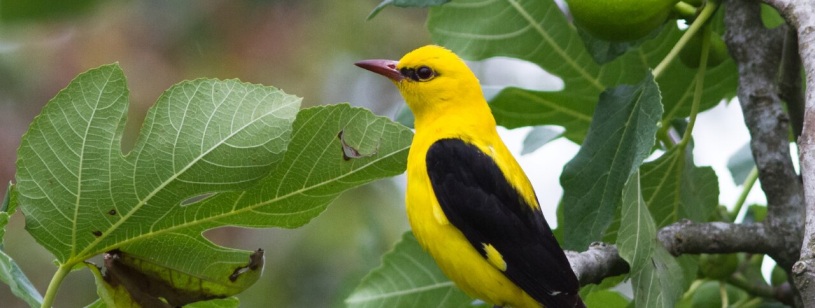
Male Eurasian golden oriole (Oriolus oriolus) in a fig tree. · Michel Idre from Plaisance du Touch, France / CC BY 2.0 (https://creativecommons.org/licenses/by/2.0). Cropped and resized.
The Eurasian golden oriole spends much of its time high in tree canopies. Males are bright yellow with black wings, yet can be surprisingly difficult to spot among leaves. Fluting notes often reveal them first. In Romania it is a summer visitor that arrives to breed.
Quick facts
| Common name | Eurasian golden oriole |
| Scientific name | Oriolus oriolus |
| Length | 24–25 cm |
| Weight | 42–102 g |
| Diet | Omnivore: mainly invertebrates and fruit |
| Conservation status | Least Concern (LC), globally |
| Distribution | Europe, parts of Asia and Africa |
| Habitat | Woodland, riverine trees, orchards and wooded parks |
| Family | Oriolidae |
| Reproduction | Usually 3–4 eggs in a suspended nest |
| Migration | Winters in sub-Saharan Africa |
| Sex differences | Male yellow and black; female greener, with streaked underparts |
- Primary category:Birds
- Explore this animal's categories:Animals of AfricaAnimals of AsiaAnimals of EuropeAnimals of RomaniaAnimals of Romania’s forestsAnimals of Romania’s gardens and parksArboreal animalsBirdsBirds of RomaniaEEgg-laying animalsFeathered animalsFlying animalsForest animalsInsect-eating animalsMigratory animalsMigratory birdsOmnivoresVertebratesWild animals
Interesting facts
- A brightly coloured male can be difficult to find among leaves.
- The nest hangs between branches like a small hammock.
- Its short whistled song is often compared with a flute.
- The same bird uses European and African habitats within a year.
Characteristics
An adult male has a golden-yellow body, largely black wings and tail, and a reddish bill. The contrast is striking in the open, but leaves and shadows break up its outline in the canopy.
Females are duller, with greenish-yellow tones, brownish wings and streaked pale underparts. Young birds lack the full adult male pattern. Identification combines plumage, shape, canopy behaviour and sounds.
Behaviour
Orioles move through high branches to forage and remain sheltered. They are often heard first. Male songs consist of short phrases separated by pauses.
Patient watching is more useful than repeatedly approaching the tree. Flights between crowns may reveal the bird briefly. During breeding, adults focus on feeding and protecting their young; song should be distinguished from the species’ other calls.
Habitat and distribution
The species breeds across much of Europe and parts of Asia, also using northern Africa. During the European winter it is mainly in sub-Saharan Africa.
Romanian breeding habitats include deciduous and riverine woodland, orchards and wooded parks, generally outside high mountain areas. Arrival is frequent in late April, with departure toward the end of summer. Lines of trees help connect usable habitats.
Diet and feeding
Invertebrates and fruit form the main diet. Birds search leaves and branches for insects and use seasonally available fruit.
Parents bring food to the nest, so canopy insect abundance affects provisioning. Diverse wooded gardens, parks and orchards offer more resources than simplified spaces with frequent insect-reducing treatments.
Reproduction and life cycle
The nest is attached within a horizontal branch fork. Woven plant fibres form a suspended cup, with its edges fastened to the branches. Other locally available materials may be included.
A clutch usually has three or four eggs, though numbers vary. Incubation takes about 13–20 days, and both parents feed the young. Nest departure occurs after a similar period but does not bring immediate independence.
Name and history
Oriolus oriolus is linked to the Latin aureolus, meaning golden, and belongs to Oriolidae. The name especially reflects adult male plumage.
English also uses oriole for American birds of another family. Common names do not replace scientific identification when comparing species.
Conservation and threats
The global category is Least Concern. Locally, tree and shelterbelt removal can eliminate feeding and nesting places.
Conservation includes mature trees, riverine woodland and habitat connections, as well as migration stopovers and African wintering areas. Suitable gardens and parks can also support the species.
Frequently asked questions
Are females equally yellow?
Females are generally greener and duller, with streaked underparts. Adult males have the bright yellow-and-black pattern.
Where is the nest built?
In a tree, suspended within a horizontal branch fork.
Where does it spend winter?
European populations migrate to sub-Saharan Africa.
Why is it heard more easily than seen?
It stays high among leaves that conceal its outline, while its song carries beyond the canopy.