LionInteresting facts and information
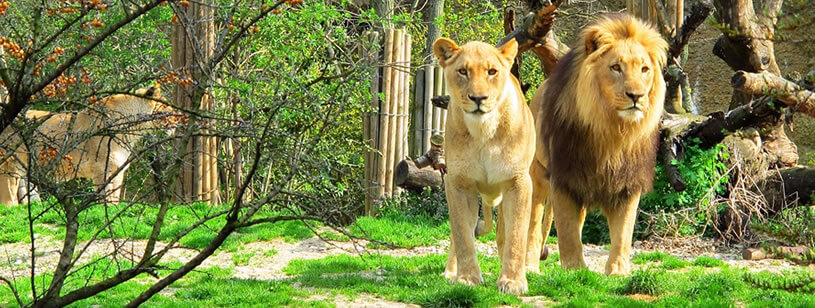
The lion (Panthera leo) is a large cat known for living in social groups called prides. Most wild lions live in Africa, with a separate population in India. Different members of a pride share the work of hunting, resting and raising the young.
Lions play an important role in African ecosystems by helping to keep herbivore numbers in balance. However, the species is declining because of habitat loss, poaching and conflict with people. Today most lions live in sub-Saharan Africa, with a small, isolated population of Asiatic lions in India.
Quick facts
| Common name | Lion |
| Scientific name | Panthera leo |
| Typical lifespan | 10-15 years in the wild, up to 25 years in captivity |
| Maximum speed | Up to about 80 km/h in short bursts |
| Dimensions | 1.1 - 1.2 m tall at the shoulder; 1.4 - 2.5 m long (head and body) |
| Weight | Males: 150 - 250 kg; females: 100 - 180 kg |
| Diet type | Carnivore (top predator) |
| Main predators | Humans (illegal killing, habitat loss) |
| Conservation status | Vulnerable (IUCN); the Asiatic lion population in India is Endangered |
| Distribution | Africa and India |
| Habitat | Savanna, dry forest, semi-desert |
Interesting facts
- The only truly social cat - Unlike other big cats, lions live in organised groups called prides, where the females do most of the hunting.
- Lions sleep a lot - They can rest for 16 to 20 hours a day, saving energy for hunting.
- A male's mane says a lot about him - A large, dark mane signals good health and strength and makes him more attractive to females.
- Their roar can be heard up to 8 km away - Lions roar to keep in touch with each other and to warn rivals away from their territory.
- The females in a pride are related - Most of them are sisters, mothers, daughters or cousins, and they usually stay in the same pride for life.
Records and remarkable features
- The lion is the second-largest living cat, after the tiger.
- It is the only wild cat that regularly lives and hunts in social groups.
- Its roar is the loudest of any big cat and can carry for about 8 km on a still night.
Characteristics
The lion is one of the largest land predators and the second-largest cat in the world, after the tiger. Males are easy to recognise by their impressive mane, while females are more agile and do most of the hunting.
Main physical features:
| Feature | Details |
|---|---|
| Length | 1.4 - 2.5 m (head and body) |
| Height | 1.1 - 1.2 m at the shoulder |
| Weight | Males: 150 - 250 kg; females: 100 - 180 kg |
| Colour | Tawny, ranging from pale beige to dark brown |
| Mane | Only in males; its colour changes with age and health |
| Retractable claws | Used to hold prey |
| Strong bite | Powerful enough to crush bone |
| Speed | Up to about 80 km/h over short distances |
Special adaptations:
- The male's mane - Protects the neck in fights with other males and shows dominance.
- Eyes adapted for night vision - Large pupils let lions see well in the dark, which helps them hunt.
- Strong legs - Give the power to leap and to pull down large prey.
- Large paws with soft pads - Let lions move silently before an attack.
Lions are top predators that combine strength, speed and social intelligence, which makes them unique among cats.
Habits and behaviour
Lions are the only cats that live in large groups called prides. Living together helps them hunt and defend their territory.
Social behaviour:
- Pride structure - A typical pride has 5-15 related females, their young and 1-4 adult males.
- Males defend the territory - A coalition of males patrols the pride's range, marking it with urine and loud roars.
- Females are the main hunters - Although males are bigger and stronger, females are faster and hunt as a team.
- The pride raises the cubs together - Females in a pride may nurse cubs that are not their own.
Feeding and hunting methods:
- Opportunistic predators - They eat antelopes, buffalo, zebras, giraffes and even young hippos.
- Team hunting - Lions use complex strategies, such as surrounding prey and attacking from several directions.
- Scavenging - When they get the chance, lions take prey from other predators, such as hyenas and leopards.
Defence and survival strategies:
- Clearly marked territories - Males mark their area with claw marks and urine to warn rivals.
- Frequent fights between males - Males must keep defending their place in the pride and are sometimes driven out by younger, stronger males.
- A risky time for cubs - When new males take over a pride, they often kill the cubs. The females then come into heat sooner, and the new males can father their own young.
Lions are highly social animals, and teamwork within the pride helps them hunt successfully and raise the next generation.
Habitat and geographic distribution
Lions live in many kinds of habitat, from African savannas to dry forests and semi-desert areas. They once ranged across much of Africa and Eurasia, but today they survive in a much smaller area.
Habitat types:
| Habitat | Main regions |
|---|---|
| Savanna | Sub-Saharan Africa |
| Open grassland | Kenya, Tanzania, South Africa |
| Dry forest | Gir National Park (India), parts of Africa |
| Semi-desert | Namibia, Botswana |
Geographic distribution:
- Africa - Most lions live in the African savanna, in national parks such as the Serengeti and the Maasai Mara.
- India - A small population of Asiatic lions survives in and around Gir National Park, in the state of Gujarat.
- Lost from other regions - Lions have disappeared from Europe, the Middle East and most of Asia, where they once lived.
Impact of human activities on lions:
- Habitat loss - Farmland and growing settlements reduce the land lions need for hunting.
- Conflict with farmers - When wild prey is scarce, lions attack cattle and are then killed in retaliation.
- Illegal killing - Lions are killed for trophies, bones and other body parts, some of which are used in traditional medicine.
Lions now survive in only a few regions of the world, and protecting them is important for the balance of African ecosystems.
Diet and feeding
Lions are top predators and eat a wide range of animals, from large herbivores to carrion. Hunting is vital for the pride, and working together gives lions a big advantage over solitary carnivores.
Types of food:
| Type of prey | Examples and context |
|---|---|
| Large herbivores | Zebra, buffalo, antelope, giraffe |
| Medium-sized prey | Warthogs, impalas, gazelles |
| Small animals | Hares, porcupines, birds |
| Scavenging | Taking kills from hyenas, leopards and cheetahs |
Hunting methods:
- Group hunting - Lionesses work as a team, surrounding prey and attacking from several directions.
- Stalking and ambush - Lions creep up quietly, using vegetation as cover to get close to their prey.
- Fast attacks - Over short distances they can sprint at up to about 80 km/h, but they tire quickly.
- A deadly hold - They pull prey down with their powerful paws and kill it with a bite to the throat or muzzle.
Feeding adaptations:
- Large, powerful canine teeth - For gripping prey and tearing meat.
- A stretchy stomach - A male can eat up to about 40 kg of meat in one meal and then go several days without food.
- Threat displays at the kill - While feeding, lions growl, bare their teeth and use their paws to keep their share.
Although they are excellent hunters, lions are also opportunists: they eat carrion and steal food from hyenas and other carnivores.
Reproduction and life cycle
Lions have a social system that is unique among cats. The adult males of a pride father most of the cubs, and the whole group helps protect the young.
Life cycle stages:
| Stage | Approximate timing | What happens |
|---|---|---|
| Mating | All year round | The pride's males mate with the females when they come into heat |
| Pregnancy | About 110 days | The female gives birth to 1-4 cubs |
| Early care | First 2-3 months | Cubs feed on milk and are kept hidden from predators |
| Learning to hunt | From 6-12 months | Cubs start learning hunting skills from adults |
| Maturity | 2-4 years | Young males leave or are driven out of the pride; females usually stay |
| Lifespan | 10-15 years in the wild | Males often live shorter lives because of fights over territory |
Reproductive behaviour:
- Mating access varies with pride membership and male coalitions. Lion societies should not be described using a universal alpha-wolf hierarchy.
- Females give birth alone - They keep their newborn cubs hidden for several weeks.
- Shared care of cubs - Females in a pride may nurse each other's cubs.
- Young males leave home - At about 2-3 years old, males are driven out and must find a territory of their own.
Lions are among the most social cats, and family bonds play a key role in the survival of the pride.
Name and history
The lion is one of the best-known and most admired animals in human history. It appears in mythology, heraldry and folklore from ancient times onwards.
Origin of the name:
- "Lion" - The word comes from the Latin leo, which in turn comes from the Greek leōn.
- The scientific name Panthera leo - Panthera is the genus of the big cats, and leo is the species name.
- Names in other languages - lion in French, asad in Arabic and simba in Swahili.
Taxonomic classification:
| Taxonomic rank | Name |
|---|---|
| Kingdom | Animalia |
| Phylum | Chordata |
| Class | Mammalia |
| Order | Carnivora |
| Family | Felidae |
| Genus | Panthera |
| Species | Panthera leo |
The lion in history:
- Ancient Egypt - Lions were symbols of power, and the goddess Sekhmet was shown with the head of a lioness.
- The Roman Empire - Lions were made to fight in arenas and were used as symbols of dominance.
- European heraldry - The lion stands for courage and nobility and appears on many coats of arms and flags.
- The legend of Heracles - The Nemean lion was a mythical beast that no weapon could wound; only the Greek hero managed to kill it.
For thousands of years, lions have been symbols of power and royalty, and they appear in a rich variety of myths and cultures.
Cultural significance and mythology
Many cultures have admired, feared and used the lion as a symbol, often linking it with divine power, royalty and protection. From ancient Egypt to European heraldry and African traditions, lions have played a central part in stories and legends.
The lion in myths and beliefs:
- Ancient Egypt - Lions were seen as guardians, and the fierce lioness goddess Sekhmet was linked with war and with protecting the pharaohs.
- Greek mythology - The Nemean lion, whose skin could not be pierced, was killed by Heracles as the first of his twelve labours.
- Sub-Saharan Africa - Lions are respected in many traditions as symbols of strength and leadership.
- Hindu mythology - Narasimha, with a lion's head and a human body, is an avatar of the god Vishnu, the protector of the universe.
- Medieval Europe - The lion became a symbol of royalty and appears on the coats of arms of many European monarchs, including that of England.
What the lion symbolises:
- Courage and power - Linked with leaders and warriors in many cultures.
- Royalty and nobility - A symbol of kings and rulers, used on crowns and seals.
- Protection and justice - In Asian traditions, stone lions guard temples and palaces.
Lions remain a strong presence in culture around the world and appear on national emblems, in sport and in art.
Conservation status and threats
Although the lion is a top predator, its numbers have fallen sharply over the last century. Lions once lived across Africa, Asia and southern Europe; today they survive only in parts of Africa and in western India.
Conservation status
| Species / population | Status (IUCN) |
|---|---|
| Lion (Panthera leo), species as a whole | Vulnerable |
| Asiatic lion (population in India) | Endangered |
| Barbary lion (North Africa) | Extinct in the wild |
Main threats:
- Habitat loss - The spread of farming leaves less space for prides.
- Conflict with people - Farmers kill lions to protect their cattle.
- Illegal killing and trophy hunting - Lions are killed for trophies, skins and bones, some of which are used in traditional medicine.
- Less wild prey - Overhunting of herbivores reduces the lions' natural food, so they turn to livestock.
Conservation efforts:
- National parks and reserves - The Serengeti, Kruger and Gir National Parks protect important lion populations.
- Relocation programmes - Some lions are moved to safer areas to avoid conflict with people.
- Campaigns against trophy hunting - Conservation groups are working to limit or ban it.
The number of African lions fell by more than 40% in about two decades. Without action, lions could disappear from the wild in some regions.
In popular culture
Lions in literature:
- The Lion, the Witch and the Wardrobe (C. S. Lewis, 1950) - Aslan, the great lion, stands for sacrifice and justice.
- Herodotus - In the writings of the ancient Greek historian, lions are linked with power and strength.
Lions in film and television:
- The Lion King (1994, 2019) - A classic story about family, honour and the struggle to survive.
- Madagascar (2005) - Alex the lion is the funny, charismatic main character.
Lions in video games and comics:
- The Witcher - The coat of arms of the Kingdom of Cintra shows lions, a symbol of royalty.
The lion as a cultural symbol:
- European heraldry - Royal coats of arms and national emblems often include a lion as a symbol of power.
- Logos and brands - Lions appear in the logos of car makers, banks and fashion companies.