HoopoeInteresting facts and information
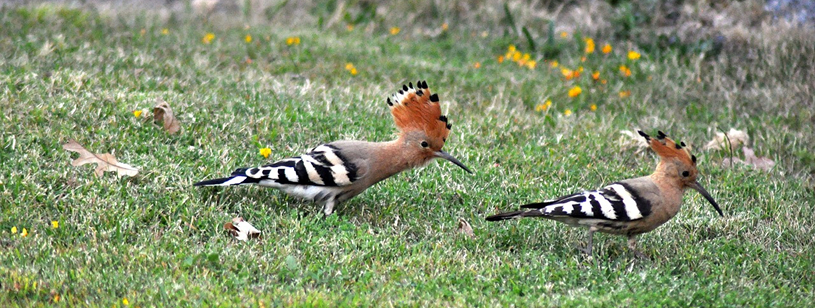
The Eurasian hoopoe (Upupa epops) is a bird with a crest, a long curved bill and boldly patterned wings. It searches the ground for insects and other small animals, often in open habitats with scattered trees.
Many Eurasian hoopoes migrate between breeding areas and wintering grounds in Africa; movements differ between populations.
As an insectivorous species, it plays an important role in the ecosystem, helping to control insect populations and larvae harmful to agriculture.
Quick facts
| Common name | Eurasian hoopoe |
| Scientific name | Upupa epops |
| Typical lifespan | Usually a few years; up to about 10 years in the wild |
| Length | About 25-32 cm |
| Wingspan | About 44–48 cm |
| Weight | About 50-90 g |
| Diet type | Insectivore (also spiders, worms and occasionally small lizards) |
| Main predators | Hawks, falcons, foxes, cats, snakes |
| Conservation status | Least Concern (IUCN) |
| Distribution | Europe, Asia and Africa |
| Living environment | Open land with scattered trees, orchards, vineyards, farmland, savannas, villages |
Interesting facts
- A crest like a fan - The hoopoe raises its black-tipped crest when excited or alarmed, and folds it back flat at other times.
- A smelly defence - Incubating females and chicks produce a foul-smelling oily liquid from a gland near the tail, which helps keep predators away.
- Chicks that hiss - When threatened, hoopoe chicks can hiss like a snake and squirt droppings at intruders.
- A long, curved bill - The hoopoe probes the ground with its bill to find insects and larvae hidden in the soil.
Records and remarkable features
- The Eurasian hoopoe (Upupa epops) is a bird with a crest, a long curved bill and boldly patterned wings. It searches the ground for insects and other small animals, often in open habitats with scattered trees.
Physical characteristics and unique adaptations
The hoopoe is an unmistakable bird, with a large crest and a long bill adapted for feeding in the soil.
Essential physical adaptations
- A striking crest - Made of long, orange-brown feathers with black tips, raised in moments of excitement or alarm.
- A long, thin, curved bill - Used to probe the soil and pull out larvae and insects.
- Bold colours - Orange-pink body with black-and-white bands on the wings and tail.
- Short, strong legs - Suited to walking and running on the ground.
- A defensive smell - Females and chicks in the nest produce a foul-smelling secretion that discourages predators.
Dimensions and variations between subspecies
| Characteristic | Details |
|---|---|
| Body length | About 25-32 cm |
| Wingspan | About 44-48 cm |
| Weight | About 50-90 g |
| Crest | Long feathers with black tips, which can be raised like a fan |
The hoopoe varies slightly between regions in colour and size, and several subspecies are recognised.
Habits and behaviour
The hoopoe usually lives alone or in pairs and spends much of its time feeding on the ground.
Life Mode
- Active by day - It spends the day looking for food on the ground, using its long bill to pull out insects and larvae.
- Butterfly-like flight - Its broad, rounded wings give it a slow, bouncing flight, a little like that of a large butterfly.
- Territorial - Males defend their territories by calling and sometimes fight rivals.
Social organisation
- Mostly solitary - Outside the breeding season, hoopoes usually live alone.
- Monogamous pairs - Pairs stay together for the breeding season.
- A distinctive call - Males repeat a soft "oop-oop-oop" call, which gave the bird its name.
Defence techniques
- Flattening on the ground - When a bird of prey appears, the hoopoe may press itself to the ground with its wings and tail spread.
- Smelly secretion - Chicks and incubating females produce an oily secretion that discourages attackers.
- Camouflage - Despite its bright colours, its striped pattern can help it blend into dappled ground.
Habitat and geographic distribution
The hoopoe is widespread in Europe, Asia and Africa, in many kinds of open habitats with scattered trees.
Population distribution
| Region | Presence |
|---|---|
| Europe | Breeds in spring and summer, mostly in the south and east; most birds winter in Africa |
| Africa | Wintering area for European birds; resident hoopoes also live in many parts of Africa |
| Central and South Asia | Breeding and resident birds; some populations winter in South Asia |
| Mediterranean | Resident and migratory populations |
Habitats
- Open countryside - It prefers open land with short grass or bare ground, where it can find insects easily.
- Orchards, vineyards and open woodland - It nests in tree holes or holes in old walls.
- Dry areas and savannas - In Africa and Asia, the hoopoe also lives in dry habitats.
- Villages and gardens - It often lives near people, feeding on lawns, pastures and farmland.
Impact of environmental change
- Pesticides - Intensive use of chemicals reduces the insects hoopoes eat.
- Loss of old trees - Removing old trees takes away nesting holes.
- Climate change - Changes in climate may affect migration timing and food supply.
Diet and feeding
The hoopoe feeds mainly on insects and larvae, which it pulls from the soil with its long, curved bill.
What does the hoopoe eat?
| Food type | Specific examples |
|---|---|
| Insects | Grasshoppers, crickets, mole crickets, beetles, ants |
| Larvae and worms | Beetle grubs, caterpillars, earthworms |
| Arachnids | Spiders, small scorpions |
| Small invertebrates | Snails, centipedes |
| Small vertebrates (occasionally) | Small lizards and frogs |
Method of feeding
- Probing the soil - It pushes its bill into the ground to find larvae and insects.
- Turning over stones and leaves - It looks for prey hidden under vegetation.
- Catching insects in the air - Rarely, a hoopoe catches flying insects.
Hoopoes eat many insect larvae that damage crops and lawns.
Reproduction and life cycle
The hoopoe is monogamous during the breeding season. It nests in holes in trees, walls, rocks or buildings.
Breeding season
- It starts in spring (April-June) in Europe and at different times in warmer regions.
- Males attract partners by calling and by bringing food to the female.
- Pairs defend the area around the nest from other hoopoes.
Nesting and eggs
| Characteristic | Details |
|---|---|
| Type of nest | Holes in trees, walls, rocks or buildings, sometimes nest boxes |
| Number of eggs | Usually 4-8 eggs, sometimes more |
| Incubation period | About 15-18 days |
| Chicks in the nest | About 26-29 days |
| Independence | About a week after leaving the nest |
Breeding of chicks
- The female incubates the eggs, and the male brings her food.
- Both parents feed the chicks once they are a few days old.
- When threatened, the chicks can produce a bad smell, hiss and squirt droppings to scare predators.
Name and history
Origin of name
- The English name "hoopoe" imitates the bird's "oop-oop-oop" call, as does the French huppe.
- The scientific name Upupa epops is also based on the call: upupa is the Latin name for the bird, and epops is its ancient Greek name.
Taxonomic Classification
| Classification | Name |
|---|---|
| Kingdom | Animalia |
| Phylum | Chordata |
| Class | Aves |
| Order | Bucerotiformes |
| Family | Upupidae |
| Genus | Upupa |
| Species | Upupa epops |
Evolution and fossils
- The hoopoe belongs to the order Bucerotiformes, together with the hornbills.
- Its closest relatives are the African wood hoopoes.
- The African and Madagascar hoopoes are sometimes treated as separate species.
Cultural significance and mythology
The hoopoe has been known since ancient times and appears in many myths, religious texts and stories.
- Ancient Egypt - The hoopoe appears in paintings on the walls of ancient Egyptian tombs.
- Greek mythology - In the myth of Tereus, the king is turned into a hoopoe; in Aristophanes' comedy "The Birds" (414 BC), Tereus as a hoopoe leads the birds.
- The Quran and Jewish tradition - The hoopoe is the bird that brings King Solomon news of the Queen of Sheba.
- Persian literature - In "The Conference of the Birds" by the 12th-century poet Attar, the hoopoe guides the birds on their journey.
- Israel - In 2008, the hoopoe was chosen as Israel's national bird.
Conservation status and threats
The hoopoe is not globally threatened, but its populations can be affected by habitat loss and pesticide use.
Conservation status
| Region | IUCN Status | Trends |
|---|---|---|
| Overall population | Least Concern | Decreasing slowly |
| Europe | Least Concern | Declines in some countries |
| Africa | Least Concern | Not well known |
| Central Asia | Least Concern | Not well known |
Main threats
- Pesticides and agricultural chemicals - Reduce the number of insects available as food.
- Loss of old trees and walls - Fewer nesting holes are available.
- Intensive farming - Loss of pastures and traditional orchards reduces feeding areas.
- Hunting - In some regions, hoopoes are still hunted or trapped.
Protection measures
- Protecting nesting sites - Keeping old trees and putting up nest boxes.
- Reducing pesticides - Organic farming and less chemical use help keep insect populations healthy.
- Awareness campaigns - Informing people about the role of hoopoes in farmland.
In popular culture
Literature
- "Amintiri din copilărie" (Memories of My Boyhood) - The Romanian writer Ion Creangă tells the famous story of the hoopoe in the linden tree, "Pupăza din tei".
- "The Birds" (414 BC) - The ancient Greek comedy by Aristophanes, in which the hoopoe is a main character.
Symbols
- National bird - The hoopoe is the national bird of Israel.
- Stamps - The hoopoe appears on stamps in many countries in Europe, Asia and Africa.