Bare-nosed wombatVombatus ursinus — habitat, diet and reproduction
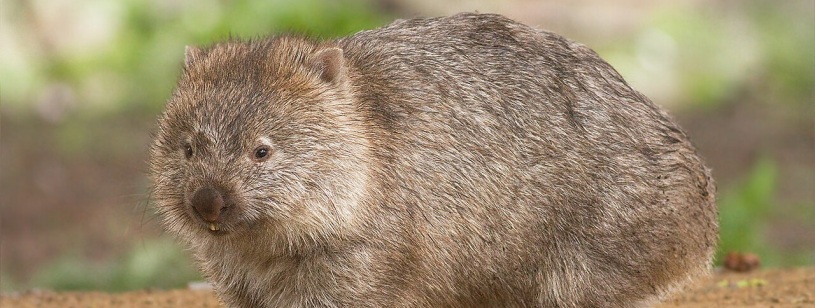
Common wombat seen from the side with its face turned towards the camera. · JJ Harrison (jjharrison89@facebook.com) / CC BY-SA 3.0 (https://creativecommons.org/licenses/by-sa/3.0). Cropped and resized. Source: https://commons.wikimedia.org/wiki/File:Vombatus_ursinus_-Maria_Island_National_Park.jpg
The bare-nosed wombat (Vombatus ursinus) is a stocky Australian mammal with short legs. It digs burrows and feeds mostly on grasses. Females raise a single young in a pouch. Wombats are marsupials and close relatives of the koala.
Quick facts
| Common name | Bare-nosed wombat; common wombat |
| Scientific name | Vombatus ursinus |
| Lifespan | Typically around 12–15 years in the wild; at least 30 years documented in captivity |
| Length | Around 84–115 cm in mainland populations |
| Weight | Around 22–39 kg on the mainland; island populations are often smaller |
| Diet | Grasses, sedges and other plant material |
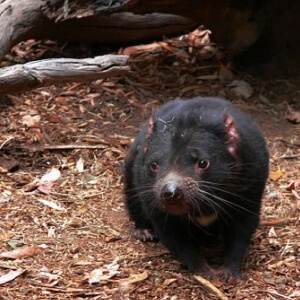
| Predators | Wild dogs; Tasmanian devils and eagles in Tasmania, especially for vulnerable individuals |
| Conservation status | Least Concern globally |
| Distribution | Southeastern Australia, Tasmania and nearby islands |
| Habitat | Open woodland, grassland and soils suitable for burrowing |
| Family | Vombatidae |
| Reproduction | Usually one young developing in a pouch |
- Primary category:Mammals
- Explore this animal's categories:
Interesting facts
- The backward-facing pouch helps keep soil out during digging.
- Cube-shaped droppings form within the intestine.
- Incisors and molars grow continuously as fibrous food wears them down.
- Daytime activity is common in cool conditions and particularly noticeable on Maria Island.
Records and extremes
Wombats are among the largest burrowing herbivorous mammals. NSW Environment describes burrow systems reaching approximately 30 m in length.
AnAge records a captive individual still alive at an estimated age of at least 30 years. This exceptional case differs from typical wild survival.
Characteristics
A broad head, powerful shoulders and short limbs suit digging. The large nose lacks fur, the ears are rounded and the tiny tail is almost hidden.
Coarse fur ranges from grey and brown to almost black. Soil can stain it. The other two living wombat species have hairy noses; this is the sole living Vombatus species.
Behaviour
The animal commonly rests underground by day and emerges in cooler evening or night conditions. Burrows buffer temperature extremes. Daytime activity also occurs.
Usually solitary, wombats can have overlapping home ranges and use the same burrow at different times. Scent and droppings mark familiar places.
Research found that drying contents, muscular contractions and alternating stiff and flexible intestinal regions produce the corners of cubed faeces.
Habitat and distribution
The species occurs in southeastern mainland Australia, Tasmania and several islands. Distribution is fragmented in some regions. Island populations are often smaller-bodied.
Open temperate woodland, grassland and scrub provide habitat where soils allow digging and drainage. Slopes beside valleys can support galleries, with nearby grass for feeding.
Diet and feeding
Grasses dominate, supplemented by sedges, roots, leaves and other plants. Incisors cut vegetation and molars grind it.
Slow digestion helps extract resources from fibrous food. Efficient water absorption contributes to dry droppings. Repeated visits can keep favoured grass patches short.
Reproduction and life cycle
Gestation lasts around 27–30 days. Usually one tiny, undeveloped young crawls into the pouch and attaches to a teat.
The young spends roughly 6–10 months in the pouch, depending on population and the stage of emergence being described. Milk feeding continues after early outings.
Dependence may extend to around 18 months. Prolonged care limits reproductive pace, with much development occurring after birth.
Name and history
George Shaw described the species in 1800. Ursinus refers to its bear-like appearance. Modern classification places it in Vombatidae.
Common wombat remains a familiar name, but bare-nosed wombat describes a distinctive feature. The Australian Museum notes that the word common can obscure fragmented distribution.
Conservation and threats
The global status is Least Concern, but habitat loss, road collisions and agricultural conflict affect local populations.
Sarcoptic mange is caused by skin-burrowing mites and can produce hair loss, wounds and severe wasting. Shared burrow environments can aid transmission.
Suspected cases should be reported to local wildlife specialists. Observe from a distance and drive carefully in wombat habitat, especially around dusk.
Frequently asked questions
Is a wombat a rodent?
It is a marsupial in Vombatidae, related to the koala.
Why does the pouch face backwards?
This helps keep soil out while the female digs.
How do cube-shaped droppings form?
Intestinal contractions, drying and differing tissue elasticity shape them.
Is it active only at night?
It can also emerge by day, especially in cool conditions.
How many young are born?
Usually one, which develops in the pouch for several months.
What is wombat mange?
A mite-caused disease that can severely damage the skin and requires specialist care.