Common fruit flyDrosophila melanogaster — habitat, diet and reproduction
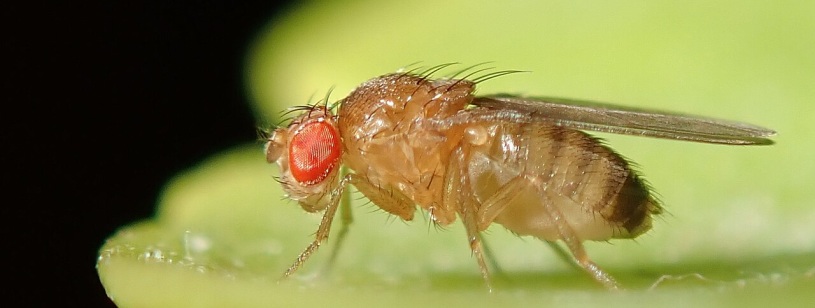
Common fruit fly (Drosophila melanogaster) on a leaf. · Alexis / CC BY 4.0 (https://creativecommons.org/licenses/by/4.0). Cropped and resized.
The common fruit fly is a tiny fly, only a few millimetres long, with a yellowish-brown body and bright red eyes. In summer it appears around overripe fruit, compost and vinegar. For scientists it is one of the most important laboratory animals, studied for more than a hundred years.
Quick facts
| Common name | Common fruit fly, vinegar fly |
| Scientific name | Drosophila melanogaster |
| Lifespan | About 50 days from egg to death |
| Length | About 2.5 mm in females; males slightly smaller |
| Diet | Yeasts and juices of fermenting fruit |
| Predators | Spiders, parasitic wasps, small birds |
| Conservation status | Not evaluated; very widespread |
| Distribution | Almost worldwide, near people |
| Habitat | Orchards, markets, kitchens, compost |
| Family | Drosophilidae |
| Development | Egg to adult in about 9 days at 25 °C |
- Primary category:Insects
- Explore this animal's categories:
Interesting facts
- Research on fruit flies has led to several Nobel Prizes in medicine.
- A female lays about 400 eggs in her lifetime.
- At 25 °C, a fruit fly goes from egg to adult in about 9 days.
- Fruit flies were among the first animals sent into space, in 1947.
Characteristics
The fruit fly has a yellowish-brown body, an abdomen with dark bands and large red eyes. Its wings are clear with fine veins.
Males are slightly smaller than females, with a darker tip to the abdomen. They are small enough to pass through many ordinary window screens.
Behaviour
Fruit flies are attracted by the smell of fermenting fruit, vinegar, wine and beer, detecting substances produced by yeasts from a distance.
They appear in summer in kitchens, markets and near compost. Because they breed very quickly, a few flies can become hundreds in days if rotting fruit is available.
Habitat and distribution
The species probably originated in Africa but has followed people around the world with fruit and now lives on almost every continent.
In Romania it is very common in summer in homes, orchards and vineyards.
Diet and feeding
Fruit flies feed not on the fruit itself but on yeasts and bacteria growing on fermenting fruit. Larvae develop in the soft pulp of spoiled fruit.
This helps break down fallen fruit, but in kitchens they can spoil fruit kept too long in the warm.
Reproduction and life cycle
The female lays a few eggs at a time on soft fruit or decaying mushrooms, up to about 400 in total. Eggs hatch in 12–15 hours.
Larvae grow, pupate and become adults, taking about 9 days at 25 °C and much longer at lower temperatures. Females can mate within hours of becoming adults.
Name and history
The scientific name Drosophila melanogaster means “black-bellied dew lover”.
From 1910, geneticist Thomas Hunt Morgan studied white-eyed flies and showed that genes are carried on chromosomes. Since then the fruit fly has helped discoveries about heredity, sleep, the biological clock and embryo development, rewarded with several Nobel Prizes.
Conservation and threats
The fruit fly is not threatened and does not transmit serious diseases to people; it is mainly a kitchen nuisance.
To get rid of it, keep ripe fruit in the fridge, throw away scraps and empty the compost bin often. A simple trap is a glass of cider vinegar with a drop of washing-up liquid.
Frequently asked questions
Where do fruit flies in the kitchen come from?
Eggs are often already on bought fruit, and adults fly in attracted by ripe fruit and vinegar.
How do you get rid of fruit flies?
Keep fruit in the fridge, throw away scraps and use a trap with cider vinegar and a drop of washing-up liquid.
How long does a fruit fly live?
About 50 days from egg to death in good conditions.
Why do scientists study fruit flies?
They breed fast, are easy to raise and share many genes with humans.