Scolopendra centipedeScolopendra — habitat, diet and reproduction
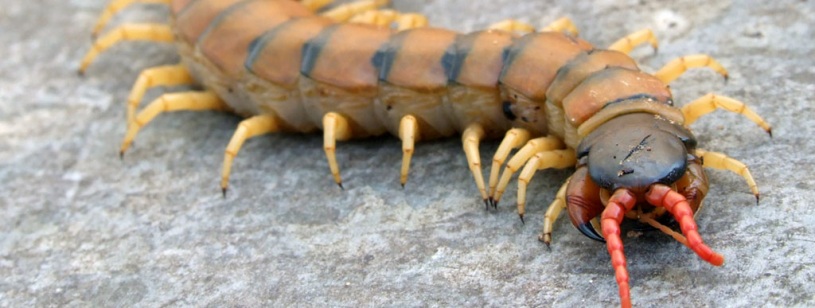
Scolopendra cingulata, also found in Romania, representing the genus Scolopendra. · ערן פינקל / CC BY-SA 3.0 (https://creativecommons.org/licenses/by-sa/3.0). Cropped and resized.
Scolopendra is a genus of predatory centipedes with segmented bodies and many pairs of legs. Beneath the head, modified appendages form venom claws used to capture prey. The genus contains several species. One, Scolopendra cingulata, also lives in Romania in warm places with suitable shelter.
Quick facts
| Common name | Scolopendra centipede; several species |
| Scientific group | Genus Scolopendra; photograph shows Scolopendra cingulata |
| Diet | Carnivore |
| Conservation status | Varies between species and populations |
| Distribution | Mainly tropical, subtropical and warm temperate regions |
| Habitat | Shelter beneath stones, wood and plant debris |
| Length | S. cingulata can reach around 12 cm; other species differ |
| Class | Chilopoda, a group of myriapods |
| Family | Scolopendridae |
| Legs | S. cingulata has 21 pairs |
| Reproduction | Eggs; females may care for eggs and young |
- Primary category:Arthropods
- Explore this animal's categories:
Interesting facts
- These are not insects: they have far more than six legs.
- Venom claws evolved from a modified appendage pair.
- Female S. cingulata may coil around eggs and young.
- Colour can vary considerably within one species.
Characteristics
The elongated, flattened body consists of segments. Antennae sit on the head, and each leg-bearing segment carries one pair of legs.
Scolopendra cingulata may have contrasting legs and a yellow-brown or darker trunk. Colour alone does not establish identity. It can reach approximately 12 cm, while some tropical relatives grow larger. Photographs of giant species should not be treated as typical Romanian centipedes.
Behaviour
Scolopendra spend much time under cover and often hunt when conditions reduce the risk of drying out. Antennae and contact with the ground help them explore narrow spaces.
They are generally solitary. Disturbed individuals may retreat or defend themselves, using flexible bodies and coordinated legs to change direction quickly. Repeatedly moving shelters can disturb both the animal and the humid conditions beneath them.
Habitat and distribution
The genus occurs across many warm regions. Scolopendra cingulata is associated with the Mediterranean and extends into other European and western Asian areas.
In Romania it is known from Dobrogea and other suitable locations, including populations near the northern European range limit. Apparently dry landscapes can contain moister pockets under stones. These small-scale conditions matter to the animals living there.
Diet and feeding
Prey mainly consists of small animals, including insects and other arthropods. Large tropical species may also take small vertebrates, but that does not describe every individual’s diet.
The body and appendages help seize prey. Forcipules, the claws immediately beneath the head, inject venom and assist immobilisation. Venom serves hunting and defence. Large centipedes can inflict painful bites and are best observed without handling.
Reproduction and life cycle
Female Scolopendra cingulata lay eggs in shelter and coil around them. Care continues after hatching until the young are more developed.
Laboratory work shows that the mother’s presence is important to early survival. This is parental care in an animal not usually associated with that behaviour. Growth involves moulting, and development differs between species and conditions, preventing one timetable from describing the entire genus.
Name and history
Scolopendra is a genus in Scolopendridae, within the centipede class Chilopoda. It should not be confused with millipedes, which generally have two leg pairs on their double body segments.
Both groups are arthropods, but their body organisation differs. Names suggesting one hundred or one thousand legs should not be read as exact counts.
Conservation and threats
Conservation situations vary between species and populations. A widespread Mediterranean species may have small isolated populations near its range edge.
Such populations help researchers understand distribution history and climatic adaptation. Loss of shelters and habitat alteration can affect local conditions. Scolopendra are part of Romania’s natural predator communities, and their role extends beyond reactions to their appearance or venom.
Frequently asked questions
Is Scolopendra an insect?
No. It is a centipede in the class Chilopoda, with many pairs of legs.
Does it occur in Romania?
Yes. Scolopendra cingulata is documented in Dobrogea and other suitable areas.
Does it have exactly one hundred legs?
No. Scolopendra cingulata has 21 pairs, or 42 legs.
Does the female care for young?
In Scolopendra cingulata, females coil around eggs and early young to protect them.