Moray eelMuraenidae — habitat, diet and reproduction
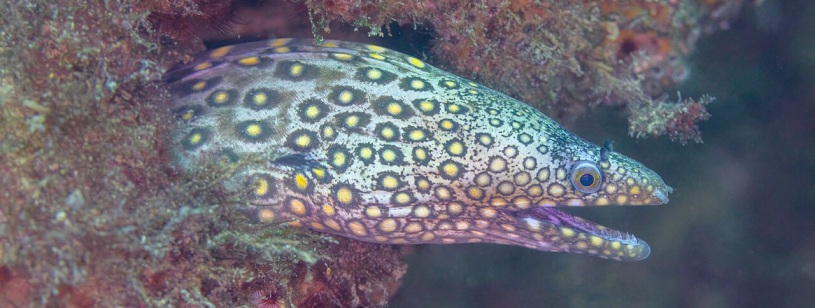
Jewel moray (Muraena lentiginosa) emerging from a crevice. · Diego Delso / CC BY-SA 4.0 (https://creativecommons.org/licenses/by-sa/4.0). Cropped and resized.
Moray eels are long, muscular, scaleless fish that look like snakes. They live in warm and temperate seas, hiding by day in reef and rock crevices. A second set of jaws in the throat shoots forward to pull prey inside.
Quick facts
| Common name | Moray eel |
| Scientific name | Muraenidae (family) |
| Lifespan | Several decades in some species |
| Length | From about 11 cm to about 4 m, by species |
| Diet | Carnivore: fish, octopus, squid, crabs |
| Predators | Sharks, large groupers, other morays |
| Conservation status | Most species Least Concern (LC) |
| Distribution | Tropical and temperate seas worldwide, including the Mediterranean |
| Habitat | Coral reefs, rocky areas, shipwrecks |
| Family | Muraenidae |
| Scales | None |
- Primary category:Fish
- Explore this animal's categories:
Interesting facts
- A moray opens and closes its mouth constantly to breathe, not to threaten.
- In its throat is a second set of jaws that lunges forward, like in the film “Alien”.
- In the Red Sea, morays and groupers sometimes hunt together.
- The Romans kept Mediterranean morays in special ponds.
Characteristics
Morays have an elongated body, flattened towards the tail, and a continuous fin along the back that joins the belly fin. They lack pectoral fins and scales. Thick skin is covered with mucus.
The head has long, sharp, backward-pointing teeth that keep prey from escaping. Colours vary widely: spotted, striped, green, yellow or black morays exist.
Behaviour
Morays spend the day in crevices with only their head showing. They hunt mostly at night and find prey by smell, as their eyesight is fairly poor.
They can enter narrow holes other predators cannot reach. In the Red Sea, groupers signal to morays with head movements and the two hunt together: the moray enters crevices and the grouper catches fish that flee.
Habitat and distribution
The family lives in tropical and subtropical seas worldwide. The Mediterranean moray (Muraena helena) also lives in the eastern Atlantic. Morays do not live in the Black Sea.
They favour coral reefs, rocky areas and wrecks, usually in shallow water.
Diet and feeding
Morays eat fish, octopus, squid, crabs and shrimp. Species with rounded teeth crush crustacean shells.
When the mouth seizes prey, the throat jaws shoot forward, grab it and pull it towards the stomach. This lets them swallow large prey without fins to hold it.
Reproduction and life cycle
Morays spawn in open water. Transparent, flattened larvae hatch and drift in the ocean for months before settling on reefs.
In some species an individual can change sex during its life. Morays grow slowly and can live a long time.
Name and history
The word “moray” comes from the Latin “muraena”, used by the Romans for the Mediterranean moray. Wealthy Romans kept them in ponds as a delicacy.
The flesh of some tropical morays can cause a poisoning called ciguatera because of toxins built up through their food.
Conservation and threats
Most species are assessed as Least Concern. Morays are locally affected by coral reef destruction, pollution and collection for aquariums.
Divers who hand-feed morays may be bitten by accident, because the fish sees poorly and relies on smell. The bite can be serious and may become infected.
Frequently asked questions
Why does a moray keep opening its mouth?
To pump water over its gills and breathe. It is not a sign of aggression.
Is the moray eel dangerous?
It does not attack people without reason but may bite if disturbed or hand-fed.
Can moray eels be eaten?
The Mediterranean moray is eaten, but the flesh of some tropical morays can cause poisoning.
Do morays live in the Black Sea?
No. They live in the Mediterranean and warm seas, but not the Black Sea.