European rollerCoracias garrulus — habitat, diet and reproduction
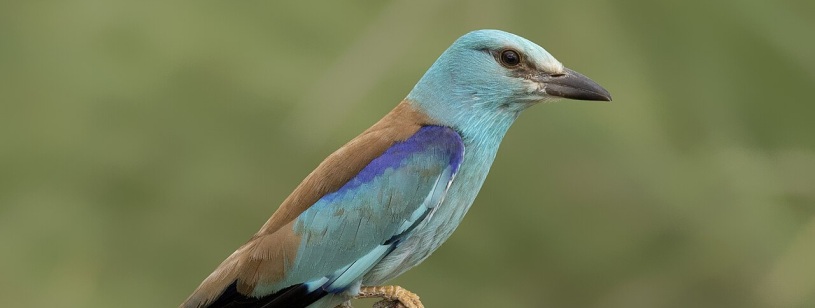
European roller (Coracias garrulus) on a dry branch. · Zeynel Cebeci / CC BY-SA 4.0 (https://creativecommons.org/licenses/by-sa/4.0). Cropped and resized.
The European roller is a blue bird with a reddish-brown back, found in sunny open landscapes. It often watches the ground from a branch or wire before dropping to catch large insects. It breeds in Romania in summer and spends the colder season in sub-Saharan Africa.
Quick facts
| Common name | European roller |
| Scientific name | Coracias garrulus |
| Length | 29–32 cm |
| Wingspan | 52–57 cm |
| Weight | 127–170 g |
| Diet | Carnivore, predominantly insect-eating |
| Conservation status | Least Concern (LC), globally |
| Distribution | Breeds in Europe and Asia; winters in sub-Saharan Africa |
| Habitat | Grassland and mixed farmland with trees and cavities |
| Family | Coraciidae |
| Reproduction | 3–6 eggs in a tree hole or another cavity |
| Occurrence in Romania | Migratory breeder, mainly in lowlands |
- Primary category:Birds
- Explore this animal's categories:
Interesting facts
- Blue head and wing feathers contrast with a reddish-brown back.
- It watches the ground from a raised perch before striking.
- Tree holes and other suitable cavities can serve as nest sites.
- An old isolated tree may provide an important nest hole in grassland.
Characteristics
The head, underparts and much of the wings are blue with greenish shades. The back is reddish brown. Flight reveals more of the colour pattern than folded wings do.
The strong dark bill is slightly hooked at the tip. Males and females look similar. Its size is roughly comparable with a jackdaw, but its colours differ greatly. This is a wild bird dependent on open habitats, food and nesting places.
Behaviour
Hunting from a raised perch is characteristic. A bird scans the ground, drops to accessible prey and often returns to a support to handle and swallow it.
Pairs occupy breeding sites rather than usually forming large colonies. A suitable cavity can influence territory choice. Migration takes birds through different landscapes, where stopover food is also necessary.
Habitat and distribution
Rollers favour warm open regions with grassland, pasture and varied farmland. Scattered trees and woodland edges provide lookout points and cavities.
In Romania they occur mainly in lowlands, including the Danube floodplain, Dobrogea and parts of the southern, eastern and western plains. Dense mountain forest is not typical habitat. Arrival is usually in late April or early May, followed by departure toward Africa in late summer.
Diet and feeding
Large insects form most of the diet, including crickets, beetles, mole crickets and other available invertebrates. Small vertebrates are taken occasionally.
Short vegetation and accessible ground make prey easier to detect. Habitat mosaics can offer more feeding opportunities than uniform landscapes. Insect loss reduces food available to both adults and chicks.
Reproduction and life cycle
Nest sites include mature-tree holes, cavities in earthen banks and other sheltered spaces. Suitable nest boxes can be used in monitored conservation projects.
Females lay about three to six eggs. Incubation lasts 17–19 days, mainly undertaken by the female. Young are fed in the nest and leave after about 25–30 days. Food abundance alone cannot compensate for the loss of nesting holes.
Name and history
The scientific name is Coracias garrulus. Coracias is linked to a Greek comparison with a crow, referring to its voice; garrulus means talkative in Latin.
The Romanian name evokes groves, but the species chiefly uses semi-open landscapes. Grassland and isolated trees are central to understanding its habitat.
Conservation and threats
The global category is Least Concern, although European populations have experienced declines and local losses. Global status does not automatically describe each region.
Threats include grassland loss, fewer insects and removal of hollow trees. Nest boxes may help where cavities are scarce, but feeding habitat must also remain. Monitoring should avoid unnecessary nest disturbance.
Frequently asked questions
Where can a European roller be seen?
In sunny open country, often on wires, posts or branches overlooking the ground.
What does it eat?
Mainly large insects and other invertebrates, with occasional small vertebrates.
Does it nest in trees?
It uses tree holes, but also earthen-bank cavities and other sheltered sites.
Are nest boxes enough to protect it?
They may help when cavities are scarce, but grassland, insects and suitable feeding habitat are also needed.