SnailInteresting facts and information
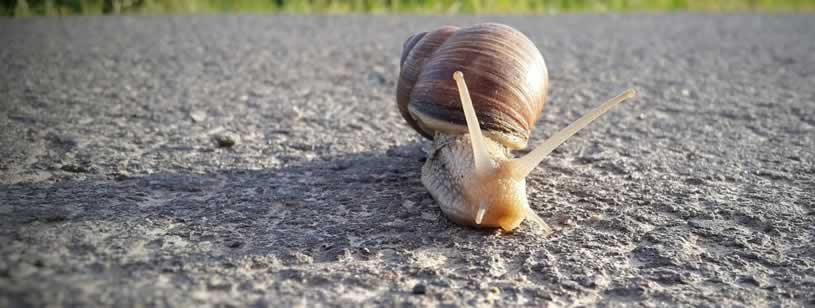
Snails are gastropod molluscs, a group that also includes slugs. Different species live on land, in freshwater or in the sea, with very different sizes, diets and adaptations.
A snail’s shell is produced by the mantle and helps protect its body. Many land snails reduce their activity during cold or dry conditions, although the response varies between species.
Snails have roles in food webs and nutrient cycling. Some are eaten by people, some damage crops and others face serious conservation threats.
Quick facts
| Common name | Snail |
| Scientific name | Gastropoda (class of molluscs that includes snails and slugs) |
| Typical lifespan | Often 1-5 years; some species live 10-20 years or more |
| Maximum speed | Varies by species; a garden snail moves at about 1 mm per second |
| Dimensions | From under 1 mm to about 90 cm (shell length), depending on the species |
| Weight | From a fraction of a gram to about 1 kg (giant African snails) and more for large sea snails |
| Diet type | Herbivore, carnivore or omnivore (depending on the species) |
| Main predators | Birds (such as thrushes), hedgehogs, beetles, rats, frogs, fish, humans |
| Conservation status | Varies by species; some are threatened, while certain introduced species are invasive |
| Distribution | Land, freshwater and marine habitats in many regions; Antarctic examples are primarily marine |
| Habitat | Forests, gardens, grasslands, fresh water, seas, caves, deserts |
Interesting facts
- Periods of inactivity – Some land snails become inactive in cold or dry conditions, reducing water loss and energy use.
- They move on their "belly" - Snails glide on a single muscular foot, producing slime that helps them move and protects them from rough surfaces.
- They have thousands of tiny teeth - Snails have a radula, a ribbon-like tongue covered with rows of microscopic teeth, which they use to scrape up food; some have more than 10,000 teeth.
- Predatory snails – Some marine cone snails use venom to capture prey, including fish.
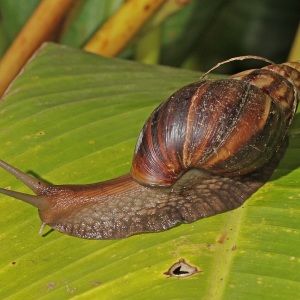
- Large land snails – African giant snails such as Achatina achatina can grow much larger than familiar garden snails.
Records and remarkable features
- The largest snail - The Australian trumpet (Syrinx aruanus), a sea snail, can have a shell about 90 cm long and weigh up to about 18 kg.
- The smallest snails - Tiny land snails of the genus Angustopila, from Asia, have shells less than 1 mm across.
- Snail speed - A garden snail moves at about 1 mm per second; at that pace, it would need more than a week of non-stop crawling to cover 1 kilometre.
- Long lives - Some land snails, such as the Roman snail, can live for 20 years or more.
- Dangerous cone snails – Some species can cause life-threatening poisoning if they sting; never handle a live cone snail.
Characteristics
Snails are gastropod molluscs with a soft body protected by a coiled shell. Over time, they have evolved many shapes, sizes and adaptations that let them live in very different environments.
Main physical characteristics
| Feature | Details |
|---|---|
| Size | From under 1 mm to about 90 cm (shell length), depending on the species |
| Weight | From a fraction of a gram to about 1 kg (giant African snails) and more for large sea snails |
| Colour | Many colours: brown, green, white, yellow, striped or spotted |
| Shell | Usually coiled in a spiral, made of calcium carbonate; protects the soft body |
| Eyes | Land snails have eyes at the tips of their upper tentacles, which sense light and shade |
| Foot | A large muscular foot that moves the snail with waves of muscle contraction |
| Slime | Helps the snail glide and protects it from drying out |
| Sense organs | Tentacles that sense smell and touch |
Special adaptations
- A protective shell - Snails can pull their whole body into the shell to escape predators or harsh weather.
- Useful slime - Besides helping them move, slime protects them from drying out and from sharp surfaces.
- The radula - A tongue-like ribbon covered with thousands of tiny teeth, used to scrape and grind food.
- Different ways of breathing - Land snails breathe with a simple lung, while many water snails have gills.
- Regeneration - Some snails can regrow damaged tentacles and even eyes.
Habits and behaviour
Snails live slowly, but they are very adaptable and good at finding and using the resources around them.
Social behaviour
- Solitary, but often together - Snails live independently, but many may gather where there is plenty of food or shelter.
- Chemical communication - They follow slime trails and scents to find mates.
- Reacting to danger - They quickly pull back into their shell, and some produce bitter or frothy slime to put off attackers.
Feeding and survival methods
- A varied diet - Most land snails eat plants, but some species are carnivores or scavengers.
- Feeding - They use their radula to scrape leaves, algae, fungi and even dead animals.
- Resting through hard times - When it is too cold or too dry, land snails seal the opening of their shell with a layer of dried mucus called an epiphragm.
- Slow but steady movement - Waves of muscle contractions move them along on a layer of slime.
Defence and survival strategies
- The shell as a shelter - Snails retreat into their shell when attacked.
- Different defences – Many snails produce mucus; cone-snail venom is delivered through a specialised tooth rather than ordinary mucus.
- Camouflage - Many species have colours and patterns that help them blend in.
Habitat and geographic distribution
Snails live on every continent and in every ocean. They have adapted to a huge range of environments, from tropical forests and seas to caves, deserts and cities.
Habitat types
| Habitat | Examples of regions |
|---|---|
| Tropical and temperate forests | South America, Southeast Asia, Europe |
| Towns and gardens | Almost everywhere, especially in damp places |
| Seas and oceans | Mediterranean, Atlantic, Pacific |
| Caves and underground habitats | The Balkans, Central America |
| Deserts and dry areas | North Africa, Australia, the Middle East |
Geographic distribution
- Europe and North America - Garden snails (Cornu aspersum) are very common.
- Africa and Asia - Giant land snails, such as Achatina achatina, thrive in warm climates.
- The world's oceans - Sea snails, including venomous cone snails (Conus), live on coral reefs and in many other marine habitats.
- Extreme places - Snails live in the deep sea, thousands of metres down, and in the cold seas around Antarctica.
Impact of human activities on snails
- Spread by people - Trade and travel have spread invasive species, such as the giant African land snail, to many countries.
- Pesticides - They have reduced native snail populations in many regions.
- Climate change - Droughts and extreme temperatures affect snails' resting periods and survival.
- Overcollecting - Some rare species are collected for their shells, for food or for the pet trade.
Snails are adaptable, but they are also sensitive to environmental change, and many species that live in small areas are threatened with extinction.
Diet and feeding
Snails have very varied diets: there are herbivorous, omnivorous and carnivorous species. Most feed by scraping surfaces with their radula, a ribbon covered with thousands of microscopic teeth.
Types of food
| Food group | Examples of snails that eat it |
|---|---|
| Leaves, herbs, lichens | Garden snails (Cornu aspersum), Roman snails |
| Fruit and vegetables | Giant African snails (Achatina achatina) |
| Algae and decaying matter | Freshwater snails, such as the great pond snail (Lymnaea stagnalis) |
| Meat and small invertebrates | Cone snails (Conus species) and predatory land snails such as Euglandina rosea |
| Calcium (chalk, eggshells, old shells) | Needed by all snails to build and repair their shells |
Feeding methods
- The radula - Most snails use their radula like a rasp to scrape plants, fungi or algae off surfaces.
- Hunting snails - Cone snails catch prey with a venomous, harpoon-like tooth.
- Eating calcium - To keep their shells strong, snails eat chalky soil, old shells or eggshells.
- Night feeding - Most land snails feed at night or after rain, when it is damp and cool.
Thanks to their varied diet, snails play an important role in recycling dead plants and controlling algae.
Reproduction and life cycle
Many snails, including most land snails, are hermaphrodites, which means each snail has both male and female organs. Usually, however, two snails must mate to produce fertile eggs.
Life cycle stages
| Stage | Approximate timing | Details |
|---|---|---|
| Mating | Mainly in spring and summer (land snails) | The two partners exchange sperm |
| Egg-laying | A few days to weeks after mating | A land snail lays dozens of eggs, sometimes hundreds, in damp soil |
| Hatching | After about 2-4 weeks | Baby snails have a thin, see-through shell |
| Maturity | About 6 months to 2 years or more | Depends on the species and conditions |
| Lifespan | Often 1-5 years; some species 10-20 years or more | Some sea snails also live a long time |
Reproductive behaviour
- Courtship - Some land snails, such as the garden snail, circle each other and stab their partner with a chalky "love dart" before mating.
- Laying eggs - Land snails lay small, round eggs in groups in damp soil or under leaves.
- Self-fertilisation - Although most hermaphrodite snails need a partner, some species can fertilise their own eggs if they cannot find one.
Because they can breed quickly, some snails become serious invasive pests in new places.
Name and history
Gastropods have a long fossil history. Modern snails are diverse animals rather than unchanged survivors from a single ancient species.
Origin of the name
- "Snail" comes from Old English snægl, a Germanic word related to the word "snake", both linked with creeping.
- The scientific name Gastropoda comes from Greek and means "stomach-foot", because snails seem to crawl on their belly.
- Other names - Escargot in French, lumaca or chiocciola in Italian, melc in Romanian.
Taxonomic classification
| Taxonomic category | Name |
|---|---|
| Kingdom | Animalia |
| Phylum | Mollusca |
| Class | Gastropoda |
| Groups | Many groups, including land snails (Stylommatophora) and predatory sea snails (Neogastropoda) |
| Families | Many, for example Helicidae, Achatinidae, Conidae |
| Species | More than 60,000 described gastropod species |
Snails in history and culture
- Ancient food - People have eaten snails since prehistoric times, and the ancient Romans raised them in special snail farms.
- Purple dye - The Phoenicians made the famous, very expensive Tyrian purple dye from murex sea snails; it became the colour of emperors.
- Shell money - Cowrie shells, from sea snails, were used as money in parts of Africa, Asia and the Pacific.
Snails have influenced human history as food, dye, money and art for thousands of years.
Cultural significance and mythology
In many cultures, snails are linked with patience, time and protection. Because of the spiral shape of their shells, they are also symbols of the cycles of nature.
Snails in mythology and folk belief
- Knights versus snails - In medieval European manuscripts, artists often drew armed knights fighting snails in the margins; historians still debate what these strange pictures meant.
- The Aztecs - The moon god Tecciztecatl was linked with a sea snail shell, which stood for the moon.
- Weather lore - In many countries, people believed that snails coming out in large numbers meant rain was on the way.
Snail symbolism
- Time and patience - Because they move so slowly, snails are symbols of patience and steady progress.
- Protection - The snail's shell is seen as a shield against danger.
- The cycles of life - The spiral of the shell has long been used as a symbol of growth and the cycles of nature.
Conservation status and threats
Snails are one of the most diverse groups of animals, but many species are threatened by habitat destruction, introduced predators and climate change. Molluscs have more recorded extinctions in modern times than any other group of animals, while some introduced snails have become invasive pests.
Conservation status
| Group | Situation |
|---|---|
| Freshwater snails | Many species threatened by pollution, dams and drained wetlands |
| Island land snails | Many species have gone extinct or are endangered, especially in Hawaii and other Pacific islands |
| Marine snails | Some species are affected by overcollecting and ocean acidification |
| Invasive species | Some, such as the giant African land snail, spread quickly and harm crops and native species |
Main threats
- Habitat loss - Deforestation, urban growth and farming destroy snail habitats.
- Pollution - Chemicals in soil and water harm snails, especially freshwater species.
- Climate change - Higher temperatures and longer droughts make it harder for snails to survive.
- Introduced predators - The rosy wolfsnail, released to control giant African snails, has instead wiped out many native snails on Pacific islands.
- Overcollecting - Some rare species are collected for their shells or for food.
Conservation efforts
- Breeding and reintroduction - Rare Hawaiian tree snails (Achatinella) and Pacific Partula snails are bred in captivity, and some have been returned to the wild.
- Protecting habitats - Conservation groups protect fragile places where rare snails live, sometimes with predator-proof fences.
- Controlling invasive species - Many countries have programmes to stop the spread of giant African snails, which damage crops.
- Research - Biologists use genetic studies and surveys to find and protect threatened populations.
Although many snails are common and widespread, others are very rare and need urgent protection.
In popular culture
Snails appear in books, films, art and cooking, sometimes as funny characters and sometimes as symbols of patience.
Snails in literature
- Alice's Adventures in Wonderland (Lewis Carroll, 1865) - In the "Lobster Quadrille", a whiting says to a snail, "Will you walk a little faster?"
- The Snail and the Whale (Julia Donaldson, 2003) - A picture book about a tiny snail who travels the world on the tail of a whale.
Snails in film and television
- Turbo (2013) - An animated film about a garden snail who dreams of becoming a racing champion.
- SpongeBob SquarePants (1999 - present) - Gary, SpongeBob's pet sea snail, meows like a cat.
Snails in food and beauty
- Escargots (France) - Snails cooked with butter, garlic and herbs are a famous French dish.
- Sea snails in Mediterranean cooking - In Greece, Italy and Spain, sea snails and land snails are used in traditional dishes.
- Snail slime cosmetics - Snail mucus is used in many skincare products, especially in South Korea.
Snails as a cultural symbol
- Medieval art - Knights fighting snails are among the strangest and most famous images in medieval manuscripts.
- Science - Sea slugs (Aplysia), relatives of snails, helped scientists discover how memory works, research that won a Nobel Prize in 2000.
- Design - The spiral shape of snail shells inspires architects, artists and designers.