BudgerigarMelopsittacus undulatus — budgie
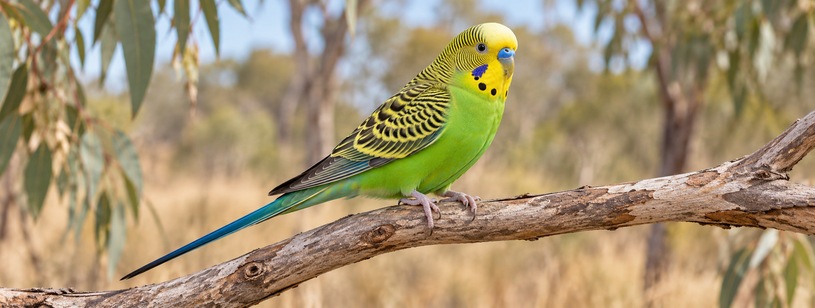
The budgerigar (Melopsittacus undulatus), or budgie, is a small Australian parrot with a long, pointed tail. Wild birds are green and yellow with black barring; captive-bred varieties also include blue, white and yellow birds. Budgies are social, active birds capable of learning sounds.
Pets need daily flight in a safe space, a varied diet and compatible budgie company. Some imitate words, but this ability differs between individuals.
Quick facts
| Common name | Budgerigar |
| Scientific name | Melopsittacus undulatus |
| Typical lifespan | Can reach 10–15 years in captivity; individuals vary considerably |
| Length | Around 17–20 cm including the tail; sources and individuals vary |
| Weight | 22–32 g in the World Parrot Trust range; captive-bred varieties may differ |
| Diet type | Mostly seeds of grasses and other plants |
| Conservation status | Least Concern (LC) |
| Geographical distribution | Australia — native range. |
| Habitat | Grassland, scrub and other open country, including arid and semi-arid regions |
| Other names | Budgie; common parakeet |
| Origin | Australia |
| Natural plumage | Green and yellow with black barring and small throat and cheek patches |
| Social life | Flocks; compatible company in captivity |
| Movements | Nomadic, following water and food availability |
| Nest | A suitable tree hollow or cavity |
| Eggs | Often 4–8 per clutch, meaning a set of eggs laid |
| Incubation | Around 18 days for an incubated egg |
| Leaving the nest | Around 30–35 days; independence does not follow immediately |
- Primary category:Birds
- Explore this animal's categories:
Interesting facts
- Flocks follow water and seeds. Rain can allow very large gatherings, but not all flocks are enormous.
- Budgies are not all green. Selective breeding has produced many colours; familiar wild birds remain green and yellow.
- They can learn sounds and words. A bird that does not imitate speech still has the same needs for care and company.
- The area above the beak can help identify sex. Called the cere, its colour needs interpretation alongside age and colour variety.
- Chicks hatch helpless. They depend on parental warmth and food.
- The curved beak is a feeding tool. Together with the tongue, it helps manipulate seeds and remove their husks.
Records and remarkable features
Puck’s vocabulary record
Guinness World Records lists Puck, a Californian budgerigar, with an estimated vocabulary of 1,728 words before his death in 1994.
This documents an exceptional individual, rather than what every budgie will do. Sound imitation should not be confused with understanding every meaning in the way a person does.
Spectacular flocks
The Australian Museum describes gatherings that can reach tens of thousands of birds under favourable conditions. In many situations, flocks are much smaller.
Characteristics
What does a budgerigar look like?
Budgies have slender bodies, narrow wings and long tails with pointed central feathers. Natural-coloured birds have green underparts, a yellow face and black wavy barring on the nape and wings.
Small violet-blue cheek patches and black throat spots are visible. Typical total length is around 17–20 cm, including the tail. Exhibition birds can look more robust than wild birds.
Male or female?
| Age or sex | Appearance of the cere |
|---|---|
| Adult male in many varieties | The cere is usually blue |
| Adult female | The cere may be whitish or pale blue outside breeding condition and turn brown in breeding condition |
| Young birds and some colour varieties | A simple blue/brown rule is insufficient; identification may need experience |
The cere is the skin surrounding the nostrils above the beak. It is distinct from forehead feathers. Loudness or friendliness does not reliably establish sex.
Beak, feet and colours
The upper beak curves down and helps open seeds. Two toes point forward and two backward on each foot, an arrangement useful for gripping branches.
Blue, white, yellow and differently patterned budgies belong to the same species. Parrots form a wider group; the budgerigar is one of its species.
Habits and behaviour
Life in a flock
Budgerigars are social birds. Wild birds forage and travel together. In captivity, human attention does not replace all interactions with other birds.
Compatible companions, enough space and several feeding places reduce competition. Do not place a new bird straight beside established birds: health checks, adjustment and gradual introductions matter.
Sounds and learning
Chirps and contact calls help birds communicate. A budgie can learn sounds from its surroundings, including some words repeated by people.
Learning should involve calm interaction and suitable rewards. Birds should not be isolated or deprived of food to make them talk. There is no guarantee that a particular bird will imitate speech.
Flight and exploration
Budgies are active by day and need exercise. Flying, chewing safe objects and searching for food provide important activities. A cage crowded with toys but lacking room to move does not meet these needs.
At night, birds need a quiet resting place without bright light or constant disturbance.
Habitat and geographical distribution
Where do wild budgerigars live?
They are native to mainland Australia and use many open habitats. Grassland, scrub and arid or semi-arid country provide seeds; hollow trees offer potential nest sites.
They are nomadic: movements respond to water and food availability. Routes vary with available resources rather than following an identical pattern every year.
They are not uniformly distributed across the continent. They are absent from Tasmania and parts of the coast and northern Australia.
Suitable space in captivity
- Room for flight and movement, with routes clear of accessories.
- Safe branches and perches of different suitable diameters.
- Food and water accessible to every bird, in clean containers.
- Protection from extreme weather, predators and strong draughts in an outdoor aviary.
Indoor flying requires a prepared room: close doors and windows, turn fans off and make large glass surfaces visible. Kitchens are unsuitable for flight or housing.
Air quality and safety
Smoke, aerosols and fumes from some heated products can seriously harm birds. Overheated non-stick cookware is a recognised hazard. Housing should be away from smoke and cooking areas.
Diet and feeding
What do wild budgies eat?
Seeds from grasses and other plants make up most of their natural diet. They often forage on the ground, using resources that become available after rain.
A pet generally uses less energy than a wild bird flying long distances to find food. Home feeding should not be reduced to an unlimited bowl of seeds.
Feeding a pet budgerigar
| Component | Role in the diet |
|---|---|
| Food formulated for budgerigars | Can be an important component of a balanced menu tailored with veterinary advice |
| Safe, washed vegetables and greens | Add variety; choose appropriate foods and remove perishable leftovers |
| Seeds | Can form a controlled part of the diet; they are not a complete menu on their own |
| Fruit | Small amounts appropriate to the species |
| Fresh water | Always available, in a container cleaned daily |
Veterinary guides differ over exact proportions. A plan should suit the bird and the foods used. An all-seed diet can contribute to nutritional imbalances and obesity.
Changing foods and avoiding hazards
Introduce dietary changes gradually and check that the bird is actually eating. Do not abruptly remove familiar food to force acceptance of another diet.
Do not feed avocado to parrots. Sweets, alcohol and very salty leftovers are not budgie foods either. A bird that stops eating or loses weight needs assessment by a veterinarian experienced with birds.
Reproduction and life cycle
Nests and eggs
Wild budgies can breed when rain and food create suitable conditions. They use tree cavities. The female lays and incubates white eggs, while the male contributes food for the family.
The World Parrot Trust gives a common clutch size of 4–8 eggs. Incubation takes around 18 days for an egg. Egg numbers and development times vary.
Chick development
Chicks hatch poorly developed, without full feathers, and depend on their parents for warmth and food.
They leave the nest at around 30–35 days, using the ranges described by the consulted sources. First flight does not mean immediate feeding independence or readiness for separation.
How long do budgies live?
The Royal Veterinary College notes that budgies can reach 10–15 years in captivity. Not every bird does so. Diet, health and living conditions affect longevity.
Breeding is not necessary for a pet bird’s welfare. Repeated egg laying can cause problems, and difficulty passing an egg needs veterinary help.
Names and history
| Classification level | Name |
|---|---|
| Class | Aves — birds |
| Order | Psittaciformes — parrots |
| Family | Psittaculidae |
A name linked to wavy markings
The Romanian name papagal ondulat refers to the wavy feather pattern. The World Parrot Trust explains Melopsittacus as “melodious parrot” and undulatus as referring to a wavy pattern.
George Shaw described the species scientifically in 1805, originally as Psittacus undulatus. Classifications separating Old World parrots place it in Psittaculidae.
Budgies bred by people
Captive breeding has produced many colour and size varieties. Some are selected for exhibition; others are more familiar as companion birds.
Colour differences do not change their identity as Melopsittacus undulatus. A blue and a green budgie can belong to the same species.
Cultural significance
Budgerigars in Aboriginal Australian art
Budgerigars appear in Aboriginal Australian art. The National Museum of Australia includes Budgerigars in the Sandhills in the collection presented in its Papunya Painting exhibition.
Conservation and threats
Wild conservation status
BirdLife International’s 2018 global IUCN assessment lists the budgerigar as Least Concern (LC). This conservation category does not mean every local population is free from difficulty.
The World Parrot Trust describes large population fluctuations during drought. Access to water, food and suitable nest sites remains important.
Risks to pet budgies
- An unbalanced diet and too little exercise can affect health.
- Isolation and insufficient activity can undermine a social bird’s welfare.
- Smoke, toxic fumes and flight accidents can cause serious harm.
- Delayed veterinary attention can postpone recognition of disease.
Breathing difficulty, loss of appetite, weakness or unusual time spent on the cage floor need prompt veterinary assessment. Birds can hide signs of illness, so behavioural changes deserve attention.
In popular culture
A budgie in Bluey
In Copycat, an episode from the first season of Bluey, Bluey and her father find an injured budgie and take it to the vet. The story explores care for animals and how children respond to a sad experience.
Frequently asked questions
Is a budgerigar a parrot?
Yes. The budgerigar is a small Australian parrot of the species Melopsittacus undulatus.
How long does a budgie live?
It can reach about 10–15 years in captivity, but lifespan differs between individuals and depends on health and care.
What do budgies eat?
Wild birds mainly eat seeds. Pets need a balanced diet that can include formulated budgie food, vegetables, controlled amounts of seed and a little fruit.
Can all budgies talk?
No. Some imitate words and other sounds, but ability and interest vary.
How can you tell males from females?
The cere, the skin above the beak, can help. It is blue in many adult males, but age and colour variety affect its appearance.
Can a budgie be kept alone?
Budgies are social and benefit from compatible budgie company. People do not replace all interactions between birds.
Why do budgies come in different colours?
Selective breeding has produced many colour varieties. Natural-coloured birds are mainly green and yellow with black barring.
Does a budgie need flight time outside its cage?
It needs flight space daily. A cage-housed bird should have supervised flying opportunities in a safe room with doors and windows closed and fans off.
Did you know? About budgerigars
- Wild budgerigars are green and yellow with black barring.
- They move in response to water and food availability.
- Some imitate words, but not every bird does.
- They are social birds that need company and flight.