Sperm whaleInteresting facts and information
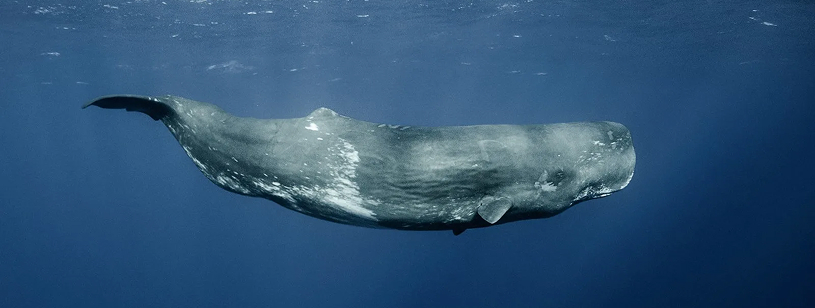
The sperm whale (Physeter macrocephalus) is the largest toothed whale. It is a deep-diving marine mammal that feeds mainly on squid and also takes other prey. Females and young live in family groups, while adult males are mostly solitary.
The sperm whale has a huge, square head and uses echolocation to find prey in the deep ocean. Historic whaling targeted the oil and spermaceti in its body and head; despite the name, spermaceti is not sperm.
Whaling greatly reduced sperm whale populations. Today the main threats are ship strikes, entanglement in fishing gear, noise and pollution.
Quick facts
| Common name | Sperm whale (cachalot) |
| Scientific name | Physeter macrocephalus |
| Typical lifespan | About 70 years or more |
| Length | About 11-16 m (males), 8-12 m (females) |
| Weight | About 30-57 tonnes (males), 11-20 tonnes (females) |
| Diet type | Carnivore, feeding mainly on squid and also on fish |
| Main predators | Orcas (may attack females and calves) |
| Conservation status | Vulnerable (IUCN); regional assessments can differ |
| Distribution | Oceans around the world, especially in deep waters |
| Living environment | Deep waters of the open ocean, mostly in tropical and temperate regions |
- Primary category:Mammals
- Explore this animal's categories:
Interesting facts
- The largest brain on Earth - The brain of a sperm whale weighs about 8 kg, more than that of any other known animal.
- Deep diving - Sperm whales usually feed at depths of several hundred metres to over 1,000 metres, and can dive to more than 2,000 metres and stay underwater for over an hour.
- Very loud clicks - Their echolocation clicks are among the loudest sounds made by any animal.
- Ambergris - A rare waxy substance called ambergris forms in the intestines of some sperm whales, probably around hard squid beaks; it was once highly valued in perfume-making.
- A famous whale - A sperm whale is the great white whale in Herman Melville's novel "Moby-Dick".
Records and remarkable features
- The sperm whale is the largest living toothed whale and has an exceptionally large brain.
- The head contains a spermaceti organ associated with sound production. Historic uses of spermaceti included candles and other products.
Physical characteristics and adaptations
The sperm whale is the largest toothed whale and one of the most remarkable marine animals, with special adaptations for deep diving and echolocation.
Key physical adaptations
- A huge head - The head makes up about a third of the body length and contains the spermaceti organ, filled with a waxy oil that helps produce and focus sound.
- The largest brain of all animals - The brain of a sperm whale weighs about 8 kg.
- Wrinkled skin - Behind the head, the skin has a wrinkled, prune-like look.
- Cone-shaped teeth - The narrow lower jaw has about 18-26 teeth on each side, each up to about 20 cm long; the upper jaw has only sockets.
- Built for deep dives - The lungs collapse under pressure, and the muscles store a lot of oxygen, so the whale can stay underwater for a long time.
- A powerful tail - The broad, triangular tail drives the whale down into the depths; it usually swims slowly but can reach about 30 km/h for short periods.
Dimensions and gender differences
| Characteristic | Males | Females |
|---|---|---|
| Length | About 11-16 m, rarely more | About 8-12 m |
| Weight | About 30-45 tonnes, up to about 57 tonnes | About 11-20 tonnes |
| Typical lifespan | About 70 years or more | About 70 years or more |
| Dorsal fin | No true dorsal fin, only a low hump followed by bumps | A low hump, often with a rough callus |
Habits and behaviour
Sperm whales are social and intelligent mammals with a complex system of clicks and long, deep feeding dives.
Daily life
- Adult males are mostly solitary; younger males live in "bachelor groups".
- Females and young live together in family groups of about 10 or more animals.
- Vertical naps - Sperm whales sleep in short naps of about 10-15 minutes, hanging almost upright in the water just below the surface.
- Long journeys - Adult males travel to cold waters near the poles to feed, then return to warmer waters to breed.
Social organisation
- Shared care of calves - While a mother dives to feed, other members of the group stay at the surface with her calf.
- Roaming males - Adult males visit groups of females in warmer waters to mate.
- Clans - Family groups belong to larger clans that share the same "dialect" of clicks.
Communication and Echolocation
- Echolocation clicks - Sperm whales use loud clicks to find prey in the dark.
- Codas - They communicate with patterns of clicks called codas.
- Group dialects - Each clan of sperm whales has its own set of codas, similar to a dialect.
Defence techniques
- The "marguerite" formation - When attacked by orcas, the group forms a circle with heads together and tails outward, protecting the calves in the middle.
- Protecting the calves - Adults stay close to calves at the surface when predators are near.
- Tail strikes - Sperm whales can strike out with their powerful tails to defend themselves.
Habitat and geographic distribution
Sperm whales live in all the world's oceans, mostly in deep water far from the coast.
Distribution context
| Region | Presence |
|---|---|
| Pacific Ocean | Widespread, for example around Hawaii, Japan, the Galápagos and New Zealand |
| Atlantic Ocean | Common near the Azores, in the Caribbean (for example off Dominica) and in the Gulf of Mexico |
| Indian Ocean | Seen off Sri Lanka, Mauritius and Madagascar |
| Southern Ocean | Mostly adult males, which travel to cold waters to feed |
Habitat types
- Deep waters - Sperm whales prefer water more than 1,000 m deep, often along steep underwater slopes and canyons where squid are plentiful.
- Warm waters - Females and young usually stay in tropical and subtropical waters.
- Cold waters - Adult males also go to high latitudes, close to the Arctic and Antarctic.
Environmental change
- Noise - Noise from ships and military sonar can disturb sperm whales.
- Collisions with ships - Ships hit and kill sperm whales in some busy areas.
- Entanglement - Sperm whales can become tangled in fishing gear.
- Plastic - Sperm whales sometimes swallow plastic, which can kill them.
Diet and feeding
The sperm whale is a deep-sea predator that feeds mainly on squid, which it finds with echolocation.
What does the sperm whale eat?
| Food group | Examples and context |
|---|---|
| Giant squid | Architeuthis dux, Mesonychoteuthis hamiltoni (colossal squid); eaten occasionally |
| Medium-sized squid | Ommastrephidae, Cranchiidae and other families; the main food |
| Deep-sea fish | Various deep-sea fish, such as toothfish |
| Octopus | Deep-sea octopus species |
| Sharks and rays (occasionally) | Small deep-sea sharks and rays |
Feeding methods
- Deep dives - Sperm whales dive deep, often for 45-60 minutes, using echolocation to find prey.
- Echolocation - They send out clicks and listen to the echoes to "see" in the darkness of the deep ocean.
- Swallowing whole - Sperm whales do not chew; they swallow prey whole, probably using suction.
- Squid scars - Some sperm whales have round scars from the suckers of large squid.
An adult sperm whale eats about 3% of its body weight each day, and sperm whales are major consumers in the deep ocean.
Reproduction and life cycle
The sperm whale has one of the slowest breeding rates of any mammal, which makes its populations slow to recover.
Breeding season
- Mating mostly takes place in spring and summer, in warmer waters.
- Adult males compete for females, sometimes fighting, as shown by scars on their heads.
- Males move between groups of females and can mate with several of them.
Gestation and birth
| Characteristic | Details |
|---|---|
| Gestation | About 14-16 months |
| Number of calves | 1 calf every 4-6 years |
| Weight at birth | About 1 tonne |
| Length at birth | About 4 m |
| Nursing | Usually 2-3 years, sometimes longer |
| Sexual maturity | About 9 years (females); males mature around 10-20 years but usually breed only from their late 20s |
Raising young
- Calves drink very fatty milk, which helps them grow quickly.
- The calves are protected by the females in the group, which may also help feed and look after them.
- Young males leave their family groups and join bachelor groups.
Name and history
Origin of the name
- The English name "sperm whale" comes from spermaceti, the waxy oil in its head, which whalers once mistook for sperm; spermaceti was used for candles and lubricants.
- The other common name, "cachalot", comes from French and probably from a Portuguese or Gascon word meaning "big head".
- The scientific name Physeter macrocephalus means "big-headed blower": physeter is Greek for "blower" and macrocephalus means "big head".
Taxonomic classification
| Classification | Name |
|---|---|
| Kingdom | Animalia |
| Phylum | Chordata |
| Class | Mammalia |
| Order | Artiodactyla (cetaceans) |
| Suborder | Odontoceti (toothed whales) |
| Family | Physeteridae |
| Genus | Physeter |
| Species | Physeter macrocephalus |
Evolution and fossils
- The sperm whale group is ancient: its earliest relatives lived more than 20 million years ago.
- Its closest living relatives are the much smaller pygmy and dwarf sperm whales.
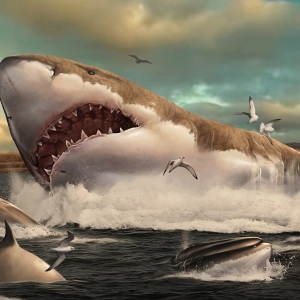
- Extinct relatives included Livyatan melvillei, found in Peru, a predatory sperm whale with teeth over 30 cm long, named after Herman Melville.
Cultural significance and mythology
The sperm whale has played an important role in human history, mainly through whaling, and its teeth have been valued objects in several cultures.
Sperm whales in myths and symbolism
- Whaling history - In the 18th and 19th centuries, whalers from places such as Nantucket and New Bedford hunted sperm whales across the world's oceans for their oil.
- Scrimshaw - Whalers carved pictures and patterns into sperm whale teeth, a folk art known as scrimshaw.
- Fiji - In Fijian culture, polished sperm whale teeth called tabua are valuable ceremonial gifts.
- New Zealand - Māori traditionally made pendants and other treasured items from sperm whale teeth and bone.
- Lamalera - In this village in Indonesia, people still hunt sperm whales by hand from wooden boats, as part of a long tradition.
Sperm whales in modern symbolism
- Exploring the deep - The sperm whale is a symbol of the mysterious deep ocean.
- Whale-watching - Places such as Kaikōura in New Zealand, Dominica and the Azores are famous for sperm whale watching.
- Ocean conservation - The sperm whale has become a symbol of the campaign against whaling and for ocean protection.
Conservation status and threats
The sperm whale is listed as Vulnerable by the IUCN. Whaling greatly reduced its numbers, and today there are probably several hundred thousand sperm whales.
Conservation status
| Region | Population information | Trends |
|---|---|---|
| Pacific Ocean | The largest numbers; widespread | Slow recovery |
| Atlantic Ocean | Widespread; small groups in the Mediterranean | The Mediterranean population is endangered |
| Indian Ocean | Widespread | Not well known |
| Southern Ocean | Mostly adult males | Not well known |
Main pressures
- Noise - Sonar and ship noise can disturb sperm whales and affect their echolocation.
- Ship strikes - In busy waters, sperm whales are sometimes hit by large ships.
- Entanglement - Sperm whales are sometimes caught in fishing nets, which can injure or drown them.
- Past whaling - Commercial whaling killed hundreds of thousands of sperm whales, and their slow breeding means recovery takes a long time.
- Pollution - Plastic and chemical pollution can harm sperm whales.
Protection measures
- International Whaling Commission moratorium - A ban on commercial whaling that has applied since 1986.
- Protected areas - Marine protected areas and shipping rules to reduce collisions.
- Research and tracking - Satellite tags and acoustic studies show how sperm whales move and behave.
- Responsible whale-watching - Rules on distance and speed help protect sperm whales while people watch them.
In popular culture
The sperm whale is one of the most famous whales in human culture, appearing in literature, films and cartoons.
Sperm whales in literature
- Moby-Dick (1851), by Herman Melville — This novel draws partly on the fate of the whaleship Essex, which was struck by a sperm whale in 1820.
- "Twenty Thousand Leagues Under the Seas" (1870), by Jules Verne - Captain Nemo's submarine Nautilus attacks a group of sperm whales.
- "The Hitchhiker's Guide to the Galaxy" (1979), by Douglas Adams - A sperm whale suddenly appears high above a planet and has a brief, funny train of thought as it falls.
Sperm whales in films and documentaries
- "Moby Dick" (1956) - John Huston's film of the novel, with Gregory Peck as Captain Ahab.
- "In the Heart of the Sea" (2015) - A film based on the true story of the whaleship Essex, sunk by a sperm whale in 1820.
- Many nature documentaries show sperm whales sleeping upright or diving into the deep.
Sperm whales in video games and cartoons
- "Pinocchio" (1940) - Monstro, the giant whale that swallows Geppetto and Pinocchio in Disney's film, is a sperm whale.
- Cartoons and children's books - The sperm whale's big, square head makes it one of the most commonly drawn whales.