TapirInteresting facts and information
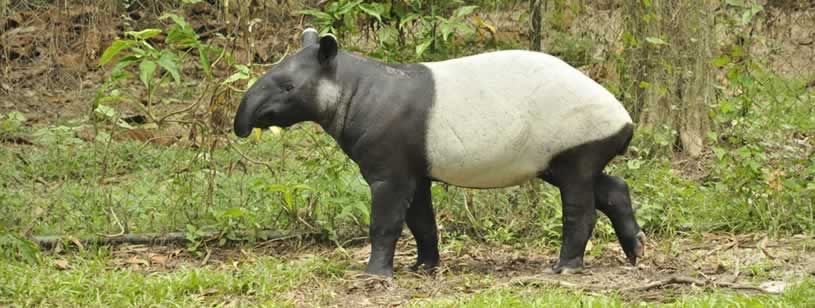
Tapirs are plant-eating mammals in the genus Tapirus. They live in the Americas and Southeast Asia and have a short, flexible snout. Young tapirs have striped and spotted coats that differ from those of adults.
Tapirs help disperse seeds as they feed and move through their habitats. Habitat loss and hunting threaten several species.
Quick facts
| Common name | Tapir |
| Scientific name | Tapiridae: Tapirus spp. |
| Typical lifespan | About 25-30 years in the wild, up to about 35 years in captivity |
| Maximum speed | Surprisingly fast through forest; exact speed not well known |
| Size | About 1.8-2.5 m long, 75-120 cm tall at the shoulder |
| Weight | About 150-320 kg, depending on the species |
| Diet type | Herbivore (leaves, fruit, twigs, water plants) |
| Main predators | Jaguars, pumas, tigers, leopards, crocodiles, humans (illegal hunting) |
| Conservation status | Assess separately by species and population; different taxa and regions have different needs |
| Geographical distribution | South America, Central America, Southeast Asia |
| Habitat | Tropical forests, wooded savannas, swamps, mountain forests |
| Social behaviour | Mostly solitary |
| Special adaptations | Flexible snout, excellent swimmer, camouflaged young |
- Primary category:Mammals
- Explore this animal's categories:
Interesting facts
- A mini trunk - Tapirs have a short, flexible snout, called a proboscis, which they use to grab leaves, sniff the air and even breathe like a snorkel when swimming.
- Excellent swimmers - Tapirs often escape predators by running into water, and they can stay underwater for a few minutes.
- Striped babies - Young tapirs have white spots and stripes, a little like a watermelon, which camouflage them in the dappled light of the forest.
- Whistling animals - Tapirs communicate with high-pitched whistles and squeals to keep in touch and to signal danger.
- Big eaters - A tapir eats many kinds of plants, and in some forests scientists have recorded more than 100 different food plants.
- Shy and secretive - Tapirs are mostly active at dusk and at night, so they are rarely seen in the wild.
Records and remarkable features
- Tapirs are plant-eating mammals in the genus Tapirus. They live in the Americas and Southeast Asia and have a short, flexible snout. Young tapirs have striped and spotted coats that differ from those of adults.
- The South American tapir is the largest land mammal native to South America.
- The Malayan tapir is the largest of the tapirs, weighing up to about 300 kg or more.
Characteristics
The tapir is a large, sturdy mammal with strong legs, adapted to life in tropical forests and wetlands. Although it looks a little like a pig, its closest relatives are horses and rhinoceroses.
Appearance
- A solid, compact body - Tapirs have a heavy body with thick skin, which helps protect them from bites and scratches.
- Short but strong legs - Suited to walking through dense forest and to swimming.
- A flexible snout - Formed from the nose and upper lip, it is used to grab leaves, sniff out food and breathe when the tapir is underwater.
- Different coats - The South American tapir is brown, the mountain tapir has thick, woolly dark hair, and the Malayan tapir is black with a white "saddle".
- Small eyes - Tapirs have poor eyesight, but excellent senses of hearing and smell.
- Unusual feet - They have four toes on their front feet and three on their back feet.
Special adaptations
- Swimming - Tapirs go into water to escape predators, cool down and get rid of parasites.
- Camouflage - The stripes and spots of the young help them hide from predators.
- A keen sense of smell - Helps them find food and detect danger.
- Thick skin - Especially thick on the back of the neck, it helps protect them from jaguars and tigers, which often bite the neck.
Habits and behaviour
Tapirs are mostly solitary animals that spend much of their time moving along forest trails in search of food. Although they seem slow and calm, they can move surprisingly fast and may defend themselves if threatened.
Social behaviour
- Mostly solitary - Tapirs usually meet other tapirs only to mate, and mothers stay with their calves.
- Overlapping ranges - Tapirs have large home ranges, which often overlap with those of other tapirs.
- Sounds and smells - They communicate with whistles and squeals and by leaving scent marks, such as urine sprays.
Survival techniques
- Escaping into water - When attacked by a jaguar or a tiger, a tapir often rushes into a river or swamp.
- Fighting back - Tapirs can bite hard and charge an attacker.
- Quiet movement - Despite their size, they move quietly through the forest along well-used paths.
Habitat and geographic distribution
Tapirs live in tropical forests, wetlands and mountain forests in South and Central America and Southeast Asia.
| Region | Species | Preferred habitat |
|---|---|---|
| South America (Brazil, Peru, Ecuador, Colombia, Venezuela, Argentina, Bolivia and others) | Tapirus terrestris (South American or lowland tapir) | Tropical forests, wetlands, wooded savannas |
| Central America and southern Mexico | Tapirus bairdii (Baird's tapir) | Tropical forests, swamps, mountain forests |
| The northern Andes (Colombia, Ecuador, Peru) | Tapirus pinchaque (mountain tapir) | Cloud forests and high mountain grasslands |
| Southeast Asia (Myanmar, Thailand, Malaysia, Sumatra) | Tapirus indicus (Malayan tapir) | Tropical forests, swamp forests |
Types of habitat
- Tropical forests - Tapirs prefer damp, dense forests where they can hide from predators.
- Swamps and rivers - They are usually found near water, as they are excellent swimmers.
- Mountain forests - The mountain tapir lives at altitudes of about 2,000-4,500 m, where its thick coat protects it from the cold.
Human impact and threats
- Deforestation - Tapirs lose their homes to logging, farming and cattle ranching.
- Illegal hunting - In many areas, tapirs are hunted for their meat and skin.
- Fragmented habitats - Roads and farms cut tapir populations off from each other, reducing genetic diversity.
- Road accidents - Many tapirs are killed by cars on roads through forests.
Diet and feeding
Tapirs are herbivores that eat a wide variety of plants, from leaves and fruit to twigs and water plants. They play an important role in forests by spreading seeds in their droppings, which helps forests regrow.
What do tapirs eat?
| Type of food | Species that eat it |
|---|---|
| Fresh leaves and shoots | All species |
| Fruit (figs, palm fruits and other forest fruits) | South American tapir, Baird's tapir, Malayan tapir |
| Twigs and bark | All species, especially the mountain tapir |
| Water plants | South American tapir and other species living near water |
| Seeds | Swallowed with fruit and later spread in their droppings |
Feeding techniques
- Using the snout - Tapirs wrap their flexible snout around leaves and pull them into their mouth.
- Browsing - They walk slowly along forest paths, eating leaves and shoots from many different plants.
- Eating clay - Tapirs visit mineral licks to eat salty soil and clay, which may provide minerals and help with plant toxins.
- Seasonal changes - When fruit is plentiful, they eat more of it; at other times, they eat more leaves and twigs.
Reproduction and life cycle
Tapirs breed slowly: a female usually gives birth to a single calf every two years or so. This low birth rate makes populations vulnerable to habitat loss and hunting.
| Feature | Details |
|---|---|
| Age at maturity | About 3-5 years |
| Breeding season | All year round, often linked to the rainy season |
| Type of reproduction | Live birth |
| Calves per birth | 1 |
| Pregnancy | About 13 months |
| Weight at birth | About 5-10 kg |
| Nursing | About 6-12 months |
| Lifespan | About 25-30 years |
Mating
- Males and females find each other using whistles and scent marks, and courtship may include circling and nipping.
- In some species, mating often takes place in water.
- Pregnancy lasts more than a year, one of the longest among land mammals of this size.
Raising the calves
- Tapir calves are covered with white spots and stripes, which camouflage them in dense vegetation.
- Calves stay with their mother for one to two years, learning which plants are good to eat.
- At about 6-8 months, the young begin to lose their stripes and spots and develop the adult coat of their species.
Name and history
Tapirs belong to an ancient group of mammals: tapir-like animals lived more than 30 million years ago. They are in the order Perissodactyla, together with horses and rhinoceroses.
Origin of the name
- The word "tapir" comes from tapi'ira, the name for the animal in the Tupi language of Brazil.
- The scientific name Tapirus was given by European naturalists in the 18th century.
The tapir in human history
- South America - Indigenous peoples of the Amazon have hunted tapirs for thousands of years, and the tapir appears in many of their traditional stories.
- Malaysia - A Malay folk tale says that, after making all the other animals, the creator used the leftover parts to make the tapir.
The tapir in folklore
Cultural significance and mythology
- The dream eater - In Chinese and Japanese folklore, the baku is a magical creature with a trunk that eats nightmares; in modern Japanese, the word baku also means "tapir".
- A "patchwork" animal - In some Asian stories, the tapir is said to be made from parts of other animals, because of its unusual shape.
- Amazon stories - In traditional stories of Amazonian peoples, the tapir is often a strong but clumsy character.
Conservation status and threats
Tapirs include several species with different conservation assessments. Habitat loss and hunting threaten their survival; they should not be assigned one shared conservation category.
| IUCN status | Species | Regions |
|---|---|---|
| Vulnerable (VU) | Tapirus terrestris (South American tapir) | South America |
| Endangered (EN) | Tapirus indicus (Malayan tapir) | Southeast Asia |
| Endangered (EN) | Tapirus pinchaque (mountain tapir) | Northern Andes |
| Endangered (EN) | Tapirus bairdii (Baird's tapir) | Central America and southern Mexico |
Main threats
- Deforestation - Logging, farming and cattle ranching destroy the forests where tapirs live.
- Illegal hunting - Tapirs are hunted for meat and skin in many places.
- Fragmented habitats - Roads and dams create barriers that isolate tapir populations, reducing genetic diversity.
- Climate change - Changes in rainfall and temperature affect food and water supplies.
Conservation efforts
- Protected areas - Tapirs are protected in nature reserves and national parks, such as Yasuní National Park in Ecuador and Taman Negara in Malaysia.
- Reintroduction - In Brazil, South American tapirs have been released into forests where they had been hunted out, such as parts of the Atlantic Forest near Rio de Janeiro.
- Fighting illegal hunting - Laws and patrols help reduce hunting.
- Monitoring - Scientists use camera traps and GPS collars to study tapir populations.
In popular culture
- Pokémon - Drowzee and Munna are Pokémon inspired by the baku, the tapir-like dream eater of Japanese folklore.
- World Tapir Day - Every year on 27 April, zoos and conservation groups celebrate tapirs and raise awareness about protecting them.
- Zoos - With their striped babies and unusual snouts, tapirs are popular animals in zoos around the world.