European chubSqualius cephalus — habitat, diet and reproduction
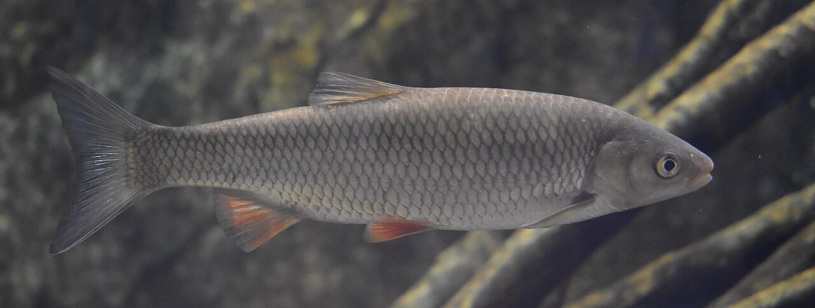
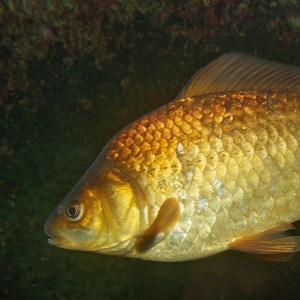
European chub (Squalius cephalus) in an aquarium. · Tylwyth Eldar / CC BY-SA 4.0 (https://creativecommons.org/licenses/by-sa/4.0). Cropped and resized.
The European chub is a river fish with a broad head, large mouth and clearly outlined scales. It may be seen near the surface beneath overhanging branches. Its diet includes insects, other small animals and plant material, while large individuals can catch fish. This flexibility lets it use different parts of a river.
Quick facts
| Common name | European chub |
| Scientific name | Squalius cephalus |
| Lifespan | About 14–20 years under favourable conditions |
| Diet | Omnivore; large adults may eat many fish |
| Predators | Pike and fish-eating birds, depending on size |
| Conservation status | Least Concern (LC), global assessment 2022 |
| Distribution | Europe and neighbouring parts of Asia |
| Habitat | Rivers and streams; also lakes with suitable breeding areas |
| Length | Often 30–40 cm, varying between populations |
| Family | Leuciscidae |
| Reproduction | Eggs laid in gravel areas |
- Primary category:Fish
- Explore this animal's categories:
Interesting facts
- Dark scale edges create a net-like body pattern.
- Insects falling from bankside vegetation can become food.
- Young chub often form groups.
- The older name Leuciscus cephalus refers to the same species.
Characteristics
The body is elongated and robust, with a relatively large head. A blunt snout ends in a wide mouth. Silvery sides may have a bronze sheen, and lower fins can be orange or reddish.
Dark scale margins are useful when the fish is seen from the side. Small chub can resemble other silver fishes; mouth size and head shape are more reliable than colour alone.
Behaviour
Young chub often live in groups. Large individuals may become more solitary and use cover beneath roots, banks or branches.
They can take food near the surface but do not remain there continuously. Pools and shallower runs allow movement between different conditions. Sudden movements on the bank can disturb them, so quiet observation from a distance is more informative.
Habitat and distribution
The range covers much of Europe and neighbouring parts of Asia. In Romania, chub inhabit numerous rivers from hilly sections to lower reaches.
They use flowing channels with pools and bankside shelter. Some populations also live in lakes with suitable spawning access. River habitat includes its margins: vegetation influences shade, shelter and food as well as the appearance of the bank.
Diet and feeding
Food includes insect larvae, worms, crustaceans, molluscs and insects on the surface. Fallen fruit and other plant fragments may also be eaten.
Large adults can become more strongly predatory, but the species is not exclusively fish-eating. Local availability still shapes the menu. The broad mouth permits a range of prey sizes, while food falling from land links river life with the surrounding vegetation.
Reproduction and life cycle
Breeding occurs in spring and summer when conditions permit egg development. Spawning often takes place over gravel in flowing water.
Several males may accompany one female. Adhesive eggs remain on the substrate, and spawning can occur in multiple batches. Silted gravel and interrupted river connections can reduce suitable areas. A varied river provides different conditions for larvae, growing fish and adults.
Name and history
The accepted name is Squalius cephalus. Older works use Leuciscus cephalus; these names reflect classification changes rather than two different animals.
The current family is Leuciscidae. European chub distinguishes it from other fishes called chub on different continents. Checking scientific identity is useful when comparing common names across languages.
Conservation and threats
The global category is Least Concern. Local populations still depend on water quality and access to spawning areas.
Barriers, channel alteration and loss of bankside vegetation can simplify habitat. Keeping suitable gravel and natural margins benefits chub alongside other freshwater species. Conservation therefore concerns connected river sections rather than isolated places where adults are seen.
Frequently asked questions
Is chub a predator?
It is an omnivore. Large fish may eat many other fish, but invertebrates and plant material also matter.
Does chub live only in rivers?
Flowing water is commonly used, but suitable lakes can also hold populations.
Why does it stay beneath branches?
They provide shelter and food can fall from them into the water.
Is Leuciscus cephalus another fish?
No. It is an older scientific name for Squalius cephalus.