KoalaInteresting facts and information
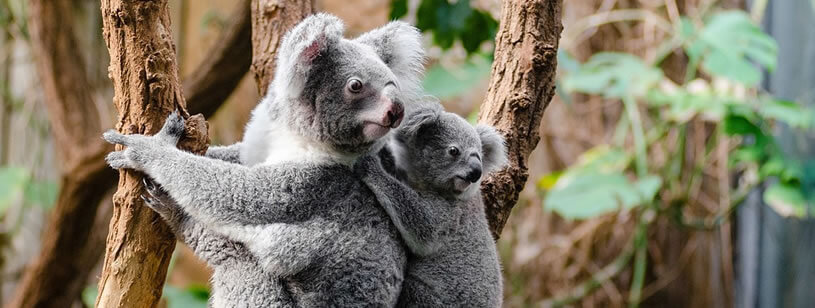
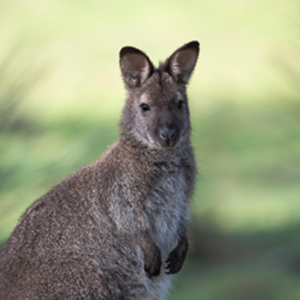
The koala (Phascolarctos cinereus) is an emblematic tree-dwelling marsupial of Australia, recognised by its rounded ears, prominent nose and dense fur. Despite a superficial resemblance to bears, it belongs to the marsupial group, alongside kangaroos and wombats.
It is a specialised leaf eater, feeding mainly on eucalypts. Low-energy food and a low metabolic rate contribute to long periods of rest.
Quick facts
| Common name | Koala |
| Scientific name | Phascolarctos cinereus |
| Typical lifespan | About 10-15 years in the wild |
| Maximum speed | Not well measured; koalas can run surprisingly fast over short distances on the ground |
| Height | Body length about 60-85 cm |
| Weight | About 4-15 kg; southern koalas are larger |
| Diet type | Herbivore, mainly eucalyptus leaves |
| Main predators | Dogs, dingoes, large owls, eagles and pythons (especially for young koalas) |
| Conservation status | Vulnerable (IUCN); Endangered in Queensland, NSW and the ACT under Australian law |
| Distribution | Eastern and south-eastern Australia |
| Living environment | Eucalyptus forests and woodlands |
- Primary category:Mammals
- Explore this animal's categories:
Interesting facts
- Not a bear: despite the name "koala bear", the koala is a marsupial; the female carries her tiny young in a pouch.
- Champion sleepers: koalas sleep or rest for about 18-22 hours a day, saving energy on their low-energy diet of leaves.
- They do drink: koalas get much of their water from leaves, but they also drink, especially in hot, dry weather, and lick rainwater from tree trunks.
- Two thumbs: on each front paw, two fingers face the other three, giving koalas a very strong grip on branches.
- A surprisingly deep voice: male koalas make loud, deep bellows thanks to special vocal folds outside the voice box.
- Fingerprints like ours: koalas have fingerprints that look remarkably similar to human fingerprints.
- Disease is a big problem: the bacterial disease chlamydia can cause blindness and infertility in koalas and affects many wild populations.
Records and remarkable features
- The last of its family: the koala is the only living member of the family Phascolarctidae.
- A specialised diet: few mammals can live on eucalyptus leaves, which are tough, low in nutrients and contain toxic compounds.
- Slow living: koalas have a low metabolic rate, which helps them survive on poor food.
- Dense, woolly fur: it protects them from heat, cold and rain.
- Bigger in the south: koalas from Victoria and South Australia are larger and have thicker fur than those from Queensland.
Physical characteristics and adaptations
Koalas are mammals built for climbing and for eating leaves, with strong gripping paws, sharp claws and a special digestive system.
Key physical adaptations
- Gripping hands and claws: the front paws have two digits that face the other three, helping them hold trunks and branches.
- Dense fur: keeps them warm and helps shed rain.
- A large, sensitive nose: koalas sniff leaves carefully to choose which ones to eat.
- A pouch: protects the joey while it grows during its first months.
- A very long caecum: this part of the gut, up to about 2 metres long, contains microbes that help break down tough leaves.
Habits and behaviour
Koalas live mostly alone in trees, but their home ranges overlap with those of their neighbours. They are most active at night and around dusk.
Daily activity
- Long rests: most of the day is spent sleeping or resting in the fork of a tree.
- Active at night: they feed and move between trees mainly in the evening and at night.
- Careful climbers: their strong paws and claws let them climb trunks and move along branches.
Social and territorial interactions
- Scent marking: males have a scent gland on their chest and rub it against tree trunks.
- Bellowing: males bellow loudly, especially in the breeding season, to show their size and attract females.
- Fights: koalas usually avoid one another, but males may fight during the breeding season.
Defence
- Camouflage: their grey-brown fur blends in with tree trunks and branches.
- Claws and teeth: a frightened koala can scratch and bite hard, so wild koalas should never be handled.
- Danger on the ground: koalas come down to move between trees, which is when they are most at risk from cars and dogs.
Habitat and geographic distribution
Koalas live only in eastern and south-eastern Australia, in eucalyptus forests and woodlands where their food trees grow.
Regional distribution
| Region | Situation |
|---|---|
| Queensland | Declining; listed as Endangered under Australian law since 2022 |
| New South Wales | Declining; listed as Endangered under Australian law since 2022 |
| Victoria | Not listed as threatened; some local populations are so dense that they damage their food trees |
| South Australia | Not listed as threatened; includes koalas introduced to Kangaroo Island in the 1920s |
Habitat types
- Eucalyptus forest and woodland: the trees give them food, shelter and routes for moving around.
- Coastal and hilly areas: koalas live in many kinds of woodland, as long as their food trees grow there.
- Drier inland areas: koalas live there mainly along rivers and creeks, where trees have more moisture.
Climate and habitat change
- Land clearing: farming and urban development remove and break up the woodland koalas need.
- Drought, heat and bushfire: severe droughts and fires destroy food trees and kill many koalas.
- Poorer leaves: higher temperatures and more carbon dioxide in the air can make eucalyptus leaves less nutritious.
Diet and feeding
Koalas are specialised leaf eaters that feed mainly on eucalyptus leaves. Their digestive system can cope with tough leaves that contain substances poisonous to most other animals.
What do koalas eat?
| Food group | Examples and context |
|---|---|
| Eucalyptus leaves | Food trees vary by region; examples include river red gum (Eucalyptus camaldulensis), manna gum (E. viminalis) and tallowwood (E. microcorys) |
| Other trees | They sometimes eat the leaves of other trees, but eucalyptus is their main food |
| Water | Leaves provide much of their water, but koalas also drink, especially in hot weather |
Feeding methods
- Choosing leaves: koalas sniff leaves and pick the most nutritious ones with the fewest toxins.
- Chewing: their grinding cheek teeth crush the leaves into a fine paste.
- Slow digestion: food stays a long time in the gut, where microbes help break it down.
- Pap for joeys: before eating leaves, joeys eat a special soft dropping from their mother called pap, which gives them the gut microbes they need.
Reproduction and life cycle
Like other marsupials, koalas give birth to tiny, undeveloped young that keep growing in their mother's pouch.
Breeding season
- Most koalas breed in the warmer months, from about September to March.
- Males bellow loudly during the breeding season, and females are thought to use these calls to judge the size of males.
Gestation and birth
| Characteristic | Details |
|---|---|
| Gestation | Around 35 days |
| Young per birth | Usually one |
| Newborn size | About 2 cm and less than 1 g |
| Time in the pouch | About 6 months; the joey then rides on its mother's back |
Raising young
- After birth, the joey crawls into the pouch and attaches to a teat, where it stays for about six months.
- After leaving the pouch, it keeps drinking milk and rides on its mother's back while it learns to eat leaves.
- Young koalas become independent at about 1 year old.
Survival
- Young koalas face dangers from disease, lack of food, predators, cars and dogs.
- Wild koalas usually live about 10-15 years; females often live longer than males.
Name and history
Origin of the name
- The word "koala" comes from Dharug, an Aboriginal language of the Sydney area. It is often said to mean "no drink", but this is uncertain, and koalas do drink.
- The scientific name Phascolarctos cinereus comes from Greek words meaning "pouch" and "bear", and the Latin word for "ash-grey".
Taxonomic classification
| Classification | Name |
|---|---|
| Kingdom | Animalia |
| Phylum | Chordata |
| Class | Mammalia |
| Order | Diprotodontia |
| Family | Phascolarctidae |
| Genus | Phascolarctos |
| Species | Phascolarctos cinereus |
Evolution and fossils
- The koala is the only living member of the family Phascolarctidae, but fossils show that there were once many kinds of koala.
- Koala relatives have lived in Australia for more than 20 million years; some extinct species were larger than today's koala.
Cultural significance and mythology
The koala is one of Australia's best-known animals and appears in the stories of many Aboriginal peoples.
An Australian symbol
- Koalas are among Australia's national symbols, alongside kangaroos and emus.
- They appear on stamps and souvenirs, and the Perth Mint issues an annual Australian Koala bullion coin.
- Koalas are often the face of campaigns to protect wildlife and forests.
Modern public perceptions
- Koalas are a major tourist attraction, but despite their cuddly look they are wild animals; in most Australian states, holding a koala is not allowed.
Conservation status and threats
The koala is listed as Vulnerable by the IUCN. In Australia, the koalas of Queensland, New South Wales and the Australian Capital Territory have been listed as Endangered since 2022.
Conservation status
| Region | Population information | Assessment context |
|---|---|---|
| Queensland | Large declines in many areas | Endangered under Australian law since 2022 |
| New South Wales | Large declines, worsened by the 2019-2020 bushfires | Endangered under Australian law since 2022 |
| Victoria | Many populations stable; some overcrowded | Not listed as threatened |
| South Australia | Mostly descended from introduced koalas | Not listed as threatened |
Major threats
- Habitat clearing: development and farming remove and split up the trees koalas need for food and shelter.
- Bushfire: the 2019-2020 fires killed, injured or displaced tens of thousands of koalas.
- Disease: chlamydia and koala retrovirus affect many populations.
- Vehicle collisions: koalas crossing roads between patches of woodland are often hit by cars.
- Dog attacks: domestic dogs attack koalas, especially when they are on the ground.
- Climate change: heatwaves and droughts kill koalas and their food trees.
Protection measures
- Habitat restoration: planting food trees and creating wildlife corridors helps koalas move and feed.
- Wildlife hospitals: specialist hospitals treat injured and sick koalas.
- Protecting land: protecting important koala habitat reduces clearing.
- Disease research: scientists have developed a vaccine against chlamydia for koalas.
- Public education: people can help by driving carefully in koala areas and keeping dogs under control.
In popular culture
Koalas appear in many films, cartoons and children's books.
Film and animation
- Blinky Bill: the famous Australian koala has appeared in animated films and TV series, including films in 1992 and 2015.
- Sing (2016): the main character, Buster Moon, is a koala who runs a theatre.
- The Wild (2006): the animated film features Nigel, a grumpy koala.
- Back to the Outback (2021): the animated film features Pretty Boy, a spoiled koala.
Books and literature
- Blinky Bill, by Dorothy Wall (1933): classic Australian stories about a mischievous koala.
- Koala Lou, by Mem Fox (1988): a picture book about a young koala and her mother's love.
- Educational books: koalas are a favourite subject of children's books about Australian animals.
Tourism and marketing
- Tourism: koalas appear on souvenirs and in advertising for Australia.
- Qantas advertisements: from 1967, the airline ran famous TV ads with a koala complaining "I hate Qantas" because the airline brought tourists to Australia.
- Conservation: koalas are a popular symbol for protecting wildlife and forests.