Komodo dragonInteresting facts and information
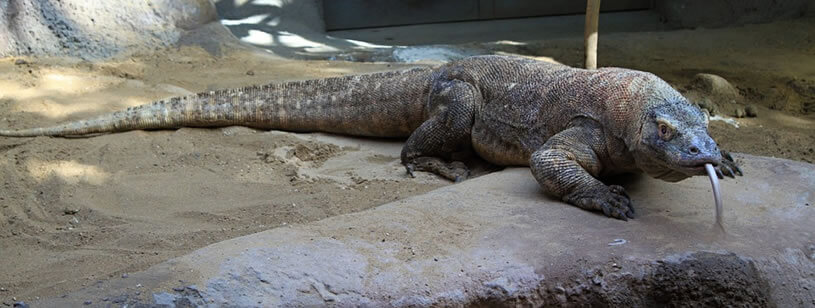
The Komodo dragon (Varanus komodoensis) is the largest living lizard. It lives only on a few islands in Indonesia, where it hunts and scavenges animal prey. Sharp, serrated teeth, powerful neck movements and venom all help it kill large animals.
Komodo dragons wound prey with their teeth and strong pulling movements, and research has shown that their venom adds to the blood loss. The old idea that they kill only with "dirty" saliva full of bacteria is no longer accepted.
The Komodo dragon is listed as Endangered by the IUCN. Its very small range and the pressures on its habitat are serious conservation concerns.
Quick facts
| Common name | Komodo dragon |
| Scientific name | Varanus komodoensis |
| Typical lifespan | About 30 years in the wild |
| Maximum speed | About 20 km/h in short bursts |
| Length | 2-3 m for males; 1.8-2.5 m for females; size varies with age and individual |
| Weight | About 70-90 kg (males), 40-60 kg (females) |
| Diet | Opportunistic carnivore (deer, pigs, buffalo, carrion) |
| Main predators | None as adults; young dragons are eaten by adult dragons, birds of prey and snakes |
| Conservation status | Endangered (IUCN assessment published in 2021) |
| Geographic distribution | Komodo, Rinca, Flores, Gili Motang and Gili Dasami, in Indonesia |
| Habitat | Savannas, dry tropical woodland and coastal habitats |
| Social behaviour | Solitary, but several gather to feed on large carcasses |
| Special adaptations | Sharp teeth, venom glands and chemical sensing with the tongue |
- Primary category:Reptiles
- Explore this animal's categories:
Interesting facts
- The largest lizard in the world - The Komodo dragon can grow up to about 3 metres long and weigh over 70-90 kg.
- An amazing sense of smell - Using its forked tongue to "taste" the air, it can smell carrion several kilometres away.
- Komodo dragons have venom glands. The effects of venom and injuries should be distinguished from the older claim that oral bacteria alone explain how they kill prey.
- It can eat up to 80% of its body weight in a single meal - Its stretchy stomach can hold huge amounts of meat.
- Female Komodo dragons can lay eggs that develop without fertilisation, a process called parthenogenesis. It does not occur in every breeding event.
- Surprisingly fast - For short bursts, it can run at about 20 km/h.
- It attacks prey much larger than itself - A Komodo dragon can kill deer, wild pigs and even water buffalo, using its sharp teeth and venom.
Records and remarkable features
- The Komodo dragon (Varanus komodoensis) is the largest and heaviest living lizard.
- It is one of the few vertebrates known to reproduce by parthenogenesis: females in zoos have produced young without a male.
- It is the top predator in its habitat, with no natural enemies as an adult.
Characteristics
The Komodo dragon is an impressive predator whose body and senses make it one of the most formidable hunters among reptiles.
Appearance
- A massive, muscular body - Up to about 3 metres long and weighing over 70 kg, it is the largest living lizard.
- A large head and strong jaws - Its sharp, serrated, backward-curving teeth are similar to those of sharks.
- A forked tongue - Works as a smell sensor, picking up the scent of carrion from several kilometres away.
- Tough, scaly skin - Contains tiny bones (osteoderms) that act like chain mail and protect it from injuries.
- A strong tail - Used for balance and for powerful blows in defence.
- Sturdy legs with sharp claws - Used for running, digging burrows and holding prey.
Special adaptations
- Venom - Glands in the lower jaw produce venom that stops blood from clotting and lowers blood pressure, making prey weak from blood loss.
- A slow metabolism - After a big meal, it can go for weeks without eating.
- Good eyesight - It can see moving objects up to about 300 metres away, though it sees poorly at night.
- Short bursts of speed - It can sprint briefly but tires quickly.
Habits and behaviour
The Komodo dragon is a solitary, opportunistic predator that uses stealth, strength and venom to catch its prey.
Social behaviour
- Solitary, but shares carcasses - It usually lives alone, but several dragons often gather to feed on a large carcass.
- A pecking order - At a carcass, the largest dragons feed first, and dominant males may attack smaller ones.
- Aggressive encounters - During the breeding season or when competing for food, Komodo dragons can bite each other badly.
Hunting techniques
- Ambush hunting – Komodo dragons can wait in cover and attack prey with a bite.
- Patient tracking - If wounded prey escapes, the dragon may follow it, sometimes for hours or days, until it collapses.
- Fast eating - It swallows large chunks of meat thanks to its flexible jaws and stretchy stomach.
Defence and survival
- Camouflage - Its grey-brown skin helps it blend in with dry ground.
- Fights back if threatened - It usually avoids conflict, but it can attack people, dogs or other large animals, especially if cornered.
- A good swimmer - It can swim between nearby islands.
Habitat and geographic distribution
The Komodo dragon lives only in Indonesia, on a few islands of the Lesser Sunda chain, mostly in dry, open habitats.
| Island | Situation | Preferred habitat |
|---|---|---|
| Komodo | One of the two largest populations | Savannas, dry tropical forests |
| Rinca | One of the two largest populations | Grasslands, coastal areas |
| Flores | Scattered populations on the west and north coasts | Dry forests, coastal lowlands |
| Gili Motang and Gili Dasami | Small populations | Rocky, dry hills |
| Padar | Died out in the 1970s-1980s, probably after its prey was hunted out | Grassy hills |
Types of habitat
- Savannas and dry grasslands - It prefers open country, where hunting is easier.
- Coasts and mangroves - It sometimes searches beaches and tidal areas for food.
- Dry forests - It shelters in the shade or in burrows during the hottest part of the day.
Human impact and threats
- Habitat loss - Farming and growing settlements, especially on Flores, reduce the dragons' habitat.
- Poaching and illegal trade - Some dragons are illegally captured and sold.
- Less prey - Hunting of deer and wild pigs by people reduces the dragons' food.
- Climate change - Rising sea levels could flood much of the dragons' low-lying coastal habitat.
Diet and feeding
Komodo dragons eat both live prey and carrion. Meal size and the time between meals vary.
What do Komodo dragons eat?
| Type of food | Share of diet | Notes |
|---|---|---|
| Deer, wild pigs, water buffalo | The main food of adults | Rusa deer are the most important prey |
| Lizards, birds, eggs | Important for young dragons | Easy prey, especially for young animals |
| Carrion and dead animals | Common | Saves the effort of hunting |
| Insects, rodents, fish | Mainly young dragons | Eaten especially in the first years of life |
| Other Komodo dragons (cannibalism) | Occasional | Adults sometimes eat young or weak dragons |
Feeding methods
- Ambush hunting - It hides and attacks prey with a powerful, venomous bite.
- Waiting - If the prey escapes, the dragon may follow it until it weakens.
- Eating almost everything - It swallows bones, hooves, skin and organs, and later coughs up hair, horns and teeth that it cannot digest.
- Swallowing whole - It can swallow smaller prey, such as goats or pigs, almost whole.
- Shared meals - Several dragons often feed on the same carcass, although they do not hunt as a team.
Reproduction and life cycle
Female Komodo dragons lay eggs. Parthenogenesis has been documented, but it is not the usual explanation for every breeding event.
| Feature | Details |
|---|---|
| Age at maturity | About 7-9 years |
| Breeding season | Mainly June - August |
| Type of reproduction | Egg-laying |
| Eggs per nest | About 15-30 |
| Incubation period | About 7-8 months |
| Size of the young at hatching | About 40 cm and 100 g |
| Independence | From hatching |
| Lifespan | About 30 years in the wild |
Breeding behaviour
- Fights between males - In the breeding season, males rear up on their hind legs and wrestle for the right to mate.
- Courtship - The winning male flicks his tongue over the female and rubs against her before mating.
- Nesting - Females often lay their eggs in the large mound nests of orange-footed scrubfowl, or dig nests in hillsides, and guard them for a while.
Hatching and growing up
- The eggs hatch after about 7-8 months, and the young are fully independent.
- Life in the trees - Young dragons spend their first years in trees, where they are safer from cannibalistic adults.
- Growing up - In their first years, they feed on insects, lizards, birds and eggs.
- After several years, they come down to live on the ground and start hunting larger prey.
Name and history
Origin of the name
- The name "Komodo dragon" comes from Komodo Island and from reports of "land crocodiles" living there.
- The scientific name Varanus komodoensis was given in 1912 by Peter Ouwens, director of the Zoological Museum in Bogor, on Java.
- On Komodo and Flores, local people call it ora; it is also known in Indonesian as buaya darat, "land crocodile".
Discovery and scientific study
- 1910 - A Dutch colonial officer, Lieutenant van Steyn van Hensbroek, investigated reports of huge lizards on Komodo.
- 1912 - Peter Ouwens published the first scientific description of the species.
- 1926 - An American expedition led by W. Douglas Burden brought the first live Komodo dragons to the Bronx Zoo in New York; Burden's stories are said to have helped inspire the film King Kong.
- Research published in 2009 documented venom glands and biologically active venom components in Komodo dragons.
The Komodo dragon in folklore
Cultural significance and mythology
- A family legend - The Ata Modo people of Komodo tell of a princess who gave birth to twins: a human boy and a dragon girl. Because of this, people and dragons are seen as siblings who should live in peace.
- A natural wonder - Komodo National Park, home of the dragons, became a UNESCO World Heritage Site in 1991.
- A national treasure - The Komodo dragon is one of Indonesia's best-known animals and a major attraction for visitors from all over the world.
Conservation status and threats
The Komodo dragon is listed as Endangered by the IUCN (2021). It has a very small range and faces pressure on its habitat, especially from rising sea levels.
| IUCN status | Population estimate | Regions |
|---|---|---|
| Endangered (EN) | A few thousand animals in total | Komodo, Rinca, Flores, Gili Motang, Gili Dasami |
Main threats
- Habitat loss - Clearing land for farming, settlements and tourism reduces the dragons' natural habitat.
- Poaching and illegal capture - Although they are protected by law, some Komodo dragons are taken and sold illegally.
- Fewer prey animals - Deer and wild pigs, the dragons' main food, are hunted by people.
- Climate change - Rising sea levels and higher temperatures could shrink the dragons' habitat considerably in the coming decades.
- Conflict with people - Dragons sometimes kill livestock and, rarely, attack people, which can lead to conflict.
Conservation efforts
- Komodo National Park - Founded in 1980, it protects the dragons and their habitat.
- Population monitoring - Researchers use camera traps and tracking devices to follow the dragons.
- Tourism controls - Indonesian authorities regulate visitor numbers and behaviour to protect the animals.
- Captive breeding - Breeding programmes in Indonesia and in zoos around the world help secure the species' future.
In popular culture
- King Kong (1933) - The film's creators were inspired partly by W. Douglas Burden's 1926 expedition to Komodo.
- The Freshman (1990) - In this comedy with Marlon Brando and Matthew Broderick, a Komodo dragon is smuggled into the USA to be served at a secret gourmet club.
- Komodo (1999) - A horror film about giant Komodo dragons let loose on an island off the US coast.