European turtle doveStreptopelia turtur — habitat, diet and reproduction
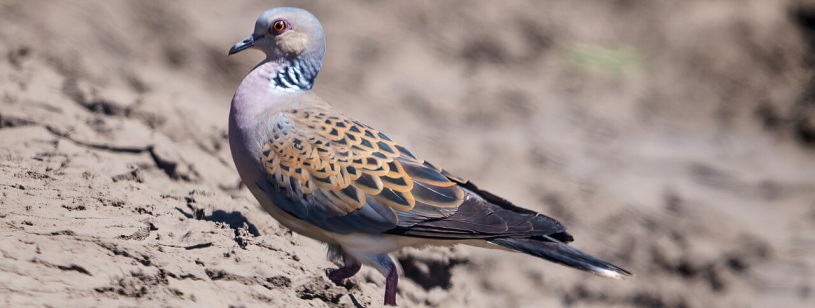
European turtle dove with chestnut-and-black patterned wings and striped neck patches. · Cezar Popescu / Wikimedia Commons / CC BY-SA 4.0 (https://creativecommons.org/licenses/by-sa/4.0/). Cropped and resized. Source: https://commons.wikimedia.org/wiki/File:20210519_Streptopelia_turtur.jpg
The European turtle dove (Streptopelia turtur) has richly patterned wings and striped patches on its neck. It gathers seeds from the ground and hides its nest in dense vegetation. It visits Romania to breed before wintering in Africa. A gentle purring call often reveals its presence.
Quick facts
| Common name | European turtle dove |
| Scientific name | Streptopelia turtur |
| Lifespan | BTO estimates around 2 years for birds reaching breeding age; exceptional birds exceed 11 |
| Length | 25–28 cm |
| Weight | 99–170 g |
| Diet | Mainly seeds gathered from the ground |
| Predators | Birds of prey and mammals, including cats |
| Conservation status | Vulnerable globally |
| Distribution | Europe, North Africa and parts of Asia; winters south of the Sahara |
| Habitat | Farmland with scrub, hedgerows and woodland edges |
| Family | Columbidae |
| Reproduction | Usually two eggs; both parents provide care |
- Primary category:Birds
- Explore this animal's categories:
Interesting facts
- Turtur echoes the bird’s repeated purring call.
- Migration connects Europe with sub-Saharan Africa.
- Juveniles initially lack the striped adult neck patch.
- Food, water and nesting cover must be accessible within the same landscape.
Records and extremes
A British ringing record reached 11 years, 2 months and 15 days. This exceptional individual far exceeded typical survival estimates.
The annual journey between Europe and Africa spans thousands of kilometres. Birds cross seas and desert, relying on suitable stopping places along the way.
Characteristics
Dark feather centres and chestnut edges create the patterned wings. A pinkish breast and black-and-white neck patches complete the adult appearance. White tail edges show in flight.
The sexes look similar; juveniles are plainer. Collared doves have more uniform beige-grey wings and a black half-collar rather than striped patches.
Behaviour
Turtle doves are often concealed in trees or scrub. Their repeated purring can be easier to detect than the bird itself. They descend to gather accessible seeds.
Displaying males swell their chests and move their heads. Dense vegetation hides the nest, while late summer brings departure towards wintering areas.
Habitat and distribution
Breeding extends across Europe, North Africa and parts of Central Asia. Wintering areas lie south of the Sahara, including the Sahel. In Romania the species favours lowlands and lower hills.
Open woods, farmland margins and thick hedgerows provide complementary resources. Young birds initially travel less far, making nearby food, water and shelter especially valuable.
Diet and feeding
Seeds of wild plants and crops dominate the diet. Birds collect them from the ground, including spilled grain.
Short, patchy vegetation and bare areas make seeds accessible. Regular drinking water also matters. Small invertebrates are taken occasionally.
Reproduction and life cycle
A platform of twigs is hidden in a tree, shrub or hedge. Thorny vegetation offers support and cover.
Usually two eggs are incubated by both parents for around two weeks. Young receive continued care and leave the nest at roughly three weeks.
Further nesting attempts depend on available time and food. Reduced resources can shorten the breeding season.
Name and history
Linnaeus described the species in 1758. Turtur imitates its call, and the genus Streptopelia also includes the distinct Eurasian collared dove.
Turtle doves have appeared in art and literature as symbols of love and fidelity. This is a cultural association recorded by the RSPB.
Conservation and threats
The species is globally Vulnerable. Loss of food and nesting habitat, hunting pressure along migration routes and drought in wintering areas contribute to concern.
Conservation restores seed-rich ground and scrub while reducing mortality along the flyway. Recent western European responses show that recovery is possible, though regional populations require separate monitoring.
Retaining wild plants and dense cover between fields can support breeding birds.
Frequently asked questions
Is it the same as a collared dove?
No. Turtle doves have patterned wings and striped neck patches.
Does it stay in Romania in winter?
The species migrates to sub-Saharan Africa.
Why is it hard to spot?
It often hides in vegetation, making the call an important clue.
What does it usually eat?
Seeds from wild plants and crops, gathered on the ground.
How many eggs are laid?
Usually two, incubated by both parents.
Why does it need conservation?
Severe declines have led to a global Vulnerable classification.