ChameleonInteresting facts and information
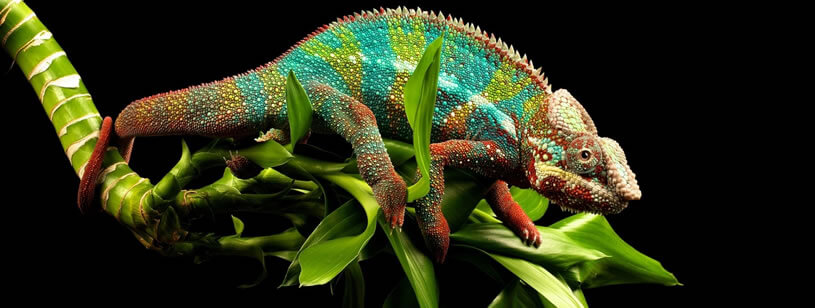
Chameleons are lizards in the family Chamaeleonidae. Most have grasping feet, eyes that move independently and a fast-shooting tongue for catching prey. They change colour mainly to communicate and to control their temperature, as well as for camouflage.
Many chameleons climb in trees and bushes, while some live on or near the ground. Their size, shape and behaviour vary greatly between species, from tiny leaf chameleons only a few centimetres long to giants of about 68 cm.
Quick facts
| Common name | Chameleon |
| Scientific name | Chamaeleonidae |
| Typical lifespan | From a few months to over 10 years (depending on the species) |
| Maximum speed | Very slow walkers, but their tongue shoots out in a fraction of a second |
| Length | From about 2 cm to about 68 cm (depending on the species) |
| Weight | From under 1 g to about 700 g |
| Diet type | Carnivore (mainly insects) |
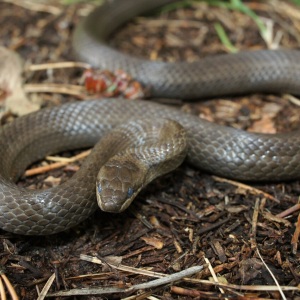
| Main predators | Snakes, birds such as shrikes and hornbills, small mammals |
| Conservation status | Varies by species; many from Madagascar are threatened (IUCN) |
| Number of species | More than 200; counts change as researchers describe and revise species |
| Habitat | Tropical forests, mountain forests, savannas, deserts |
- Primary category:Reptiles
- Explore this animal's categories:
Interesting facts
- Chameleons change colour not only for camouflage, but also to show their mood, to control their body temperature and to communicate. For example, a stressed chameleon may turn dark, while an excited male may show bright colours.
- Tongue projection – A chameleon can project its tongue rapidly to capture prey; timing and reach differ between species.
- Their eyes can move independently of each other, so they can look in two different directions at once. This gives them an almost 360-degree field of view.
- Chameleons have special climbing feet: their toes are joined in two opposing bundles that work like tongs, so they can grip branches firmly.
- Hearing – Chameleons lack external ear openings, but this does not mean they detect no sound or vibration.
- Tail use – Many chameleons have a grasping tail, but this is not unique among reptiles and is not equally developed in every species.
- Tiny chameleons – Some leaf chameleons from Madagascar, such as Brookesia micra and Brookesia nana, are only about 2-3 cm long.
- The panther chameleon (Furcifer pardalis) has amazingly varied colours, depending on where it comes from: some are mostly red, others blue, green, orange or a mix of colours.
- Instead of fleeing from predators, chameleons usually keep still or move slowly and sway like a leaf in the wind, relying on camouflage.
- Chameleons rarely drink from still water; they lick drops of dew and rain from leaves.
Records and remarkable features
- One of the largest chameleons is Parson's chameleon (Calumma parsonii) from Madagascar, which can reach about 68 cm in length and weigh up to about 700 g.
- The smallest known chameleon is Brookesia nana, described in 2021; adult males have a body only about 1.4 cm long.
- Small chameleons can project the tongue with rapid acceleration. No unsupported fastest-species record or comparison with fighter aircraft is asserted here.
- One of the most colourful chameleons is the panther chameleon (Furcifer pardalis), whose colours vary greatly between regions and with its mood.
- Labord's chameleon (Furcifer labordi) has one of the shortest lives of any four-legged animal: it lives only about 4-5 months after hatching.
Characteristics
Chameleons are unusual lizards of the family Chamaeleonidae, with special adaptations that set them apart from other lizards. From their colour changes to their independent eyes, they are skilled hunters and masters of disguise.
Main physical characteristics
- A flattened body - Most species have a body that is flattened from side to side, which helps them hide among leaves and branches.
- Colour change can involve pigment cells and light-reflecting structures in the skin. Its roles include signalling and temperature regulation as well as concealment.
- A gripping tail - In many species, the tail works like a fifth limb, helping the chameleon hold on to branches.
- Chameleon toes are arranged in opposing groups of two and three, helping the feet grip branches.
- Independent eyes - Chameleons' eyes, set in cone-shaped turrets, can move separately, giving an almost 360-degree field of view.
- A projectile tongue - In some species, the tongue can be about twice as long as the body and shoots out at amazing speed.
Special adaptations for survival
- Colour for communication - Chameleons change colour mainly to show their mood, attract mates, warn rivals or warm up and cool down; camouflage is mostly provided by their normal colours.
- Slow but steady - Chameleons move very slowly and often rock back and forth like a leaf, which helps them avoid being noticed.
- A slow metabolism - Helps them survive where food is scarce.
Habits and behaviour
Chameleons are solitary and spend most of their time alone in bushes and trees. They meet mainly when mating or defending their territory.
Social behaviour
- Territorial - Most species are aggressive towards other chameleons and defend their territory with bright colours and threatening postures.
- Fights between males - Males compete for females by gaping, changing colour, puffing up and pushing; horned species may even lock horns.
- Loners - They do not form groups and avoid each other outside the breeding season.
Hunting methods
- Sit and wait - Instead of chasing prey, chameleons keep still and catch insects with their lightning-fast tongue.
- Stereoscopic vision - When they spot prey, they point both eyes at it to judge the distance precisely.
- A sticky tongue - The tip of the tongue is covered with very thick, sticky mucus that holds the insect fast.
Defence methods
- Camouflage - Their green and brown colours help them blend in with leaves and branches.
- Keeping still - Instead of running away, they prefer to stay motionless to avoid being seen.
- Threat display - If cornered, a chameleon may puff up, gape its mouth, show bright colours and hiss.
Habitat and geographic distribution
Chameleons live mainly in tropical and subtropical regions with warm weather and plenty of vegetation. Many species live only in a small area and are found nowhere else.
Habitat types
- Tropical forests - Most species live in trees and bushes, where thick vegetation protects them.
- Savannas and deserts - Some species, such as the Namaqua chameleon (Chamaeleo namaquensis), live on the ground and can cope with great heat.
- Mountains - Species such as Jackson's chameleon live in cool highland forests in East Africa.
Geographic distribution
| Region | Approximate number of species |
|---|---|
| Madagascar | About 90 or more (almost half of all species) |
| Mainland Africa | Many species, especially in the forests and mountains of East and Central Africa |
| North Africa and the Middle East | A few species |
| South Asia | 1-2 species, including the Indian chameleon |
| Southern Europe (Spain, Portugal, Greece, Malta, Cyprus) | 2 species |
Threats to their habitat
- Deforestation - Habitat loss is the biggest threat to chameleons, especially in Madagascar, where many species live nowhere else.
- Climate change - Rising temperatures may force mountain species to move higher up, where there is less space.
- Illegal trade - Many chameleons are captured and sold as pets, which harms wild populations.
Diet and feeding
Chameleons are carnivores that feed mainly on insects, although some large species also eat small vertebrates, and a few eat some plant matter. Their unique way of hunting makes them very effective at catching prey.
Main food
- Insects - Crickets, grasshoppers, flies, cockroaches, caterpillars.
- Arachnids - Spiders and other small arthropods.
- Snails and worms - Larger species may eat snails and larvae.
- Some larger chameleons, including the veiled chameleon (Chamaeleo calyptratus), may take small vertebrate prey.
- Leaves and fruit - The veiled chameleon sometimes eats leaves, possibly to get water.
Feeding methods
Chameleons hunt by surprise:
- Spotting prey - Their independent eyes scan the area, and when they find a target, both eyes lock on to it.
- Firing the tongue - The tongue can be up to about twice the length of the body and shoots out in a fraction of a second.
- Sticking and catching - The tip of the tongue is covered with very thick, sticky mucus, so the prey is trapped at once.
- Pulling back - The tongue is pulled back quickly, and the chameleon swallows the prey after crushing it with its jaws.
Diet by size and habitat
| Species | Main food |
|---|---|
| Tiny leaf chameleons (Brookesia) | Tiny insects, such as springtails and mites |
| Panther chameleon (Furcifer pardalis) | Crickets, grasshoppers, other insects |
| Veiled chameleon (Chamaeleo calyptratus) | Large insects, sometimes leaves |
| Parson's chameleon (Calumma parsonii) | Large insects, occasionally small vertebrates |
| Namaqua chameleon (Chamaeleo namaquensis) | Beetles, spiders, scorpions, even small lizards |
Reproduction and life cycle
Chameleons have internal fertilisation. Most species lay eggs, but some give birth to live young.
Mating
- Males show bright colours to attract females and puff up their bodies to look bigger.
- Fights between males - Rival males gape, push and try to drive each other away.
- Females also change colour to show whether they will accept a male; females that are already carrying eggs often turn dark with bright spots.
- Fertilisation is internal; males have paired organs called hemipenes.
Types of reproduction
- Egg-laying - Most species lay eggs in a burrow in the ground. The panther chameleon lays about 10-40 eggs, and depending on the species, incubation lasts from about 4 months to more than a year.
- Some chameleons give birth to live young, including Jackson’s chameleon (Trioceros jacksonii, formerly Chamaeleo jacksonii). Reproductive timing differs between species and conditions.
Development of the young
- The young are independent from the moment they hatch and soon start hunting tiny insects.
- They grow quickly, and many chameleons become adults within 6-12 months.
- Lifespan varies from a few months to over 10 years, depending on the species; larger chameleons usually live longer than small ones.
Name and history
Chameleons have been known for thousands of years and have long been seen as mysterious creatures because of their colour changes.
Origin of the name
- The word "chameleon" comes from the Greek khamaileon, meaning "ground lion" (khamai = on the ground, leon = lion).
- In English, "chameleon" is also used for a person who changes their opinions or behaviour to suit the situation.
Taxonomic classification
| Taxonomic category | Name |
|---|---|
| Kingdom | Animalia |
| Phylum | Chordata |
| Class | Reptilia |
| Order | Squamata |
| Family | Chamaeleonidae |
| Main genera | Chamaeleo, Furcifer, Trioceros, Calumma, Bradypodion, Brookesia |
Discovery and study of chameleons
- The earliest detailed descriptions come from ancient Greece, where Aristotle wrote about the chameleon.
- European explorers from the 16th to the 18th centuries described many chameleons from Africa and Madagascar.
- Modern research has shown that colour change depends partly on tiny crystals in the skin and is used mostly for communication and temperature control, not only for camouflage.
Role in history and culture
- An old myth - Ancient and medieval writers believed that chameleons lived on air alone, an idea mentioned by Shakespeare in Hamlet.
- African folklore - In many African cultures, chameleons are linked with change, slowness and the origin of death.
- Exotic curiosities - Chameleons were kept as rare curiosities by collectors and royal courts in Europe.
Chameleons continue to fascinate scientists and animal lovers and are among the most studied reptiles because of their unique adaptations.
Cultural significance and mythology
Chameleons have been seen as mysterious, even magical creatures in many cultures. Their colour changes, swivelling eyes and strange way of walking have inspired many myths and superstitions.
Chameleons in mythology and folklore
- Zulu mythology - The creator Unkulunkulu sent the chameleon to tell people that they would live forever. The chameleon dawdled on the way, and a fast lizard arrived first with the message that people must die, so humans became mortal.
- Other African stories - Similar tales about a slow messenger and the origin of death are told by many peoples across Africa, and in some places chameleons are feared and avoided.
Chameleons as symbols
- Adaptability and change - Chameleons are a common symbol of adapting to new situations.
- Discretion and survival - In modern culture, they are seen as masters of disguise.
- Slow but effective - They stand for the idea that patience and precision can matter more than speed.
Conservation status and threats
Many chameleons are vulnerable, because they often live in small areas and are affected by habitat destruction and the pet trade.
Conservation status
- Parson's chameleon (Calumma parsonii) - Near Threatened, because of habitat loss and collection in Madagascar.
- Tarzan's chameleon (Calumma tarzan) - Critically Endangered; it lives only in a few small forest fragments in Madagascar.
- Jackson’s chameleon (Trioceros jacksonii) – Collection and habitat change can affect populations; status should be checked for the named taxon.
- Common chameleon (Chamaeleo chamaeleon) - Not threatened globally, but declining in parts of southern Europe because of building along the coast.
Main threats
- Deforestation - Madagascar, home to almost half of all chameleon species, loses large areas of forest every year.
- The pet trade - Many chameleons are captured and sold as pets, although many species do poorly in captivity.
- Climate change - Rising temperatures and changing habitats affect where species can live.
- Pesticides - Farm chemicals reduce the insects that chameleons eat.
Conservation efforts
- Forest protection and replanting in Madagascar to save the habitats of species found nowhere else.
- Strict trade rules - CITES, the Convention on International Trade in Endangered Species, controls or bans the export of many chameleons.
- Captive breeding of popular pet species to reduce collection from the wild.
In popular culture
Chameleons are popular in films, books, games and songs because of their unusual looks and abilities.
Chameleons in film and animation
- Rango (2011) - An animated western in which the hero is a pet chameleon who becomes a sheriff.
- Tangled (Disney, 2010) - Pascal, a little chameleon, is Rapunzel's loyal friend.
- Nature documentaries - Chameleons are favourite subjects of wildlife films because of their fascinating behaviour.
Chameleons in literature
- The Mixed-Up Chameleon (Eric Carle, 1975) - A picture book about a chameleon who wishes to be like other animals and learns to be happy as himself.
Chameleons in video games
- Yooka-Laylee (2017) - A video game whose hero, Yooka, is a chameleon.
Chameleons as symbols
- Music - "Karma Chameleon" (Culture Club, 1983) became a worldwide hit.
- Design and branding - Chameleons are often used as symbols of change and flexibility.
- Tattoos and art - The chameleon is a popular image of transformation and individuality.