Mediterranean musselMytilus galloprovincialis — habitat, diet and reproduction
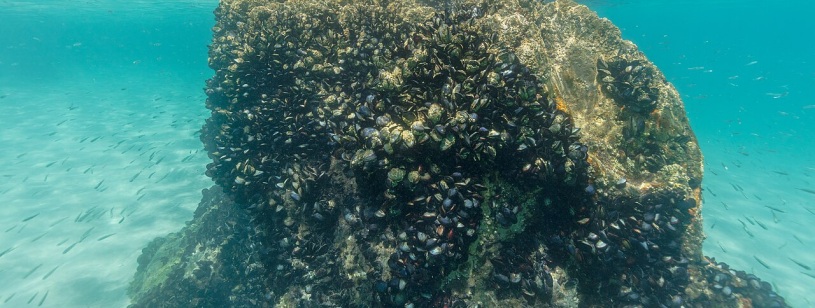
A colony of Mytilus galloprovincialis attached to underwater rock in Portugal. · Diego Delso / CC BY-SA 4.0 (https://creativecommons.org/licenses/by-sa/4.0). Cropped and resized.
The Mediterranean mussel, Mytilus galloprovincialis, is a bivalve mollusc native to the Mediterranean and Black seas. It forms dense groups on rocks and other hard surfaces. Beneath its dark shell, the animal filters particles from seawater and holds itself in place with strong byssal threads.
Quick facts
| Common name | Mediterranean mussel |
| Scientific name | Mytilus galloprovincialis |
| Diet | Filter feeder: phytoplankton and organic particles |
| Main predators | Predatory marine snails and shorebirds; varies regionally |
| Conservation context | Widespread; invasive in some introduced regions |
| Distribution | Native to the Mediterranean and Black seas; introduced elsewhere |
| Habitat | Coastal seawater, attached to hard substrates |
| Length | Shell often around 5 cm, reaching approximately 12 cm |
| Class | Bivalvia |
| Family | Mytilidae |
| Attachment | Byssal threads |
| Reproduction | External fertilisation and drifting larvae |
Interesting facts
- A mussel is an animal even when it remains attached.
- Its anchoring threads are produced by its own body.
- Larvae disperse through water before settling.
- A species can be native in one sea and invasive elsewhere.
Characteristics
Two shell valves enclose the body, explaining the name Bivalvia. The outside can be dark blue, brown or nearly black, with an elongated outline and a narrower end.
Size depends on age and conditions: shells are often around 5 cm and may reach approximately 12 cm. Colour and outline alone cannot always separate related Mytilus species, which may look similar and hybridise.
Behaviour
Mussels cluster in dense layers. They have no roots: attachment comes from byssus, a bundle of threads secreted by the animal.
A muscular foot helps explore surfaces and establish an anchor, particularly in young stages. Mussel beds also reshape the surface they occupy. Gaps between shells shelter small organisms, making the colony a habitat as well as a gathering of individuals.
Habitat and distribution
The species is native to the Mediterranean and Black seas. Human activities have transported it to other regions, where introduced populations have become established.
Rocks, harbour structures and aquaculture equipment provide suitable surfaces. Waves, food, salinity and competition influence where colonies grow. These marine bivalves should not be confused with freshwater mussels, which belong to different groups and have different environmental requirements.
Diet and feeding
Water flowing through the body brings phytoplankton and organic particles. Gills collect food, and suitable particles are transported towards the digestive system.
Growth depends on food arriving with the surrounding water. Filtering is a feeding process, not a guarantee that water becomes safe for people. Materials present in the environment may also accumulate in the animal’s tissues.
Reproduction and life cycle
Males and females release sperm and eggs into the water. After external fertilisation, development includes larval stages carried by currents.
Later, a larva explores a surface using its foot, produces attachment threads and adopts a life associated with the substrate. Large egg numbers do not guarantee survival: suitable conditions must still be encountered. Temperature, food and region influence growth and reproductive timing.
Name and history
Mytilus galloprovincialis identifies the Mediterranean mussel, while everyday names may also refer to similar relatives.
People have collected mussels for many centuries. Rope culture uses their natural attachment and their ability to feed on particles already present in seawater. In Romania, the species belongs to the living Black Sea coastal environment, as well as being familiar as seafood.
Conservation and threats
Native colonies contribute to coastal habitat structure. Predatory marine snails and some shorebirds feed on them, with relationships varying regionally.
Introduced populations can compete with local molluscs and alter rocky-shore communities, as documented in South Africa. Protecting marine environments involves maintaining water quality and avoiding the transport of organisms beyond their natural ranges.
Frequently asked questions
Is a mussel an animal or a plant?
It is an animal: a bivalve mollusc attached by threads produced by its body.
Does it live in the Black Sea?
Yes. Mytilus galloprovincialis is native to the Mediterranean and Black seas.
What does it eat?
It filters phytoplankton and other organic particles from seawater.
Why does it cluster on rocks?
Hard surfaces provide attachment sites, and individuals can accumulate into dense beds.