American black bearUrsus americanus — habitat, diet and reproduction
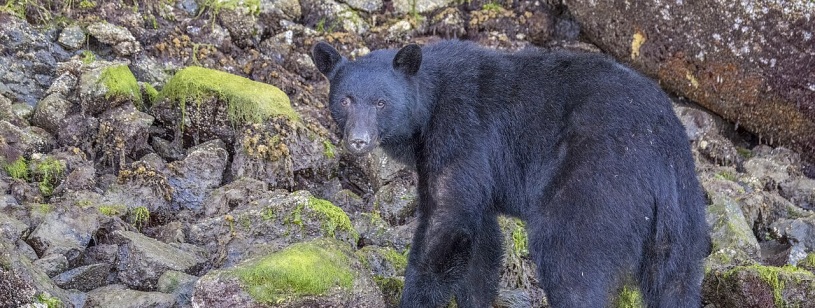
American black bear (Ursus americanus) on a rocky shore. · Charles J. Sharp / CC BY-SA 4.0 (https://creativecommons.org/licenses/by-sa/4.0). Cropped and resized.
The American black bear is the most widespread bear in the world, found in forests from Alaska and Canada to northern Mexico. It is smaller than the brown bear, climbs trees very well and eats mostly plants. Its name can mislead: its fur may also be brown, cinnamon or even white.
Quick facts
| Common name | American black bear |
| Scientific name | Ursus americanus |
| Lifespan | About 18–20 years in the wild; sometimes over 30 |
| Length | About 1.2–2 m |
| Weight | Males about 60–300 kg; females about 40–150 kg |
| Diet | Omnivore: berries, nuts, grasses, insects, fish, carrion |
| Predators | Brown bears, wolves and pumas may kill cubs |
| Conservation status | Least Concern (LC) |
| Distribution | Canada, the United States and northern Mexico |
| Habitat | Broadleaf and conifer forests, swamps, mountains |
| Family | Ursidae |
| Hibernation | Yes, for several months a year in cold regions |
Interesting facts
- A white form of the black bear, the “spirit bear” or Kermode bear, lives on the coast of Canada.
- The teddy bear is named after US President Theodore Roosevelt, who refused to shoot a tied-up black bear.
- Winnie-the-Pooh was named after Winnipeg, a black bear at London Zoo.
- Cubs are born in the den in midwinter, weighing only a few hundred grams.
Characteristics
The American black bear has a longer, straighter muzzle than the brown bear, larger ears and no shoulder hump. Its claws are short and curved, suited to climbing.
Fur is usually black in the east, but in the west many bears are brown or cinnamon. Males are much larger than females, and weight varies greatly between autumn and spring.
Behaviour
It is usually solitary and most active at dawn and dusk. It has an excellent sense of smell and a good memory for food sites.
When frightened, it climbs a tree quickly. In cold regions it enters a den in autumn and spends the winter hibernating without eating or drinking. Attacks on people are rare, but accessible food draws bears into camps and towns.
Habitat and distribution
The black bear lives across almost all of Canada, many US states and northern Mexico. It prefers dense forest but adapts to swamps, mountains and areas near towns.
It is the most numerous bear in the world, with an estimated population of several hundred thousand.
Diet and feeding
More than three-quarters of its food is plant matter: grasses, buds, berries, acorns and hazelnuts. It also eats insects, larvae, honey, fish, eggs and carrion.
In autumn it eats enormously to store fat for winter. It sometimes catches deer or moose calves. Near people it raids bins, so national parks use bear-proof containers.
Reproduction and life cycle
Mating takes place in summer, but the embryo only starts developing in autumn. Cubs, usually two or three, are born in the den in January or February.
Newborns are blind and very small and grow on their mother’s milk until spring. They stay with her about a year and a half, learning where to find food.
Name and history
The scientific name Ursus americanus means “American bear”.
The 1902 story of President Theodore Roosevelt, who refused to shoot a captured black bear, inspired the “Teddy bear” toy. Later, Winnipeg, a bear at London Zoo, gave her name to Winnie-the-Pooh.
Conservation and threats
The species is assessed as Least Concern, and in many regions numbers have increased in recent decades.
Main problems are conflicts with people over accessible food, vehicle collisions and forest loss. In some US states it is legally hunted under quotas.
Frequently asked questions
Is the black bear always black?
No. Its fur can be black, brown, cinnamon, blond or even white, as in the Kermode bear of Canada.
Can black bears climb trees?
Yes, very well, especially when frightened or looking for food.
What does the American black bear eat?
Mostly plants, berries and nuts, plus insects, fish, eggs and carrion.
Does the American black bear live in Romania?
No. Romania has the brown bear; the American black bear lives only in North America.