Wild boarInteresting facts and information
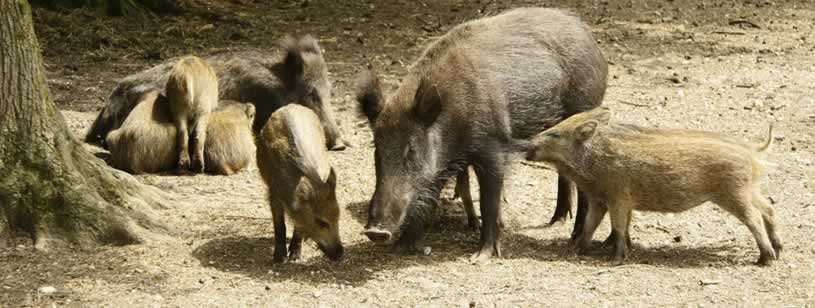
The wild boar (Sus scrofa) is a mammal native to much of Eurasia and parts of North Africa. It feeds on many kinds of plant and animal food. Wild boar, domestic pigs and feral pigs need distinct descriptions.
Wild boar live in forests, marshes, grasslands and even farmland. They play an important role in ecosystems by turning over the soil and eating insects and small animals. In some regions, however, wild boar and feral pigs have become invasive and damage crops and natural ecosystems.
In many cultures, the wild boar is a symbol of strength, courage and perseverance and appears in mythology, heraldry and literature. It is also an important game animal, valued for its meat and impressive tusks.
Quick facts
| Common name | Wild boar |
| Scientific name | Sus scrofa |
| Typical lifespan | Up to about 10-14 years in the wild, up to about 20 years in captivity |
| Maximum speed | About 40-48 km/h over short distances |
| Height | About 70-110 cm at the shoulder |
| Length | About 120-180 cm |
| Weight | About 50-200 kg; large males can exceed 300 kg |
| Diet type | Omnivore (fruit, nuts, roots, insects, small animals, carrion) |
| Main predators | Wolves, lynxes, bears, tigers, leopards, humans |
| Conservation status | Least Concern (IUCN); invasive where introduced |
| Geographical distribution | Europe, Asia, North Africa; introduced to the Americas and Australia |
| Social behaviour | Females and young live in groups called sounders; adult males usually live alone |
| Special adaptations | High intelligence, large tusks for defence, excellent sense of smell |
- Primary category:Mammals
- Explore this animal's categories:Animals of AfricaAnimals of AsiaAnimals of AustraliaAnimals of EuropeAnimals of North AmericaAnimals of RomaniaAnimals of Romania’s forestsAnimals of South AmericaAnimals of the Danube DeltaForest animalsFurry animalsHoofed animalsInsect-eating animalsLive-bearing animalsMammalsMammals of RomaniaMountain animals of RomaniaOmnivoresVertebratesWWild animals
Interesting facts
- Wild boar are very intelligent - Studies show that wild pigs learn quickly from experience, remember solutions to problems and can even use simple tools.
- They are good swimmers - Wild boar can cross wide rivers and even swim to islands near the coast.
- They have many calls - They grunt, squeal, growl and bark to signal danger, food or their place in the group.
- They have an excellent memory for places - Wild boar remember good feeding sites and return to them year after year.
- Males' tusks keep growing - The lower tusks of old males can stick out up to about 20 cm and are used for fighting and digging.
- An amazing sense of smell - Wild boar can smell food buried deep in the ground, which is why pigs are used to find truffles.
- Piglets in one litter can have several fathers - A sow may mate with more than one male, which increases the genetic diversity of her young.
- They learn to avoid hunters - In many areas, wild boar become active mainly at night and learn to avoid traps and hunting areas.
Records and remarkable features
- The wild boar (Sus scrofa) is a mammal native to much of Eurasia and parts of North Africa. It feeds on many kinds of plant and animal food. Wild boar, domestic pigs and feral pigs need distinct descriptions.
Characteristics
The wild boar is a large, sturdy and highly adaptable mammal whose body is perfectly built for survival in the wild.
Appearance
- A heavy, muscular body - Wild boar have a compact body with powerful shoulders and a back that slopes down towards the tail, which helps them dig and run fast.
- A large head and long snout - The snout is very sensitive and full of nerve endings, and boar use it to search for food in the soil.
- Sharp tusks - Males have large canine teeth, called tusks, which they use to defend themselves and fight rivals.
- A thick, coarse coat - Its colour ranges from light brown to black, and it grows thicker in winter to protect against the cold.
- A short tail - Usually held down, but raised when the animal is alert or excited.
- Strong legs and hard hooves - Let wild boar run away quickly and cross rough ground, mud and snow.
Special adaptations
- A superb sense of smell - Wild boar can detect food, predators and other wild boar from long distances.
- An excellent memory - They remember where they found food and where they met danger.
- Survival skills - They dig resting places, wallow in mud to cool down and get rid of insects, and use dense vegetation to escape pursuers.
- Fast spread - Wild boar can quickly colonise new areas, adapting to forests, plains, marshes and even semi-dry areas.
Habits and behaviour
The wild boar is a social and intelligent animal. Females and young live in groups called sounders, led by an experienced sow.
Social behaviour
- Females and piglets live together - A sounder may have about 5-20 animals, made up of related sows and their young.
- Adult males live alone - Young males leave the group as they grow up, and adult males join sounders mainly in the breeding season.
- They communicate a lot - Wild boar use sounds, smells and body postures to send messages.
Defence and survival techniques
- Fast running - Although they look heavy, wild boar can reach about 40-48 km/h and move nimbly through forests.
- Tusks as weapons - Males use their tusks to fight each other and to defend themselves against predators.
- Camouflage - Their brown and black coat helps them blend into the forest.
- Cunning - Hunted boar may double back, hide in thickets or swim across water to lose their pursuers.
Habitat and geographic distribution
Wild boar are very adaptable and live in many environments, from dense forests to wetlands and farmland.
| Region | Populations | Preferred habitat |
|---|---|---|
| Europe | European wild boar | Mixed forests, plains, mountains |
| Asia | Several Asian subspecies, including the Indian wild boar | Jungles, grasslands, marshes |
| North Africa | North African wild boar | Dry areas, mountains |
| North America | Introduced wild boar and feral pigs (invasive) | Forests, farmland, swamps |
| Australia | Feral pigs (invasive) | Dry areas, savannas, pastures |
Types of habitat
- Deciduous and mixed forests - Their ideal habitat, with plenty of food and shelter.
- Marshes and river banks - Wild boar like the mud and lush vegetation.
- Farmland - In many regions, wild boar enter fields and cause serious damage to crops.
- Dry regions - Feral pigs in parts of Australia survive dry conditions by eating juicy plants and staying near water.
Human impact and threats
- Habitat change - In many regions, farmland has replaced forests.
- Conflict with farmers - Wild boar damage crops and can spread diseases to domestic pigs.
- Hunting - In many places, wild boar are hunted heavily for meat, as trophies and to control their numbers.
- Invasive populations - In the USA and Australia, wild boar and feral pigs have become a serious threat to native plants and animals.
Diet and feeding
The wild boar is an opportunistic omnivore with a varied diet that lets it survive in many environments. It eats fruit, roots, insects, small animals and carrion.
What do wild boar eat?
| Type of food | Examples |
|---|---|
| Fruit and nuts | Acorns, chestnuts, beech nuts, apples, pears, walnuts |
| Roots and tubers | Wild tubers, bulbs, roots of grasses |
| Insects and other invertebrates | Earthworms, beetle larvae, grubs |
| Small animals | Mice, frogs, snakes, small birds |
| Carrion and eggs | Dead animals, birds' eggs |
| Crops | Maize, wheat, potatoes (from farmland) |
| Other plants | Grass, young leaves, bark |
Feeding techniques
- Rooting - Wild boar use their powerful snout to dig up roots, insects and seeds.
- Choosing food - Although they eat almost anything, wild boar prefer the most nutritious foods and learn to avoid harmful ones.
- Night feeding - Where they are hunted, wild boar feed mainly at night.
- Learning from others - When one boar finds a good source of food, others in the sounder quickly learn to use it too.
Adapting to food supply
- Fattening up for winter - In autumn, wild boar eat large amounts of acorns and chestnuts to build up fat.
- Raiding crops - Where forests are small, wild boar feed on maize, wheat or potatoes.
- Seasonal diet - In spring they eat more leaves and insects, in summer more fruit, and in winter more roots and carrion.
Reproduction and life cycle
Wild boar breed quickly, which lets them colonise new areas fast. A sow can give birth to up to about 12 piglets in one litter.
| Feature | Details |
|---|---|
| Age at maturity | About 8-12 months for females |
| Breeding season | Mainly November to January in temperate climates |
| Type of reproduction | Live birth (mammal) |
| Piglets per litter | Usually 4-12 |
| Pregnancy | About 115-120 days (about 4 months) |
| Nursing | About 3-4 months |
| Lifespan | Up to about 10-14 years in the wild, though most die much younger; up to about 20 years in captivity |
Breeding
- Fights between males - In the breeding season, males fight fiercely, using their tusks, for the chance to mate.
- The sow builds a nest - Before giving birth, she makes a nest of leaves, grass and branches that keeps the piglets warm.
- Striped piglets - Piglets are born with light stripes that camouflage them in the forest.
- Fierce mothers - A sow defends her piglets aggressively and attacks any threat.
- Fast development - Piglets start exploring after 2-3 weeks and become independent at about 6-12 months.
Survival strategies
- Hiding - When danger approaches, piglets lie flat and stay perfectly still.
- Safety in groups - Sows raise their piglets together, which reduces the risk from predators.
- Fast breeding - When hunting reduces their numbers, wild boar can make up for it by having more young.
Name and history
The wild boar has a long shared history with people and has been hunted, honoured and feared over the centuries.
Origin of the name
- The English word "boar" comes from Old English bār, which originally meant a male pig.
- The scientific name Sus scrofa comes from Latin: sus means "pig", and scrofa means "breeding sow".
The wild boar in human history
- The Stone Age - Wild boar were an important food for hunter-gatherers and appear in cave paintings.
- The Roman Empire - Wild boar were hunted and shown in the arena, and their meat was a delicacy.
- The Middle Ages - European nobles organised boar hunts, which were seen as a test of courage and skill.
- Modern times - In some countries, wild boar are managed for hunting and raised for meat.
The wild boar in folklore and superstition
- A symbol of courage - In many cultures, the boar stands for strength and determination.
- Norse mythology - The god Freyr had a magical boar called Gullinbursti, whose bristles lit up the darkness.
- European heraldry - The boar appears on the coats of arms of many noble families as a symbol of bravery.
- Country beliefs - In some areas, a boar crossing your path was thought to bring good luck.
Cultural significance and mythology
Throughout history, the wild boar has been a symbol of courage, power and perseverance in many cultures. From mythology to heraldry and superstition, it has inspired warriors, hunters and folk legends.
The wild boar in mythology and religion
- Norse mythology - The god Freyr, linked with fertility and farming, had a magical boar called Gullinbursti ("Golden Bristles"), which ran faster than any horse and lit up the darkness.
- Celtic mythology - The boar was a symbol of strength and endurance and appears in many Irish and Welsh legends, such as the hunt for the giant boar Twrch Trwyth.
- Greek mythology - Capturing the Erymanthian boar was one of the twelve labours of Heracles.
- Hinduism - The god Vishnu took the form of a giant boar, Varaha, to rescue the Earth from the cosmic ocean.
The boar in heraldry and symbolism
- Coats of arms - In Europe, the boar appeared on the shields and crests of nobles as a symbol of courage in battle.
- Japan - The wild boar is one of the animals of the East Asian zodiac and is linked with courage and determination.
- Hunters' charms - In many cultures, boar tusks are worn as protective amulets.
The wild boar in folk beliefs
- "A boar crossing your path brings good luck" - In some parts of Europe, meeting a boar before a hunt or a journey was seen as a good sign.
- Dreams - In some Asian traditions, dreaming of a boar is said to bring prosperity.
Conservation status and threats
The wild boar (Sus scrofa) is not threatened and is one of the most widespread mammals in the world. Some local populations have declined, and several related wild pig species are endangered.
| Status | Species | Region |
|---|---|---|
| Least Concern (LC) | Wild boar (Sus scrofa) | Europe, Asia, North Africa; introduced elsewhere |
| Endangered (EN) | Javan warty pig (Sus verrucosus), a related species | Indonesia |
| Critically Endangered (CR) | Visayan warty pig (Sus cebifrons), a related species | Philippines |
Main threats
- Habitat loss - Forests are cleared for farming, reducing the natural habitat of wild pigs.
- Overhunting - In some countries, wild boar are hunted heavily for meat and trophies.
- Conflict with farmers - Crop damage leads to conflict and sometimes illegal killing.
- Disease - African swine fever has killed many wild boar in Europe and Asia and threatens domestic pigs.
Conservation and management
- Protecting rare relatives - Threatened wild pig species are protected in reserves and bred in captivity.
- Hunting rules - Many countries have hunting seasons to keep wild boar numbers in balance.
- Disease monitoring - Veterinary authorities track the spread of African swine fever to limit outbreaks.
In popular culture
The wild boar has inspired books, films and video games because of its fierce and independent character.
Literature and comics
- Asterix (René Goscinny and Albert Uderzo, from 1959) - Roast wild boar is Obelix's favourite food and appears in almost every story.
- Medieval legends - Many stories of knights and heroes include a dangerous boar hunt.
Films and cartoons
- The Lion King (1994) - Pumbaa, the friendly warthog, is a member of the pig family and one of Disney's best-loved characters.
- Princess Mononoke (Studio Ghibli, 1997) - Giant boar gods, such as Nago and Okkoto, defend the forest against humans.
Video games
- The Legend of Zelda - The villain Ganon is often shown as a giant boar-like beast.
- World of Warcraft - Boars are among the first creatures players meet in the game.
The wild boar as a symbol
- Sports clubs - Several football and rugby clubs use a boar in their logo as a symbol of strength and determination.
- Tusks as trophies - In some cultures, tusks are worn as charms for protection and strength.
- Food - Wild boar meat is a traditional dish in France, Italy, Germany and other countries.