Giant African land snailLissachatina fulica — habitat, diet and reproduction
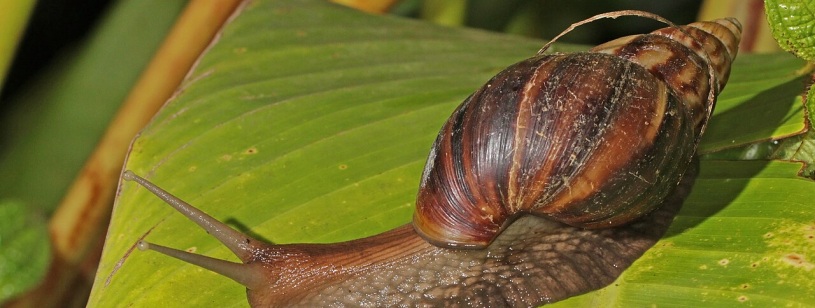
Giant African land snail (Lissachatina fulica) on a leaf. · Charles J. Sharp / CC BY-SA 4.0 (https://creativecommons.org/licenses/by-sa/4.0). Cropped and resized.
The giant African land snail is one of the largest land snails in the world, with a conical shell that can exceed 20 cm in length. Native to East Africa, it has been carried by people to many warm countries, where it has become invasive, and in Europe it is often kept as a pet.
Quick facts
| Common name | Giant African land snail |
| Scientific name | Lissachatina fulica (synonym: Achatina fulica) |
| Lifespan | About 3–5 years; sometimes up to 9–10 years |
| Length | Shell up to about 20 cm long and 7 cm wide |
| Diet | Herbivore: leaves, vegetables, fruit; sometimes animal remains |
| Predators | Birds, rats, frogs, predatory snails |
| Conservation status | Not evaluated; invasive in many countries |
| Distribution | Native to East Africa; introduced to Asia, the Americas, Oceania |
| Habitat | Forests, crops, gardens, urban areas in warm, humid regions |
| Family | Achatinidae |
| Reproduction | Hermaphrodite; lays hundreds of eggs |
- Primary category:Molluscs
- Explore this animal's categories:
Interesting facts
- It is considered the most widespread invasive snail in the world.
- Each snail is both male and female, but it needs a partner to produce eggs.
- A single snail can lay hundreds of eggs in a year.
- It can carry a parasite dangerous to people, so hands should always be washed after touching it.
Characteristics
The giant African land snail has an elongated conical shell, brown with darker and lighter stripes. Its soft body is brown or grey with two pairs of tentacles, the eyes at the tips of the longer pair.
Hatchlings have shells only a few millimetres long; adults can weigh several hundred grams.
Behaviour
It is active mainly at night and in damp weather, hiding by day under leaves, in soil or in shade.
In drought or cold, it withdraws into its shell, seals the opening with hardened mucus and rests, sometimes for months. It moves slowly, gliding on a layer of mucus.
Habitat and distribution
The species is native to East Africa, on the coasts of Kenya and Tanzania. People have carried it, as food or by accident, to Asia, Pacific and Indian Ocean islands, South America and the Caribbean.
It cannot survive Romanian winters outdoors and lives only in terrariums as a pet.
Diet and feeding
It eats leaves, vegetables, fruit, flowers and bark. Where it is invasive, it destroys whole crops of vegetables, bananas or cocoa.
It needs calcium for its shell, which it takes from limestone, empty shells or even building plaster. In terrariums it gets vegetables, fruit and extra calcium.
Reproduction and life cycle
Giant African land snails are hermaphrodites with both male and female organs. After mating, both partners can lay eggs.
Eggs about 5 mm long are buried in soil, a hundred or more at a time. Young hatch after a few weeks and mature within months, so populations grow very quickly.
Name and history
The scientific name has changed: the species was long called Achatina fulica and is now often placed in Lissachatina. “Achatina” comes from agate, the banded stone.
In some African and Asian countries, giant snails are eaten. Large and easy to keep, they have become popular pets.
Conservation and threats
The species is not threatened; on the contrary, it is one of the most harmful invasive species, destroying crops and competing with native snails.
It can carry the parasitic worm Angiostrongylus cantonensis, which can cause serious meningitis in people. Many countries, including the United States, ban keeping it. Owners should wash their hands after handling and never release it.
Frequently asked questions
How big does it grow?
The shell can reach about 20 cm long and 7 cm wide.
What does it eat?
Vegetables, fruit, leaves and a calcium source, such as cuttlebone, for its shell.
Is it dangerous?
It can carry a parasite dangerous to people, so wash your hands after touching it. Never eat it raw.
How long does it live?
Usually 3–5 years, and up to about 9–10 years in good conditions.