Corn snakePantherophis guttatus — habitat, diet and reproduction
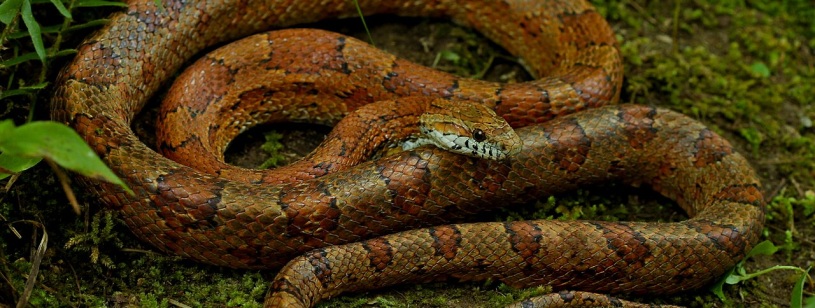
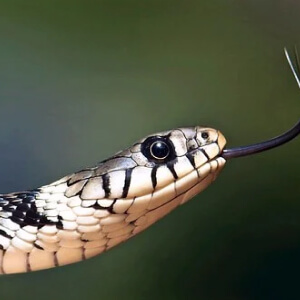
Corn snake (Pantherophis guttatus) with its natural pattern. · Peter Paplanus / CC BY 2.0 (https://creativecommons.org/licenses/by/2.0). Cropped and resized.
The corn snake is a non-venomous snake from the south-eastern United States, with red or orange blotches edged in black. It is calm, easy to care for and one of the world’s most popular pet snakes. In the wild it hunts rodents in fields, woods and around farms.
Quick facts
| Common name | Corn snake |
| Scientific name | Pantherophis guttatus |
| Lifespan | About 10–15 years in the wild; over 20 years in captivity |
| Length | Adults are usually 0.6–1.8 m |
| Diet | Carnivore: rodents, small birds, eggs, lizards |
| Predators | Birds of prey, larger snakes, foxes, raccoons |
| Conservation status | Least Concern (LC) |
| Distribution | South-eastern and central United States |
| Habitat | Pine woods, fields, woodland edges, farms |
| Family | Colubridae |
| Reproduction | Lays eggs |
- Primary category:Reptiles
- Explore this animal's categories:
Interesting facts
- Breeders have produced dozens of colour forms: white, pink, grey or patternless.
- The belly has a black-and-white checkerboard pattern, like kernels on a cob of multicoloured corn.
- When frightened, it vibrates its tail in dry leaves, like a rattlesnake.
- It can climb trees and squeeze through very narrow gaps.
Characteristics
The corn snake has a slim, long body, a head slightly wider than the neck and round pupils. The natural pattern has red or orange blotches edged in black on an orange or grey ground.
The head usually bears a spearpoint-shaped mark. Hatchlings are duller and brighten after a few sheds.
Behaviour
It is active mainly at dusk and night and hides by day under logs, stones or in rodent burrows. In the north of its range, it becomes dormant in winter.
It is a peaceful snake. If threatened, it hisses, vibrates its tail and may bite, but the bite is shallow and has no venom.
Habitat and distribution
The species lives in the south-eastern United States, from New Jersey to Florida and Louisiana. It has been accidentally introduced to some Caribbean islands and to Australia.
It favours pine woods, shrubby fields, woodland edges and farm buildings, where rodents are plentiful.
Diet and feeding
Its main prey is mice and rats. It also eats small birds, eggs, bats, lizards and frogs.
It seizes prey with its mouth and constricts it before swallowing it whole. Pet corn snakes are fed thawed frozen rodents rather than live ones, to avoid injuries.
Reproduction and life cycle
Mating takes place in spring. One to two months later, the female usually lays 10–30 elongated, soft-shelled eggs in rotting wood or leaf litter.
Eggs develop for about 60–65 days without parental care. Hatchlings, 20–30 cm long, are independent and shed for the first time after about a week.
Name and history
The scientific name Pantherophis guttatus means “spotted panther-snake”, after its blotches.
There are two explanations for the name “corn snake”. One says it entered corn stores to hunt mice. The other says its belly pattern resembles the kernels of multicoloured “Indian corn”.
Conservation and threats
The species is assessed as Least Concern and is still widespread in the wild, though some local populations decline because of habitat loss and road traffic.
As a pet it needs a secure terrarium with hiding places, a heat source and clean water. It lives over 20 years, so adopting one is a long-term decision. It must never be released into the wild.
Frequently asked questions
Is the corn snake venomous?
No. It has no venom and is considered one of the gentlest pet snakes.
How big does a corn snake get?
Adults are usually 0.6–1.8 m long.
What does a corn snake eat?
In the wild, rodents, small birds and eggs. Pets are fed thawed frozen mice.
How long does a corn snake live?
In captivity it often lives over 20 years.