Kit foxInteresting facts and information
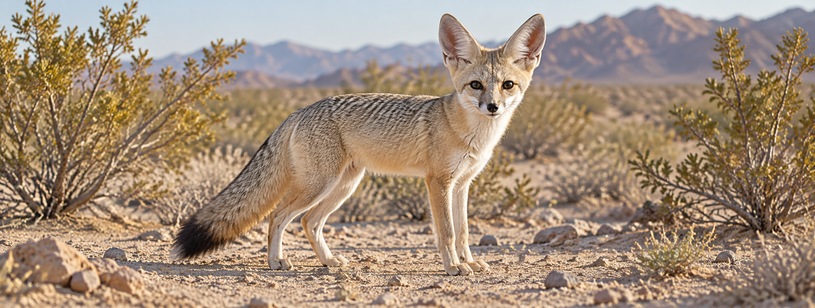
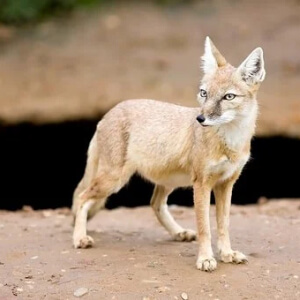
AI illustration of kit fox.
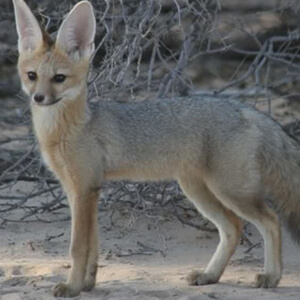
The kit fox is a small fox of arid North America, with very large ears, greyish-sandy fur and a black-tipped tail. It lives in the south-western United States and Mexico, searching mainly for small animals after dusk.
Its scientific name is Vulpes macrotis. It resembles the swift fox but is a distinct species. One subspecies, the San Joaquin kit fox, faces a much more difficult conservation situation than the species’ global status suggests.
Quick facts
| Species | Vulpes macrotis |
| Class / order / family | Mammalia / Carnivora / Canidae |
| Distribution | Western and south-western United States and northern Mexico |
| Habitat | Desert, semi-desert, scrub and dry grasslands |
| Size | Often approximately 1.5–3 kg; small body and very large ears |
| Diet | Omnivorous; small mammals such as kangaroo rats are important |
| Reproduction | Gestation approximately 49–55 days; usually about 4 pups |
| Young | Born alive and raised in a den |
| Conservation | Least Concern (LC) globally; San Joaquin subspecies Endangered in the US |
Interesting facts
- Large ears serve several roles. They help detect sounds and exchange heat with the surroundings.
- Much of its water comes from food. Desert life does not remove its body’s need for water.
- Dens provide refuge from extreme temperatures. They are used outside pup rearing too.
- “Kit fox” is a species name. Adults retain the name; it does not indicate a juvenile in this context.
- Global and subspecies statuses can differ. The San Joaquin kit fox is protected as an endangered subspecies in the United States.
Records and remarkable features
It is one of North America’s smallest Vulpes foxes. Only the island fox of California's Channel Islands is a smaller North American canid.
Adults often weigh around 1.5–3 kg, varying between sexes and regions.
Ear size relative to the head is particularly striking. Behaviour, particularly den use and nocturnal activity, remains essential.
Characteristics
The coat varies between grey, yellowish and sandy shades, with a paler underside. It has a fine muzzle, large ears and a well-furred, black-tipped tail.
| Feature | Importance |
| Large ears | Hearing and heat exchange |
| Pale coat | Camouflage on arid ground |
| Light body | Moving among shrubs and over exposed soil |
| Black-tipped tail | One clue to the species’ appearance |
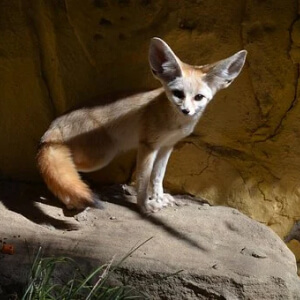
It is distinct from the fennec. Fennecs live in North Africa, whereas kit foxes are North American. Similar ears reflect some comparable environmental conditions, rather than identity of species.
Compared with swift foxes, kit foxes tend to have larger ears and differ in proportions and distribution. Reliable identification combines several features.
Habits and behaviour
It is mainly nocturnal. It retreats to shelter during difficult daytime conditions and searches for food at more favourable temperatures. Exact timing depends on season, weather and dangers.
It can use several dens within its range. These refuges matter for rest, pup rearing and avoiding predators.
Adults can form pairs, and group organisation varies. Pairs often stay together for several years.
Coyotes pose an important threat. Great Basin studies have examined links between habitat use and predation risk. A food-rich place may be less suitable if it lacks safety.
Habitat and geographic distribution
The range includes arid and semi-arid regions of the western and south-western United States and Mexico. Habitats include desert, open scrub, dry grassland and other landscapes with relatively low vegetation.
It does not live only on dunes. Stony areas, compacted or sandy soils and desert vegetation can form a habitat mosaic. Shelter and prey availability influence its use.
- Sparse vegetation allows foraging and a view of the surroundings.
- Suitable denning soils provide refuge.
- Small mammals and insects support the food base.
- Connected areas allow travel between places used.
The San Joaquin subspecies is associated with California. Some San Joaquin kit foxes even live in the city of Bakersfield, using parks, school grounds and golf courses.
Diet and feeding
Small mammals are very important foods, including rodents and lagomorphs, depending on region. Insects, birds, reptiles, carrion and some plant resources can also occur.
Prey is located by hearing, smell and searching close to the ground. Large ears help detect faint sounds, but success also depends on attack timing and access to hidden animals.
Food also supplies water. This is important where free-standing water is scarce.
Dietary proportions vary. Local prey availability explains many dietary differences.
Reproduction and life cycle
Pups are raised in dens. Zoological sources and wildlife agencies describe gestation of approximately 49–55 days, and litters usually have about 4 pups (1–7).
Newborns depend on adult care. They initially remain hidden, later emerging near the entrance to explore. Families need enough food and a shelter that is not repeatedly disturbed.
| Stage | What changes |
| Birth | Dependence on milk and protection |
| Early growth | Developing senses and mobility |
| First outings | Play and exploration near the den |
| Moving towards independence | Using wider areas and resources |
Young kit foxes usually leave their parents in late summer or autumn, at about 5–6 months old.
Name and history
The scientific name Vulpes macrotis refers to the large ears, a highly visible feature. The English common name kit fox identifies the species, rather than a juvenile stage.
Historically, similarities prompted discussion of its relationship with the swift fox. Current Canid Specialist Group treatments present Vulpes macrotis and Vulpes velox as distinct species.
San Joaquin kit fox identifies the subspecies Vulpes macrotis mutica, important in California conservation programmes. It is not an alternative name for every kit fox.
Conservation status and threats
Vulpes macrotis has a global status of Least Concern (LC), according to the Canid Specialist Group. The same source reports a declining global trend.
The San Joaquin subspecies has been listed as Endangered in the United States since 1967.
Habitat conversion and fragmentation, road accidents, poisons and disease can affect populations. Conservation requires suitable, connected land and mortality monitoring, alongside protection of individual dens.
Discover other foxes
Read about Red fox or explore: Culpeo · Pale fox · Blanford's fox · Cape fox · Corsac fox · Tibetan sand fox · Swift fox · Bengal fox · Fennec fox · Arctic fox.
Frequently asked questions
- Where does the kit fox live? In the western and south-western United States and parts of Mexico. It uses deserts, semi-deserts and other dry landscapes with suitable food and refuges.
- Why are its ears so large? They contribute to hearing and heat exchange. Avoiding heat through nocturnal activity and den use remains very important.
- Is it the same species as the fennec? No. The kit fox is the North American Vulpes macrotis. The fennec is Vulpes zerda, associated with North African deserts. Similar ears do not make them the same species.
- What does it eat? Mainly small mammals, supplemented with insects, other animals, carrion and some plant resources. Availability changes between habitats and seasons, so the menu varies.
- Can it live without water? Like every mammal, it needs water, but much can come from food.
- How long is gestation? Approximately 49–55 days, according to zoological sources and wildlife agencies. Pups grow in a den and initially depend on adult care.
- Is the San Joaquin kit fox a separate species? It is the Californian subspecies Vulpes macrotis mutica.
- Is it endangered? The species is globally Least Concern. However, the San Joaquin subspecies is listed as Endangered in the United States.