Galápagos tortoiseChelonoidis niger — habitat, diet and reproduction
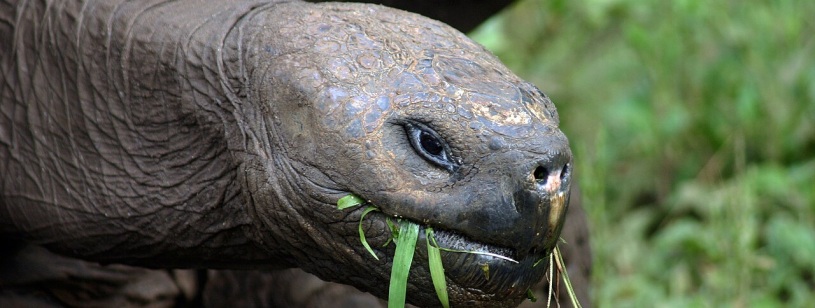
Galápagos tortoise (Chelonoidis) eating plants. · Charles J. Sharp / CC BY-SA 3.0 (https://creativecommons.org/licenses/by-sa/3.0). Cropped and resized.
The Galápagos tortoise is the largest land tortoise in the world. Big males can weigh over 400 kilograms, and some individuals have lived more than a hundred years. It lives only on the Galápagos Islands in the Pacific Ocean, where it inspired Charles Darwin’s observations.
Quick facts
| Common name | Galápagos tortoise, giant tortoise |
| Scientific name | Chelonoidis niger (species complex) |
| Lifespan | Over 100 years |
| Length | Shells of large males reach about 1.5 m |
| Weight | Large males can exceed 400 kg |
| Diet | Herbivore: grasses, leaves, cacti, fruit |
| Predators | Adults have no natural predators; introduced animals eat eggs and young |
| Conservation status | Species assessed from Vulnerable (VU) to Critically Endangered (CR) |
| Distribution | Only the Galápagos Islands (Ecuador) |
| Habitat | Dry cactus lowlands and moist, grassy highlands |
| Family | Testudinidae |
| Reproduction | Lays eggs in nests dug in soil |
- Primary category:Reptiles
- Explore this animal's categories:
Interesting facts
- Several species of giant tortoise live on the islands, each on its own island or volcano.
- Some have domed shells; others have a raised “saddle” at the front that lets them stretch up to cacti.
- They can survive months without food or water, so sailors kept them alive on ships.
- Lonesome George, the last tortoise from Pinta Island, died in 2012.
Characteristics
Giant tortoises have a large, heavy shell, thick elephant-like legs and a long neck. The skin is grey and scaly.
Shell shape varies by island. On large, wet islands with low grass, shells are domed. On dry islands where food grows higher, the front of the shell rises like a saddle. Males are much larger than females.
Behaviour
Tortoises are slow and rest for many hours, especially early in the morning and in the heat. They wallow in pools and mud, which cool them and protect them from mosquitoes.
Some populations migrate seasonally, climbing to moist highlands in the dry season and returning to lowlands in the rainy season, along paths used for generations.
Habitat and distribution
Giant tortoises live only on some of the Galápagos Islands, about 1,000 km off the coast of Ecuador.
Some species live in arid cactus lowlands, others in moist forests and grasslands on volcanoes. Each species developed in isolation on its island.
Diet and feeding
They are herbivores, eating grasses, leaves, flowers, fruit and fungi. Prickly pear cacti are important because they also provide water.
They can store water and survive long periods without drinking. By feeding and moving, tortoises spread seeds and shape island vegetation.
Reproduction and life cycle
Mating takes place mainly in the hot, wet season. Females travel to lowlands, dig a hole with their hind legs and usually lay 2–16 round eggs the size of tennis balls.
Eggs develop for months in the warm soil, and temperature determines the sex of the young. Hatchlings dig out alone and grow very slowly, maturing at 20–25 years.
Name and history
The islands’ name comes from an old Spanish word, “galápago”, used for a tortoise or a kind of saddle, so the islands were essentially named after these tortoises.
In 1835, Charles Darwin visited and learned that locals could tell which island a tortoise came from by its shell. Such observations helped him develop his theory of evolution.
Conservation and threats
Between the seventeenth and nineteenth centuries, whalers and pirates removed tens or even hundreds of thousands of tortoises for meat. Goats, pigs and rats brought by people destroyed vegetation, eggs and young, and some species vanished completely.
Today, Galápagos National Park and conservation groups breed young tortoises and remove invasive animals. On Española Island, the population grew from 14 adults to more than a thousand tortoises.
Frequently asked questions
How long do Galápagos tortoises live?
Over 100 years. Some zoo individuals have lived around 170 years.
How much does a giant tortoise weigh?
Large males can exceed 400 kg; females are much smaller.
What do Galápagos tortoises eat?
Grasses, leaves, fruit and cacti, which also supply water.
Why do some have saddle-shaped shells?
The saddle lets them lift their necks high towards cacti and shrubs on dry islands.