GouramiTrichopodus — habitat, diet and reproduction
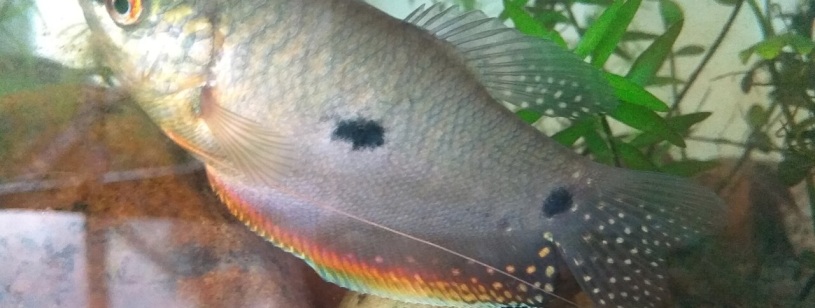
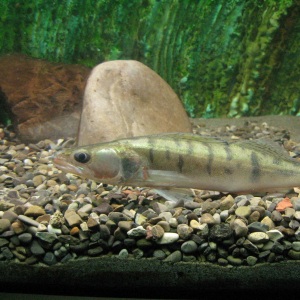
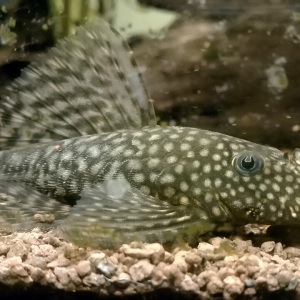
Three-spot gourami (Trichopodus trichopterus) in an aquarium. · Christopher / CC BY 4.0 (https://creativecommons.org/licenses/by/4.0). Cropped and resized.
Gouramis are freshwater fish from South-East Asia, loved in aquariums for their colours and calm behaviour. A special organ called the labyrinth lets them breathe air taken from the surface. Males build floating nests of air bubbles where they guard the eggs.
Quick facts
| Common name | Gourami, three-spot gourami, blue gourami |
| Scientific name | Trichopodus (genus; common species T. trichopterus) |
| Lifespan | About 4–6 years in aquariums |
| Length | Up to about 10–15 cm, by species |
| Diet | Omnivore: insects, larvae, zooplankton, algae |
| Predators | Larger fish, waterbirds, water snakes |
| Conservation status | Least Concern (LC) for common species |
| Distribution | South-East Asia: Mekong basin, Thailand, Malaysia, Indonesia |
| Habitat | Slow or still waters, swamps, rice paddies, channels |
| Family | Osphronemidae |
| Breathing | Gills plus a labyrinth organ for air |
- Primary category:Fish
- Explore this animal's categories:
Interesting facts
- The gourami can live in oxygen-poor water because it also breathes air at the surface.
- Its pelvic fins are long, thread-like feelers used for touch.
- The male builds a nest of saliva-coated bubbles floating among plants.
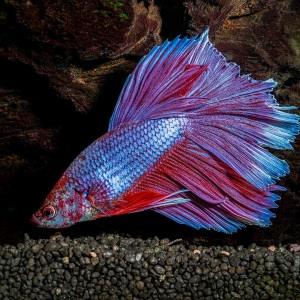
- The betta, known as the “fighting fish”, belongs to the same family.
Characteristics
The three-spot gourami has an oval, laterally flattened body with a dark spot mid-flank and another at the tail base; the eye counts as the third “spot”. Aquarium forms may be blue, golden, silver or marbled.
The pelvic fins have become long, mobile threads used to touch objects and other fish. Males have a longer, more pointed dorsal fin.
Behaviour
Gouramis are calm fish that swim slowly among plants and often rise to take a breath of air.
Males may become territorial while breeding and chase other males, so a densely planted aquarium with hiding places helps them live peacefully.
Habitat and distribution
The three-spot gourami lives naturally in South-East Asia: the Mekong basin, Thailand, Malaysia and Indonesia. Other gourami species range from India to Borneo.
They prefer warm, slow, plant-rich waters: swamps, channels, rice paddies and ponds. The labyrinth organ lets them survive in low-oxygen water where other fish would suffocate.
Diet and feeding
Gouramis eat small insects, mosquito larvae, zooplankton and algae. Some species can spit jets of water at insects above the surface.
In aquariums they get tropical flakes plus live or frozen food. By eating mosquito larvae, they help control these insects in the wild.
Reproduction and life cycle
The male builds a surface nest of saliva-coated air bubbles, then courts the female and wraps his body around her, and the fertilised eggs rise into the nest.
The male guards the nest and returns fallen eggs. After a few days the young start swimming on their own.
Name and history
The name “gourami” comes from Malay. The genus name Trichopodus means “hair-footed”, after the thin pelvic fins.
The same family includes the dwarf gourami (Trichogaster lalius), the pearl gourami (Trichopodus leerii) and the giant gourami, farmed in Asia for food.
Conservation and threats
Common gourami species are assessed as Least Concern and are bred in large numbers for aquariums. Some wild species with small ranges suffer from drained swamps and oil-palm plantations.
Almost all traded gouramis come from fish farms and suit planted aquariums.
Frequently asked questions
How does the gourami breathe air?
It has a special labyrinth organ that absorbs oxygen from air taken at the surface.
What does the gourami eat?
Tropical flakes, live or frozen food and algae.
Is the gourami aggressive?
It is usually calm, but males can be territorial while breeding.
What is a bubble nest?
A layer of saliva-coated bubbles built by the male at the surface, where he guards the eggs.