Prussian carpCarassius gibelio — habitat, diet and reproduction
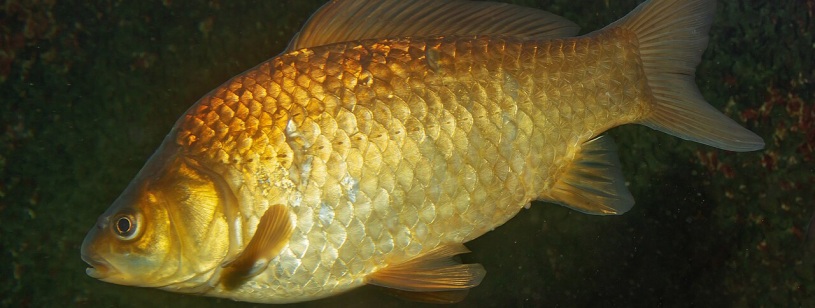
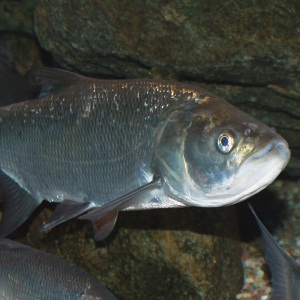
Prussian carp seen from the side underwater. · H. Zell / CC BY-SA 3.0 (https://creativecommons.org/licenses/by-sa/3.0). Cropped and resized. Source: https://commons.wikimedia.org/wiki/File:Carassius_gibelio_-_Wilhelma_01.jpg
Prussian carp (Carassius gibelio) are freshwater fish with large scales and a laterally compressed body. They eat both animal and plant material. Some populations reproduce through gynogenesis, in which sperm from another fish activates egg development.
Quick facts
| Common name | Prussian carp, gibel carp |
| Scientific name | Carassius gibelio |
| Lifespan | Up to about 10 years in FishBase |
| Length | Commonly around 20 cm; large specimens can exceed 40 cm |
| Diet | Omnivorous |
| Predators | Predatory fish and fish-eating birds, especially for small individuals |
| Conservation status | Not Evaluated in the consulted FishBase IUCN field |
| Distribution | Europe and Asia; introduced elsewhere, including Canada |
| Habitat | Vegetated ponds, lakes, canals and lowland rivers |
| Family | Cyprinidae |
| Reproduction | Sexual reproduction or gynogenesis, depending on population |
| Eggs | Adhesive, attached to submerged plants and other supports |
Interesting facts
- Some populations contain a very high proportion of females.
- Males also occur, with proportions varying between populations.
- Tolerance of low oxygen helps the species occupy changing pond habitats.
- Prussian carp and crucian carp, Carassius carassius, are distinct species.
Records and extremes
FishBase gives a common length of about 20 cm and a maximum reported total length of 46.6 cm. These describe different parts of the species’ size range.
Reported longevity reaches around 10 years. Food, temperature and crowding affect growth.
Characteristics
The deep body has large scales and silvery to brown-grey colouring. The long dorsal fin has a straight or slightly concave edge.
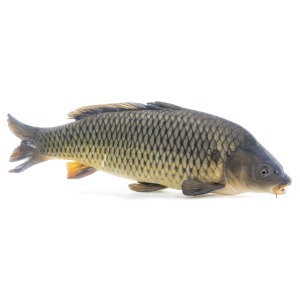
The mouth lacks the barbels found on common carp. Some stiff fin rays have serrated edges. Similarity among Carassius species can make identification difficult.
Behaviour
Prussian carp feed near the bottom and among aquatic plants. Young fish use complex habitats such as reed margins.
The species tolerates low oxygen. In some lakes, fish move towards river mouths in winter to find better-oxygenated water.
Habitat and distribution
Prussian carp are widespread across Europe and Asia, with introductions including Canada. Their original European range remains debated because of old transfers and confusion with related species.
Romanian habitats include ponds, lakes and the Danube Delta. Slow water, aquatic plants and seasonally flooded areas provide suitable conditions.
Diet and feeding
The diet includes plankton, bottom-dwelling invertebrates, algae, plant fragments and detritus, meaning decomposing organic remains.
This varied diet allows fish to use different food resources. Small Prussian carp can themselves be eaten by predatory fish and birds.
Reproduction and life cycle
Spawning takes place during the warmer season in shallow, vegetated areas. Timing varies regionally, and repeated seasonal spawning has been described in Turkey’s Topçam Lake.
In gynogenesis, sperm activates an egg, usually without contributing genetic material. Offspring then inherit maternal genetic material. Related fish species can provide the sperm.
Sexual reproduction also occurs. Studies reveal several genetic forms and reproductive strategies, so populations cannot all be described as female-only.
Name and history
Bloch described the species in 1782. The older name Carassius auratus gibelio still appears in some sources. European commercial-name records connect it with the Romanian name caras.
Ornamental goldfish belong to Carassius auratus. Genetic studies help clarify the relationships and reproductive biology of these similar fishes.
Conservation and threats
The consulted FishBase account lists Not Evaluated in its IUCN field. This indicates assessment status rather than abundance in a particular waterbody.
In introduced ranges, Prussian carp can compete with native fishes. The 2025 USFWS assessment documents native population declines following establishment.
Accurate identification and preventing uncontrolled transfers between waters support freshwater conservation.
Frequently asked questions
Are Prussian and crucian carp the same fish?
They are different species: Carassius gibelio and Carassius carassius.
Do Prussian carp have barbels?
They lack the mouth barbels present in common carp.
Are all Prussian carp female?
Males occur too; sex ratios and reproductive modes vary between populations.
What is gynogenesis?
Sperm triggers egg development, usually without adding paternal genetic material.
Do they eat only plants?
They also consume small aquatic animals and organic remains.
Can they tolerate poorly oxygenated water?
They have substantial low-oxygen tolerance, although water conditions still influence their survival and movements.