European mantisMantis religiosa — habitat, diet and reproduction
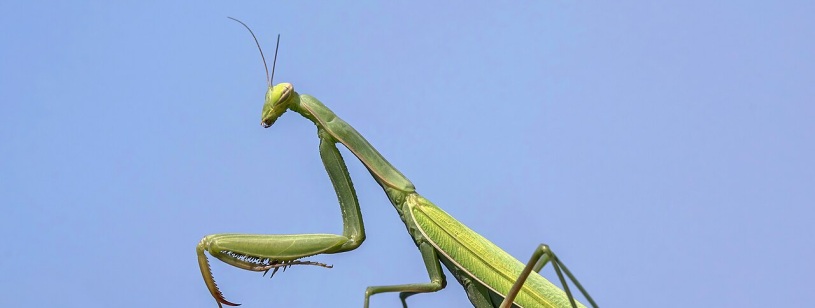
Green European mantis with a triangular head and folded forelegs. · Charles J. Sharp / Wikimedia Commons / CC BY-SA 4.0 (https://creativecommons.org/licenses/by-sa/4.0/). Cropped and resized. Source: https://commons.wikimedia.org/wiki/File:European_praying_mantis_(Mantis_religiosa)_green_female_Dobruja.jpg
The European mantis (Mantis religiosa) is a predatory insect that waits among grasses and shrubs. Folded front legs seize nearby prey. Green or brown colouring blends with vegetation. This species also occurs in Romania, especially in warm, sunny habitats.
Quick facts
| Common name | European mantis |
| Scientific name | Mantis religiosa |
| Lifespan | Annual cycle in temperate climates; adults live a few months |
| Length | Approximately 4–8 cm; females are larger |
| Colour | Green or brown |
| Diet | Carnivorous, mainly other insects |
| Predators | Birds, lizards and other insect predators |
| Conservation status | Least Concern globally |
| Distribution | Europe, Africa and Asia; introduced to North America |
| Habitat | Warm grassland, shrubs and woodland edges |
| Family | Mantidae |
| Reproduction | Eggs enclosed in a protective case called an ootheca |
- Primary category:Insects
- Explore this animal's categories:
Interesting facts
- Spines on the forelegs hold captured prey.
- Young resemble small adults but lack developed wings.
- Egg cases survive winter and hatch in spring in temperate regions.
- Females sometimes eat males, but many matings occur without cannibalism.
Records and extremes
Long periods of stillness are followed by a rapid close-range strike. This combination suits hunting among stems and leaves.
Females can reach around 8 cm; males are generally smaller and slimmer. Camouflage helps both hunting and predator avoidance.
Colour can vary during moults, when the insect replaces its outer covering.
Characteristics
The mobile triangular head carries two large compound eyes, each made of many visual units. Three small simple eyes, called ocelli, lie between them.
Three pairs of legs attach to the thorax. Spiny forelegs seize food and carry a dark inner spot, often with a pale centre.
Adults have wings. Females have a broader abdomen, while green and brown forms blend with different vegetation.
Behaviour
Usually solitary, mantises hunt from stems or branches. Their eyes and mobile head track movement until prey comes within reach.
When threatened, they may raise the forelegs and spread the wings. The larger silhouette and exposed markings can discourage an attacker.
Habitat and distribution
The species occurs across Europe and parts of Africa and Asia, with introduced populations in North America. European observations have expanded northwards.
Dry grassland, shrubs and sunny woodland edges provide cover and prey. Suitable Romanian habitats include parts of Dobruja.
Diet and feeding
Flies, grasshoppers and other suitably sized insects provide food. Both immature nymphs and adults are predators.
Forelegs close around prey and spines hold it near the mouth. Chewing mouthparts break it down.
Pollinators and other predators may also be eaten. A mantis in a garden therefore does not guarantee selective control of pests.
Reproduction and life cycle
Females surround eggs with foam that hardens into an ootheca. Attached to vegetation or another support, the case may contain dozens or hundreds of eggs.
In temperate regions, eggs overwinter and nymphs emerge in spring. Successive moults lead to adulthood without a pupal stage.
Adults reproduce in summer and autumn, then die before winter. Sexual cannibalism can occur before, during or after mating, but field studies show it is variable.
Name and history
Linnaeus described the species in 1758. Its accepted name is Mantis religiosa, in the family Mantidae.
The common name refers to folded forelegs resembling hands held in prayer. The position prepares the insect to seize prey.
Conservation and threats
The global category is Least Concern, though local populations can face different conditions. Loss of suitable vegetation reduces hunting and egg-laying sites.
Leaving some stems through winter can protect egg cases. Avoiding unnecessary insecticide use also preserves prey. Observation without capture allows natural behaviour to continue.
Frequently asked questions
Is it venomous?
It catches food with its legs and jaws and has no venom-injecting apparatus.
Does the female always eat the male?
No. Cannibalism occurs sometimes, while many matings end without it.
What is the foam-like case on a stem?
It may be an ootheca, the hardened protective covering around eggs.
Is there a pupal stage?
No. Nymphs develop through moults into adults.
Does it live in Romania?
Yes, in suitable warm habitats, including Dobruja.
Can it instantly change colour?
Colour changes accompany development and moulting rather than happening instantly.