House martinDelichon urbicum — habitat, diet and reproduction
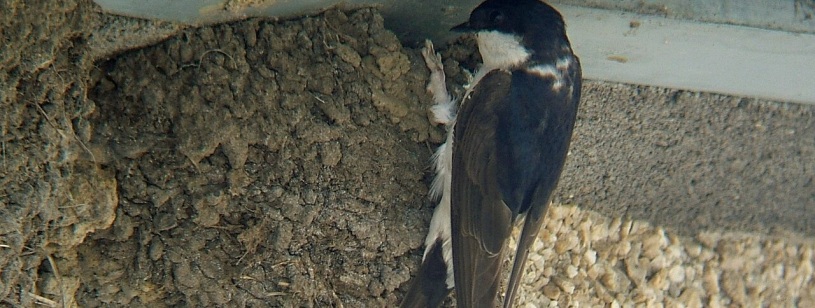
House martin (Delichon urbicum) at its mud nest. · MPF / CC BY 2.5 (https://creativecommons.org/licenses/by/2.5). Cropped and resized.
The house martin is a small bird, glossy blue-black above and white below, with a white rump that shows well in flight. It builds its nest from mud pellets stuck under the eaves of houses and apartment blocks. It hunts insects flying over villages and towns.
Quick facts
| Common name | House martin |
| Scientific name | Delichon urbicum |
| Lifespan | Usually 2–3 years in the wild |
| Length | About 13 cm |
| Weight | About 15–23 g |
| Diet | Insectivore: small insects caught in flight |
| Predators | Hobbies and sparrowhawks |
| Conservation status | Least Concern (LC), globally |
| Distribution | Breeds in Europe, North Africa and Asia; winters in Africa |
| Habitat | Villages, towns, cliffs, near water and grassland |
| Family | Hirundinidae |
| Nest | Closed mud cup under eaves |
- Primary category:Birds
- Explore this animal's categories:Animals of AfricaAnimals of AsiaAnimals of EuropeAnimals of RomaniaAnimals of Romania’s gardens and parksAnimals that live in groupsBirdsBirds of RomaniaBlack-and-white animalsEgg-laying animalsFeathered animalsFlying animalsHInsect-eating animalsMigratory animalsMigratory birdsVertebratesWild animals
Interesting facts
- A house martin nest can contain around a thousand mud pellets.
- Its legs and toes are covered with white feathers.
- House martins often nest in colonies, with dozens of nests side by side.
- House sparrows sometimes take over martin nests before the martins return from Africa.
Characteristics
The house martin is smaller and stockier than the barn swallow. Its head and back are glossy blue-black, while the throat, underparts and rump are white.
The tail is short and forked, without long streamers. White feathers cover the legs like socks. Males and females look alike.
Behaviour
It is a social bird that lives and feeds in groups. It flies higher than the swallow and glides more.
Martins land on the ground only to collect mud at puddle edges. Before migrating in autumn, they gather in large flocks on wires and roofs alongside swallows.
Habitat and distribution
The species breeds across almost all of Europe, North Africa and temperate Asia and winters in Africa south of the Sahara.
In Romania it arrives in April and leaves in September. It nests in villages and towns on houses, blocks, bridges and stables, and on cliffs, its original habitat.
Diet and feeding
Its food is small insects caught in flight: flies, midges, aphids and flying ants.
In fine weather it hunts high up; in cold weather it drops over water and grassland, where insects fly lower. Long rainy spells can cause chicks to starve.
Reproduction and life cycle
The pair builds the nest from mud pellets mixed with saliva, carried one at a time. It is a closed cup with a small entrance at the top and can take one to two weeks to build.
The female usually lays 4–5 white eggs, incubated by both parents for about two weeks. Chicks stay in the nest for about a month, and pairs usually raise two broods per summer.
Name and history
The scientific name Delichon urbicum roughly means “town swallow”. “Delichon” is an anagram of the Greek “chelidon”, swallow.
In many Romanian villages, a martin or swallow nest under the eaves was seen as a sign of good luck for the house.
Conservation and threats
The species is assessed globally as Least Concern, but numbers have declined in Europe.
Main causes include nest destruction during facade renovation, lack of mud in paved settlements and fewer insects. Artificial nests and a small muddy puddle in spring help. Destroying occupied nests is illegal.
Frequently asked questions
How do you tell a house martin from a swallow?
The martin has a pure white rump and underparts and a short tail. The swallow has a red throat and long tail streamers.
What is a house martin nest made of?
Small mud pellets mixed with saliva, stuck under eaves or on walls.
Can house martin nests be removed?
No. The birds and their occupied nests are protected by law.
Where do house martins winter?
In Africa, south of the Sahara.